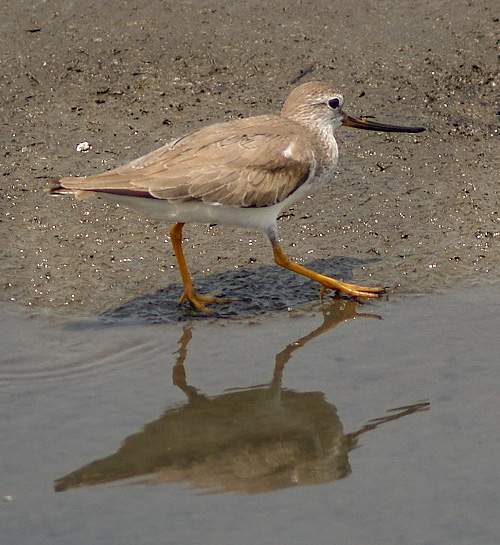
The Terek sandpiper (Xenus cinereus) belongs to the family Scolopacidae under the order Charadriiformes.
Terek sandpiper taxonomy
The Scolopacidae is the family of sandpipers, curlews and snipes. The family Scolopacidae was first described by Constantine Samuel Rafinesque-Schmaltz (22 October 1783 – 18 September 1840), a zoologist, botanist, writer and polyglot, in the year 1815.
The family Scolopacidae comprise fifteen genera, including genus Xenus. The genus Xenus is monotypic containing one species, Xenus cinereus.
The genus Xenus was first introduced by Johann Jakob von Kaup[1] (10 April 1803 – 4 July 1873), a German naturalist, in the year 1829.
The species Xenus cinereus was first described (as Scolopax cinerea) by Johann Anton Güldenstädt (26 April 1745 in Riga, Latvia – 23 March 1781 in St. Petersburg, Russia), a German naturalist, in the year 1775. It is also known by Synonym Tringa cinerea.
Taxonomic classification
Binomial name:
Xenus cinereus
Species:
X. cinereus
Genus:
Xenus
Subfamily:
-
Family:
Scolopacidae
Order:
Charadriiformes
Class:
Aves
Phylum:
Chordata
Kingdom:
Animalia
1.Terek sandpiper - Xenus cinereus Image by Koskikara at Finnish Wikipedia
2.Terek sandpiper - Xenus cinereus Image by Alpsdake
3.Terek sandpiper - Xenus cinereus Image by Alpsdake
4.Terek sandpiper - Xenus cinereus Image by Alpsdake
5.Terek sandpiper - Xenus cinereus Image by Alnus
6.Terek sandpiper - Xenus cinereus Image by Ekaterina Chernetsova (Papchinskaya)
7.Xenus cinereus by Ekaterina Chernetsova (Papchinskaya)
1.Terek sandpiper image source: https://en.wikipedia.org/wiki/File:Xenus_cinereus_Lapland.JPG (cropped)
Author: Koskikara at Finnish Wikipedia | License: CC BY-SA 3.0 as on 10/11/18
2.Image source: https://en.wikipedia.org/wiki/File:Xenus_cinereus_eating_ragworm.JPG (cropped)
Author: Alpsdake | License: CC BY-SA 3.0 as on 10/11/18
3.Source: https://commons.wikimedia.org/wiki/File:Xenus_cinereus_in_Sh%C5%8Dnai_River.JPG (cropped)
Author: Alpsdake | License: CC BY-SA 3.0 as on 10/11/18
4.Image source: https://commons.wikimedia.org/wiki/File:Xenus_cinereus_(restig).jpg (cropped)
Author: Alpsdake | License: CC BY-SA 3.0 as on 10/11/18
5.Source: https://en.wikipedia.org/wiki/File:Xenus_cinereus_(Alnus).jpg (cropped)
Author: Alnus | License: CC BY-SA 3.0 as on 10/11/18
6.Image source: https://www.flickr.com/photos/katechka/34172082804/ (cropped)
Author: Ekaterina Chernetsova (Papchinskaya) | License: CC BY 2.0 as on 10/11/18
7.Source: https://www.flickr.com/photos/katechka/34172096534/ (cropped)
Author: Ekaterina Chernetsova (Papchinskaya) | License: CC BY 2.0 as on 10/11/18
8.Image source: https://www.flickr.com/photos/sussexbirder/14180524430/in/photostream/ (cropped)
Author: Ron Knight | License: CC BY 2.0 as on 10/11/18
9.Source: https://www.flickr.com/photos/sussexbirder/14366192444/in/photostream/ (cropped)
Author: Ron Knight | License: CC BY 2.0 as on 10/11/18
Detailed description and information on distribution, habitat, behavior, feeding and breeding habits, migration and conservation status of beautiful birds with their images.
Recently updated and current topic in Bird World: Terek sandpiper - Xenus cinereus images.
Contact State Tourism or travel agents for bird watching and wildlife tours.
The Terek sandpiper (Xenus cinereus) belongs to the family of curlews and sandpipers, the Charadriidae.
The Terek sandpiper is distributed in Europe, Asia, Africa, Indian subcontinent, southeast Asia and Australia. These sandpiper species are fully migratory. These sandpipers are monotypic species.
Appearance, physical description and identification
The Terek sandpiper (Xenus cinereus) is a small-sized sandpiper, measuring 20 to 25 cm in length and weighing 50 to 120 grams. The wingspan 55 to 60 cm.
The Terek sandpiper has pale grayish brown upperparts, head and breast. There is fine dark streaking on the head, neck, throat and breast. The underparts are white.
The long, upcurved, dark bill is dirty orange at the base. The irises are brownish black. There is a white eye-ring. The legs and feet are orange or greenish yellow. Their call is a sharp twittering sound.
1.Bird World - Image of Terek sandpiper - Xenus cinereus by Alpsdake
2.Bird World - Image of Terek sandpiper - Xenus cinereus by Koskikara at Finnish Wikipedia
3.Bird World - Image of Terek sandpiper - Xenus cinereus by Alpsdake
Origin, geographical range and distribution
The Terek sandpiper species is distributed in Finland, Belarus, Ukraine, Kazakhstan and in the coastal regions of southeast Africa, Madagascar, Arabian peninsula, Indian subcontinent, southeast Asia and Australia.
Vagrant populations of these species occur in Canada, Argentina, Denmark, France, Germany, Belgium, Bulgaria, Spain, United Kingdom, Libya, Morocco, Botswana, Gambia, Maldives, Mauritius, Nepal and USA.
The Important Bird and Biodiversity Areas (IBA) of these sandpiper species in Australia is Eighty Mile Beach. The IBA in Russia are Lower Ob', Dvuob'ye and Basins of the Schuchya and Khadytayakha rivers.
The IBA of these sandpiper species in Tanzania are Mafia Island, Zanzibar Island-South Coast and Rufiji Delta. The IBA in Japan are Shirakawa estuary, Kumakawa estuary, Hakata bay and Fujimae tidal flat.
Ecosystem and habitat
The Terek sandpiper species have low forest dependence. They normally occur in altitudes between 0 to 100 meters. The artificial ecosystems and habitats of these species include salt production ponds.
The natural ecosystems and habitats of these species include boreal forests, subarctic shrublands, tundra wetlands, mangrove forests, freshwater lakes, marine lakes, estuaries, marshes and intertidal mudflats.
Diet and feeding behavior
The diet of these Terek sandpiper species consists mainly of invertebrates. Insects, larval insects, beetles, flies, crustaceans, molluscs, arachnids and seeds are their primary food.
These sandpiper species forage solitarily at high and low tide. They catch the crabs on the ground by running after them. They also peck and poke deeply into the ground for worms.
Reproduction and breeding habits
The breeding season of these Terek sandpiper species is from May to August in most of their breeding range. They are monogamous and breed in small colonies.
The breeding habitats include extensive open flat grounds near water with sparse vegetation. The nest is a shallow depression on the ground. It is lined with grass and plant matter.
The clutch contains two to five eggs. The female sandpipers incubate the eggs. The chicks hatch out after 24 days of incubation and fledge after 15 days. Both the parents take care of the young.
Migration and movement patterns
These Terek sandpiper species are fully migratory birds (del Hoyo et al. 1996). The breeding populations occur in Arctic tundra and subArctic northern Russia, Finland, Kazakhstan and Ukraine.
These sandpipers leave the breeding grounds by the end of July and migrate to coastal regions of Africa, Indian subcontinent, Arabian peninsula, southeast Asia and Australia for wintering.
The return migration to the breeding grounds takes place during March and April. Non-breeders and several one-year old sub-adults remain back in the wintering grounds.
Diet and feeding habits: invertebrates, small molluscs, larval insects, seeds
IUCN status listing: Least Concern (LC)
Conservation and survival
The global population size of the Terek sandpiper (Xenus cinereus) is estimated to be about 160,000 to 1,200,000 individual birds (Wetlands International 2015). The overall population trend of the species is considered to be declining.
In most of its range, this species is reported to be locally uncommon to rare. The generation length is 6.4 years. Its distribution size is about 14,600,000 sq.km.
Habitat alteration, human disturbance, pollution and climate change are the main threats that are endangering the survival of this sandpiper species.
IUCN and CITES status
The Terek sandpiper (Xenus cinereus) does not approach the thresholds for being Vulnerable, either under the range size criterion, or under the population trend criterion or under the population size criterion.
The IUCN (International Union for Conservation of Nature) has categorized and evaluated the sandpiper species and has listed it as of "Least Concern".
The CITES (Convention on International Trade in Endangered Species of Wild Fauna and Flora) status is ‘Not Evaluated’ for the Terek sandpiper (Xenus cinereus).
Taxonomy and scientific classification of Xenus cinereus
Kingdom:
Animalia
Phylum:
Chordata
Class:
Aves
Order:
Charadriiformes
Family:
Scolopacidae
Subfamily:
-
Genus:
Xenus
Species:
X. cinereus
Binomial name:
Xenus cinereus
IUCN status listing:
Least Concern
The Terek sandpiper (Xenus cinereus) is closely related to the spotted sandpiper (Actitis macularius) and the common sandpiper (Actitis hypoleucos).
1.Terek sandpiper image source: https://en.wikipedia.org/wiki/File:Xenus_cinereus_eating_ragworm.JPG (cropped)
Image author: Alpsdake | License: CC BY-SA 3.0 as on 10/11/18
2.Image source: https://en.wikipedia.org/wiki/File:Xenus_cinereus_Lapland.JPG (cropped)
Image author: Koskikara at Finnish Wikipedia | License: CC BY-SA 3.0 as on 10/11/18
3.Image source: https://commons.wikimedia.org/wiki/File:Xenus_cinereus_in_Sh%C5%8Dnai_River.JPG (cropped)
Image author: Alpsdake | License: CC BY-SA 3.0 as on 10/11/18
Detailed description and information on distribution, habitat, behavior, feeding and breeding habits, migration and conservation status of beautiful birds with their images.
Recently updated and current topic in Bird World: Terek sandpiper - Xenus cinereus.
Contact State Tourism or travel agents for bird watching and wildlife tours.