Showing posts with label Cuculidae. Show all posts

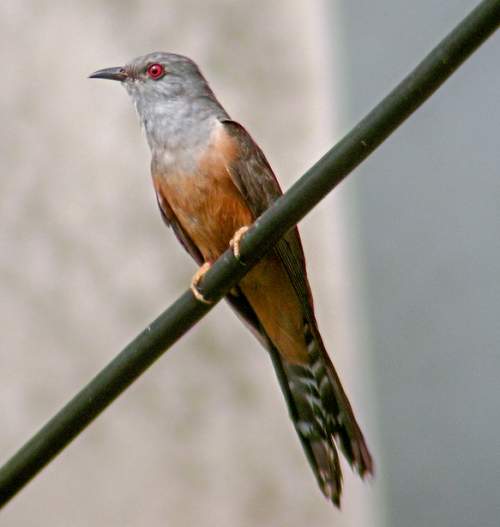
Banded bay cuckoo images


   ›      ›   Banded bay cuckoo - Cacomantis sonneratii images
Taxonomic classification   < >   Images

The Banded bay cuckoo (Cacomantis sonneratii) belongs to the family of cuckoos, roadrunners and koels, the Cuculidae under the order Cuculiformes.

Banded bay cuckoo taxonomy

The Cuculidae is the family of cuckoos, roadrunners, koels and malkohas. The family Cuculidae was first introduced by William Elford Leach, MD, FRS (2 February 1791 – 25 August 1836), an English zoologist and marine biologist, in the year 1820.

The family Cuculidae comprises six subfamilies, including Cuculinae. The subfamily Cuculinae comprises twelve extant genera, including Cacomantis.

The genus Cacomantis was first described by Dr. Salomon Mรผller (7 April 1804 – 29 December 1864), a German naturalist, in the year 1843. The genus Cacomantis comprises ten extant species, including Cacomantis sonneratii.

The species Cacomantis sonneratii was first described by John Latham (27 June 1740 – 4 February 1837), an English physician and naturalist, in the year 1790.

The species Cacomantis sonneratii is polytypic and comprises four subspecies, viz., C. s. sonneratii (Latham, 1790), C. s. waiti (E. C. S. Baker, 1919), C. s. fasciolatus (S. Mรผller, 1843) and C. s. musicus (Ljungh, 1804).

Taxonomic classification
Binomial name:Cacomantis sonneratii
Species:C. sonneratii
Genus:Cacomantis
Subfamily:-
Family:Cuculidae
Order:Cuculiformes
Class:Aves
Phylum:Chordata
Kingdom:Animalia
Cacomantis sonneratii
1.Banded bay cuckoo - Cacomantis sonneratii
Image by Sandeep Gangadharan


Cacomantis sonneratii
2.Banded bay cuckoo - Cacomantis sonneratii
Image by Sandeep Gangadharan

Cacomantis sonneratii
3.Banded bay cuckoo - Cacomantis sonneratii
Image by Vivekpuliyeri

Cacomantis sonneratii
4.Banded bay cuckoo - Cacomantis sonneratii
Image by vil.sandi

Cacomantis sonneratii
5.Banded bay cuckoo - Cacomantis sonneratii
Image by vil.sandi

Cacomantis sonneratii
6.Banded bay cuckoo - Cacomantis sonneratii
Image by vil.sandi
Popular posts in Birds World
Jungle owlet Golden-throated barbet
Grey-capped woodpecker Mangrove pitta
Grey-headed lapwing Common snipe
Mew gull Long-tailed broadbill
Green-billed malkoha Collared owlet
Lineated barbet White-browed piculet
Western hooded pitta Common woodshrike
White-breasted woodswallow Marshall's iora
Blue-naped pitta Long-billed dowitcher
Red-wattled lapwing Lesser black-backed gull

1.Image source: https://www.flickr.com/photos/23285057@N04/12510896284 (cropped)
Author: Sandeep Gangadharan | License: CC BY 2.0 as on 10/9/18
2.Image source: https://www.flickr.com/photos/sandeepak/13919235841/ (cropped)
Author: Sandeep Gangadharan | License: CC BY 2.0 as on 10/9/18
3.Source: https://commons.wikimedia.org/wiki/File:Banded_Bay_Cuckoo_(Cacomantis_sonneratii).jpg (cropped)
Author: Vivekpuliyeri | License: CC BY-SA 4.0 as on 10/9/18
4.Image source: https://www.flickr.com/photos/vil_sandi/8204376316/
Author: vil.sandi | License: CC BY-ND 2.0 as on 10/9/18
5.Image source: https://www.flickr.com/photos/vil_sandi/8203134351/
Author: vil.sandi | License: CC BY-ND 2.0 as on 10/9/18
6.Source: https://www.flickr.com/photos/vil_sandi/8200226919/
Author: vil.sandi | License: CC BY-ND 2.0 as on 10/9/18
Current topic in Bird World: Banded bay cuckoo - Cacomantis sonneratii images.
Contact State Tourism or travel agents for bird watching and wildlife tours.

Plaintive cuckoo images

   ›      ›   Plaintive cuckoo - Cacomantis merulinus images
Taxonomic classification   < >   Images
The Plaintive cuckoo (Cacomantis merulinus) belongs to the family of cuckoos, roadrunners, koels and malkohas, the Cuculidae under the order Cuculiformes.

Plaintive cuckoo taxonomy

The Cuculidae is the family of cuckoos, roadrunners, koels and malkohas. The family Cuculidae was first introduced by William Elford Leach, MD, FRS (2 February 1791 – 25 August 1836), an English zoologist and marine biologist, in the year 1820.

The family Cuculidae comprises six subfamilies, including Cuculinae (brood-parasitic cuckoos). The subfamily Cuculinae comprises twelve extant genera, including Cacomantis (barred-tail cuckoos).

The genus Cacomantis was first described by Dr. Salomon Mรผller (7 April 1804 – 29 December 1864), a German naturalist, in the year 1843. The genus Cacomantis comprises ten extant species, including Cacomantis merulinus.

The species Cacomantis merulinus was first described by Giovanni Antonio Scopoli (3 June 1723 – 8 May 1788), an Italian physician and naturalist, in the year 1786.

The species Cacomantis merulinus is polytypic and comprises four subspecies, viz., C. m. querulus Heine, 1863, C. m. threnodes Cabanis & Heine, 1863, C. m. lanceolatus (S. Mรผller, 1843) and C. m. merulinus (Scopoli, 1786).

Taxonomic classification
Binomial name:Cacomantis merulinus
Species:C. merulinus
Genus:Cacomantis
Subfamily:-
Family:Cuculidae
Order:Cuculiformes
Class:Aves
Phylum:Chordata
Kingdom:Animalia
Plaintive cuckoo - Cacomantis merulinus
1.Plaintive cuckoo - Cacomantis merulinus
Image by Alnus


Cacomantis merulinus
2.Plaintive cuckoo - Cacomantis merulinus
Image by Ron Knight

Cacomantis merulinus
3.Plaintive cuckoo - Cacomantis merulinus
Image by Ron Knight

Cacomantis merulinus
4.Plaintive cuckoo - Cacomantis merulinus
Image by Ariefrahman

Cacomantis merulinus
5.Plaintive cuckoo - Cacomantis merulinus
Image by Charles Lam

Cacomantis merulinus
6.Plaintive cuckoo - Cacomantis merulinus
Image by sfitzgerald86

Cacomantis merulinus
7.Plaintive cuckoo - Cacomantis merulinus
Image by Lip Kee

Cacomantis merulinus
8.Plaintive cuckoo - Cacomantis merulinus
Image by Lip Kee

Cacomantis merulinus juvenile
9.Plaintive cuckoo juvenile - Cacomantis merulinus
Image by J.M.Garg
Popular posts in Birds World
Eastern grass-owl Slender-billed oriole
Ashy minivet Grey plover
Eurasian curlew River tern
Andaman green pigeon Boreal owl
Coppersmith barbet Darjeeling woodpecker
Small minivet Common ringed plover
Spotted redshank Roseate tern
Thick-billed green pigeon Andaman hawk-owl
Great spotted woodpecker White-bellied minivet
Brown-fronted woodpecker Pied triller
Pacific golden-plover Bar-tailed godwit
Crow-billed drongo Andean siskin
Horned screamer American black duck
Choco tinamou Russet-backed oropendola
Yellow-faced siskin American wigeon
Black-headed jay Dusky-green oropendola
Barnacle goose Red-billed blue magpie
Common kingfisher South polar skua
Pin-tailed sandgrouse Common wood pigeon
Blossom-headed parakeet Sri Lanka frogmouth
Oriental scops owl Large-tailed nightjar
White-rumped spinetail Oriental dollarbird
Blue-eared kingfisher Blue-bearded bee-eater
Common hoopoe Indian skimmer
Pomarine jaeger Chestnut-bellied sandgrouse
Speckled wood pigeon Blue-winged parakeet
Andaman scops owl Alexandrine parakeet
Red siskin White-cheeked tern
Green imperial-pigeon Short-eared owl
Scarlet-breasted woodpecker Grey-chinned minivet

1.Image source: https://commons.wikimedia.org/wiki/File:Plaintive_Cuckoo_2850_(cropped).jpg (cropped)
Author: Alnus | License: CC BY-SA 3.0 as on 9/8/18
2.Image source: https://www.flickr.com/photos/sussexbirder/8080154310/in/photostream/ (cropped)
Author: Ron Knight | License: CC BY 2.0 as on 9/8/18
3.Image source: https://www.flickr.com/photos/sussexbirder/8080154600/ (cropped)
Author: Ron Knight | License: CC BY 2.0 as on 9/8/18
4.Image source: https://en.wikipedia.org/ (cropped)
Author: Ariefrahman | License: CC BY-SA 3.0 as on 9/8/18
5.Image source: https://www.flickr.com/photos/kclama/6397045137/in/photostream/ (cropped)
Author: Charles Lam | License: CC BY-SA 2.0 as on 9/8/18
6.Image source: https://www.flickr.com/photos/sfitzgerald86/3304352869/in/photostream/ (cropped)
Author: sfitzgerald86 | License: CC BY-nc 2.0 as on 9/8/18
7.Image source: https://www.flickr.com/photos/lipkee/2436138459/ (cropped)
Author: Lip Kee | License: CC BY-SA 2.0 as on 9/8/18
8.Image source: https://www.flickr.com/photos/lipkee/2436138605/ (cropped)
Author: Lip Kee | License: CC BY-SA 2.0 as on 9/8/18
9.Source: https://en.wikipedia.org/ (cropped)
Author: J.M.Garg | License: CC BY-SA 3.0 as on 9/8/18
Current topic in Bird World: Plaintive cuckoo juvenile - Cacomantis merulinus images.
Contact State Tourism or travel agents for bird watching and wildlife tours.

Lesser coucal

   ›      ›   Lesser coucal - Centropus bengalensis

The lesser coucal (Centropus bengalensis) belongs to the family of cuckoos and coucals, the Cuculidae.

The lesser coucal species is distributed in India, Nepal, Bhutan, Bangladesh and southeast Asia. Unlike other cuckoos, these coucal species are not brood-parasites. These coucals are polytypic species.
Overview & Quick Facts Description & Identification
Pictures of Lesser Coucal Distribution & Range
Ecosystem & Habitat Diet & Feeding Behavior
Breeding Habits Migration & Movement Patterns
Conservation & Survival IUCN Status
Taxonomy & Classification Bird World

Appearance, physical description and identification

The lesser coucal (Centropus bengalensis) is a comparatively small coucal, measuring 30 to 40 cm in length and weighing 90 to 150 gram. There is size variation among the subspecies.

The overall plumage of the lesser coucal is black and the wings are rufous. In breeding plumage, the head and the upper back becomes glossy black with dark shafts to the feathers.

In non-breeding plumage, the feather shafts on the head and back become whitish.The tail is long. The central tail coverts are long and barred. The juveniles have pale brown feathers with barring.

The bill of lesser coucal is short, down-curved and yellowish. The irises are dark brown. The feet are blackish and the hind claw is long. Their call is a series of low "whoot..woot" sound.
Indian birds - Picture of Lesser coucal - Centropus bengalensis
1.Birds of India - Image of Lesser coucal - Centropus bengalensis by ๅญซ้‹’ ๆž—

Advertisement

Images
Birds of India - Photo of Lesser coucal - Centropus bengalensis
2.Indian birds - Picture of Lesser coucal - Centropus bengalensis by Ron Knight

Indian birds - Image of Lesser coucal - Centropus bengalensis juvenile
3.Birds of India - Photo of Lesser coucal - Centropus bengalensis juvenile by Jason Thompson

Origin, geographical range and distribution

The lesser coucal species is distributed in India, Nepal, Bhutan, Bangladesh, Myanmar, Thailand, Cambodia, Laos, Vietnam, China, Taiwan, Malaysia, Singapore, Brunei, Indonesia, Philippines and Timor-Leste.

In India, these lesser coucals are distributed in the states of Karnataka, Kerala, Tamil Nadu, Odisha, West Bengal, Bihar, Uttar Pradesh, Uttarakhand, Sikkim, Assam, Meghalaya, Arunachal Pradesh, Nagaland, Manipur, Tripura and Mizoram.

The lesser coucal nominate subspecies C. b. bengalensis is distributed in India, Nepal, Bhutan, Bangladesh, Myanmar, Thailand, Cambodia, Laos and Vietnam. The subspecies C. b. medius is distributed in Maluku Islands (Indonesia).

The coucal subspecies C. b. lignator is distributed in south and southeast China, Hainan (China) and Taiwan. The subspecies C. b. javanensis is distributed in Malaysia, Singapore, Brunei, Indonesia and and southwest Philippines.

The lesser coucal subspecies C. b. philippinensis is distributed in Philippines. The subspecies C. b. sarasinorum is distributed in the Talaud Islands, Sangihe Islands, Sulawesi Islands and the Lesser Sunda Islands of Indonesia.

Ecosystem and habitat

These lesser coucal species do not normally occur in forests. They normally occur in altitudes from 0 to 1800 meters. The artificial ecosystems and habitats of these species include tropical and subtropical heavily degraded forests and cultivated lands.

The natural ecosystems and habitats of these species include, open country, tropical and subtropical moist shrublands, marshlands, mangroves, swamps, peatlands and bamboo thickets.

Diet and feeding behavior

The diet of the lesser coucal consists mainly of insects. Caterpillars and other insect larvae, grasshoppers, cicadas, crickets, locust, spiders and lizards are their primary food. They glean the insects from the foliage and branches as well as hawk them in the air.

Reproduction and breeding habits

The breeding season of these lesser coucal species is during May to September in India. The laying season is from December to July in Malaysia.

The nesting sites of these species are located in low trees and shrubs. The nest is a dome of grass blades and twigs. These coucal species are monogamous. Both parents take part in incubation and care of young. The clutch usually contains two to four eggs.

Migration and movement patterns

These lesser coucal species are non-migrant resident birds. The birds in the higher altitudes descent to lower levels during winter.

Post breeding, the juveniles may disperse and establish in new locations within the range. Within their range they may make local movements for feeding and breeding.

Lesser coucal - Quick Facts

  • Scientific name: Centropus bengalensis
  • Species author: (Gmelin, 1788)
  • Synonyms/Protonym: Cuculus bengalensis J. F. Gmelin, 1788
  • Family: Cuculidae › Cuculiformes › Aves › Chordata › Animalia
  • Vernacular names: English: Lesser coucal, Chinese: ๅฐ้ธฆ้นƒ, French: Coucal rufin, German: Bengalenkuckuck, Spanish: Cucal bengalรญ, Russian: ะœะฐะปะฐั ัˆะฟะพั€ั†ะตะฒะฐั ะบัƒะบัƒัˆะบะฐ, Japanese: ใƒใƒณใ‚ฑใƒณ, Indonesian: Bubut alang alang
  • Other names: Black Coucal, Lesser Coucal
  • Distribution: India, Nepal, Bhutan, Bangladesh, Myanmar, Thailand, Cambodia, Laos, Vietnam, China, Taiwan, Malaysia, Singapore, Brunei, Indonesia, Philippines, Timor-Leste
  • Diet and feeding habits: insects, caterpillars, locust, cricket, cicadas, grasshoppers, mantids, beetles, spiders, lizards
  • IUCN status listing: Least Concern (LC)

Conservation and survival

The global population size of the lesser coucal (Centropus bengalensis) has not been quantified. The overall population trend of the species is considered to be increasing.

In most of its range, this coucal species is reported to be common and locally abundant. The generation length is 3.8 years. Its distribution size is about 21,100,000 sq.km.

Habitat alteration and destruction, hunting and trapping for pet-trade are the main threats that are endangering the survival of this species.

IUCN and CITES status

The lesser coucal (Centropus bengalensis) does not approach the thresholds for being Vulnerable either under the range size criterion, or under the population trend criterion or under the population size criterion.

The IUCN (International Union for Conservation of Nature) has categorized and evaluated the coucal species and has listed it as of "Least Concern".

The CITES (Convention on International Trade in Endangered Species of Wild Fauna and Flora) status is ‘Not Evaluated’ for lesser coucal (Centropus bengalensis).
Taxonomy and scientific classification of Centropus bengalensis
Kingdom:Animalia
Phylum:Chordata
Class:Aves
Order:Cuculiformes
Family:Cuculidae
Subfamily:-
Genus:Centropus
Species:C. bengalensis
Binomial name:Centropus bengalensis
IUCN status listing:
Least Concern
The lesser coucal (Centropus bengalensis) is closely related to the black coucal (Centropus grillii) and the Philippine coucal (Centropus viridis).

The six recognized subspecies of the lesser coucal are: C. b. bengalensis (J. F. Gmelin, 1788), C. b. medius Bonaparte, 1850, C. b. lignator Swinhoe, 1861, C. b. sarasinorum Stresemann, 1912, C. b. javanensis Dumont de Sainte Croix, 1818 and C. b. philippinensis Mees, 1971.
Popular posts on Birds of India
Blue-throated barbet photos Blue-throated barbet
Long-tailed broadbill Common (Grey-capped) emerald dove
Blue-naped pitta Large woodshrike
Brown wood owl Little swift
River lapwing Swinhoe's snipe
Small pratincole Little gull
Eastern spotted dove Asian (western) koel
Tawny owl Great barbet
Yellow-rumped honeyguide Eurasian wryneck
Square-tailed drongo-cuckoo Red turtle dove
Black-headed gull Collared pratincole
Wood snipe Indian thick-knee
Eurasian oystercatcher Great thick-knee
Crab-plover Beach thick-knee
Ibisbill Black-winged stilt
Pied avocet Northern lapwing
Pintail snipe Oriental pratincole
Black-headed cuckooshrike Mangrove whistler
White-tailed lapwing Black-tailed godwit
Western hooded pitta Common woodshrike
White-breasted woodswallow Marshall's iora
Sabine's gull Orange-breasted green pigeon
House swift Spotted owlet
Grey-headed lapwing Common snipe
Mew gull Andaman cuckoo-dove
Sirkeer malkoha Asian barred owlet
White-cheeked barbet Brown-capped pygmy woodpecker
Asian dowitcher Black-legged kittiwake
Nicobar pigeon Crested kingfisher
Indian pitta Bar-winged flycatcher-shrike

1.Image source: https://www.flickr.com/photos/outdoor_birding/16150101550/ (cropped)
Image author: ๅญซ้‹’ ๆž— | License: CC BY-SA 2.0 as on 1/12/18
2.Image source: https://www.flickr.com/photos/sussexbirder/8080210237/ (cropped)
Image author: Ron Knight | License: CC BY 2.0 as on 1/12/18
3.Image source: https://commons.wikimedia.org/wiki/File:Lesser_Coucal_juvenile.jpg (cropped)
Image author: Jason Thompson | License: CC BY 2.0 as on 1/12/18
Current topic in Birds of India: Lesser coucal - Centropus bengalensis.
Contact State Tourism or travel agents for bird watching and wildlife tours.

Andaman (brown) coucal

   ›      ›   Andaman (brown) coucal - Centropus andamanensis

The Andaman coucal (Centropus andamanensis) aka brown coucal belongs to the family of cuckoos, the Cuculidae.

The Andaman coucal species is distributed in Andaman and Nicobar Islands of India and Coco Islands of Myanmar. These brown coucal species are endemic to these islands in the Bay of Bengal. These coucals are monotypic species.
Overview & Quick Facts Description & Identification
Pictures of Andaman Coucal Distribution & Range
Ecosystem & Habitat Diet & Feeding Behavior
Breeding Habits Migration & Movement Patterns
Conservation & Survival IUCN Status
Taxonomy & Classification Bird World

Appearance, physical description and identification

The Andaman coucal (Centropus andamanensis) is a large coucal, measuring 45 to 50 cm in length and weighing 230 to 300 grams.

The overall plumage is shades of brown. The head, mantle and underparts are pale grayish brown. The rear mantle and wings are chestnut brown. The tail is pale brown at the base and darkens towards the tip.

The bill has downward curve and is dark metallic gray. The irises are deep red and there is a brownish eye ring. The legs and feet are blackish gray. The call of these coucals is a series of deep, resonant "hoop..hoop..hoop" and also chuckling and grating sounds.
Indian birds - Picture of Centropus andamanensis
1.Birds of India - Image of Andaman coucal - Centropus andamanensis by Albinjacob

Advertisement

Images
Birds of India - Photo of Centropus andamanensis
2.Indian birds - Picture of Andaman coucal - Centropus andamanensis by Antony Grossy

Indian birds - Image of Andaman coucal - Centropus andamanensis
3.Birds of India - Photo of Centropus andamanensis by T R Shankar Raman

Origin, geographical range and distribution

The Andaman coucal species is distributed in India (Andaman Islands, Great Nicobar Island) and Myanmar (Great Coco Island, Little Coco Island and Table Island).

The Important Bird and Biodiversity Areas (IBA) of these coucal species are, Baratang-Rafters Creek, Jarawa Reserve, Kadakachang, Landfall Island, Wandoor National Park, Mount Diavalo, Mount Harriet, Sentinel Islands, North Reef Island and Rani Jhansi Marine National Park.

Ecosystem and habitat

These Andaman coucal species have moderate forest dependence. They normally occur in altitudes from 0 to 100 meters. The artificial ecosystems and habitats of these species include cultivated lands, flooded agricultural lands, pasturelands and thickly covered gardens.

The natural ecosystems and habitats of these species include, subtropical and tropical moist lowland forests, subtropical and tropical mangrove forests and swamps.

Diet and feeding behavior

The diet of the Andaman coucal consists mainly of insects. Grasshoppers, crickets, moths, insect larvae, small frogs, crabs and lizards are their primary food.

Reproduction and breeding habits

The breeding season of these Andaman coucal species is from February to July in Indian Islands. The nest is a dome of twigs, grass and leaves placed on the tree. The clutch contains two or three chalky white eggs.

Migration and movement patterns

These Andaman coucal species are non-migratory and are resident birds.

Post breeding, the juvenile coucals may disperse and establish in new locations within the range. They may make local movements for feeding and breeding within their range.

Andaman coucal - Quick Facts

  • Scientific name: Centropus andamanensis
  • Species author: Beavan, 1867
  • Synonyms/Protonym: Centropus andamanensis Beavan, 1867
  • Family: Cuculidae › Cuculiformes › Aves › Chordata › Animalia
  • Vernacular names: English: Andaman coucal, Chinese: ่ค้ธฆ้นƒ, French: Coucal des Andaman, German: Andamanenkuckuck, Spanish: Cucal de Andamรกn, Russian: ะะฝะดะฐะผะฐะฝัะบะฐั ัˆะฟะพั€ั†ะตะฒะฐั ะบัƒะบัƒัˆะบะฐ, Japanese: ใ‚ขใƒณใƒ€ใƒžใƒณใƒใƒณใ‚ฑใƒณ
  • Other names: brown coucal
  • Distribution: India (Andaman Islands, Nicobar Islands), Myanmar (Great Coco Island, Little Coco Island)
  • Diet and feeding habits: insects, insect larvae, grasshoppers, small frogs, crabs, lizards
  • IUCN status listing: Least Concern (LC)

Conservation and survival

The global population size of the Andaman coucal (Centropus andamanensis) has not been quantified. The overall population trend of the species is considered to be stable.

Throughout its range, this coucal species is reported to be common. The generation length is 3.8 years. Its distribution size is about 77,700 sq.km.

Habitat alteration and destruction and deforestation are the main threats that are endangering the survival of this coucal species.

IUCN and CITES status

The Andaman coucal (Centropus andamanensis) does not approach the thresholds for being Vulnerable either under the range size criterion, or under the population trend criterion or under the population size criterion.

The IUCN (International Union for Conservation of Nature) has categorized and evaluated the coucal species and has listed it as of "Least Concern".

The CITES (Convention on International Trade in Endangered Species of Wild Fauna and Flora) status is ‘Not Evaluated’ for Andaman coucal (Centropus andamanensis).
Taxonomy and scientific classification of Centropus andamanensis
Kingdom:Animalia
Phylum:Chordata
Class:Aves
Order:Cuculiformes
Family:Cuculidae
Subfamily:-
Genus:Centropus
Species:C. andamanensis
Binomial name:Centropus andamanensis
IUCN status listing:
Least Concern
The Andaman coucal (Centropus andamanensis) is closely related to the greater coucal (Centropus sinensis).
Popular posts on Birds of India
Sirkeer malkoha Asian barred owlet
Small green barbet Indian pygmy woodpecker
Blossom-headed parakeet Indian cuckoo
Oriental scops owl Large-tailed nightjar
Indian pitta Bar-winged flycatcher-shrike
Black-winged cuckooshrike Sociable lapwing
Asian dowitcher Black-legged kittiwake
Nicobar pigeon Ashy wood pigeon
Jungle owlet Golden-throated barbet
Grey-capped woodpecker Mangrove pitta
Grey-headed lapwing Common snipe
Mew gull Red-breasted parakeet
European bee-eater Oriental pied hornbill
White-eyed gull Caspian tern
Himalayan cuckoo Long-tailed parakeet
Plaintive cuckoo Dusky eagle-owl
Alpine swift White-breasted kingfisher
Chestnut-headed bee-eater Rufous-necked hornbill
Great hornbill Asian emerald cuckoo
Cream-coloured courser Collared kingfisher
Sooty gull Tawny fish owl
Lesser crested tern Pacific swift
European turtle dove Asian emerald cuckoo
Eurasian eagle-owl Common gull-billed tern
Nicobar scops owl Andaman nightjar
White-throated needletail Oriental dwarf kingfisher
Asian green bee-eater Malabar grey hornbill
Arctic jaeger Spotted sandgrouse
Green-billed malkoha Collared owlet
Lineated barbet White-browed piculet

1.Image source: https://en.wikipedia.org/wiki/File:Andaman_Coucal.jpg (cropped)
Image author: Albinjacob | License: CC BY-SA 4.0
2.Image source: https://en.wikipedia.org/wiki/File:The_Andaman_Coucal.jpg (cropped)
Image author: Antony Grossy | License: CC BY-SA 4.0
3.Image source: https://commons.wikimedia.org/wiki/File:Andaman_Coucal_1.JPG (cropped)
Image author: T R Shankar Raman | License: CC BY-SA 4.0
Current topic in Birds of India: Andaman coucal - Centropus andamanensis.
Contact State Tourism or travel agents for bird watching and wildlife tours.

Greater coucal photos

   ›      ›   Greater coucal - Centropus sinensis photos
Taxonomic classification   <>   Photos
The greater coucal (Centropus sinensis) belongs to the family Cuculidae under the order Cuculiformes.

Greater coucal taxonomy

The family Cuculidae comprises six subfamilies and is divided into about thirty genera. This family was first described by William Elford Leach, MD, FRS (2 February 1791 – 25 August 1836), an English zoologist and marine biologist, in the year 1820.

The type species (Cuculus canorus) of this family was first introduced by Carl Linnaeus (23 May 1707 – 10 January 1778), a Swedish botanist, physician and zoologist, in the year 1758.

The genus Centropus was first described by Carl Linnaeus in the year 1766. The genus Centropus comprises about 30 species.

The species Centropus sinensis was first introduced (as Polophilus sinensis) by James Francis Stephens (16 September 1792 – 22 December 1852), an English entomologist and naturalist, in the year 1815.

The species Centropus sinensis is polytypic and comprises six subspecies, C. s. sinensis, C. s. parroti, C. s. intermedius, C. s. anonymus, C. s. bubutus and C. s. kangeangensis.

.
Taxonomic classification
Binomial name:Centropus sinensis
Species:C. sinensis
Genus:Centropus
Subfamily:-
Family:Cuculidae
Order:Cuculiformes
Class:Aves
Phylum:Chordata
Kingdom:Animalia
Greater coucal - Centropus sinensis
1.Greater coucal - Centropus sinensis
Photo by Shivramsagar

Advertisement

Photos
Centropus sinensis
2.Greater coucal - Centropus sinensis
Photo by Shantanu Kuveskar

Centropus sinensis
3.Greater coucal - Centropus sinensis
Photo by ARUN THANGARAJ

Centropus sinensis
4.Greater coucal - Centropus sinensis
Photo by Deepugn

Centropus sinensis
5.Greater coucal - Centropus sinensis
Photo by Dhaval Vargiya

Centropus sinensis
6.Greater coucal - Centropus sinensis
Photo by J.M.Garg

Centropus sinensis
7.Centropus sinensis juvenile
Photo by J.M.Garg

Centropus sinensis
8.Greater coucal - Centropus sinensis
Photo by Selvaganesh17

Centropus sinensis
9.Centropus sinensis
Photo by Selvaganesh17

Advertisement

Popular posts in Birds of India
Grey-headed lapwing Common snipe
Mew gull Andaman cuckoo-dove
White-rumped spinetail Oriental dollarbird
Blue-eared kingfisher Blue-bearded bee-eater
Common hoopoe Indian skimmer
Pomarine jaeger Chestnut-bellied sandgrouse
Green-billed malkoha Collared owlet
Lineated barbet White-browed piculet
Great eared nightjar Crested treeswift
Rock dove Rose-ringed parakeet
Chestnut-winged cuckoo Common barn-owl
Mountain scops-owl Hodgson's frogmouth
Western hooded pitta Common woodshrike
White-breasted woodswallow Marshall's iora
Grey nightjar Indian swiftlet
Red-headed trogon Tibetan sandgrouse
Snow pigeon Grey-headed parakeet
Common hawk-cuckoo Sri Lanka bay owl
Andaman cuckooshrike Long-billed dowitcher
Red-wattled lapwing Lesser black-backed gull
White-breasted waterhen Black-tailed crake
Little crake Baillon's crake
Ruddy-breasted crake Watercock
Common moorhen Common coot
Siberian crane Sarus crane
Common crane Black-necked crane
Long-tailed broadbill Common (Grey-capped) emerald dove
Blue-naped pitta Large woodshrike
Yellow-wattled lapwing Great snipe
Franklin's gull Barred cuckoo-dove

1.Photo source: https://commons.wikimedia.org/wiki/File:Greater_Coucal_in_Perundurai.JPG (cropped)
Author: Shivramsagar | License: CC BY-SA 3.0
2.Photo source: https://commons.wikimedia.org/ (cropped)
Author: Shantanu Kuveskar | License: CC BY-SA 3.0
3.Photo source: https://commons.wikimedia.org/ (cropped)
Author: ARUN THANGARAJ | License: CC BY-SA 4.0
4.Source: https://commons.wikimedia.org/wiki/File:Crow-crow-pheasant-from-kottayam-kerala.jpg (cropped)
Author: Deepugn | License: CC BY-SA 4.0
5.Photo source: https://en.wikipedia.org (cropped)
Author: Dhaval Vargiya | License: CC BY-SA 4.0
6.Photo source: https://en.wikipedia.org (cropped)
Author: J.M.Garg | License: CC BY-SA 3.0
7.Source: https://en.wikipedia.org (cropped)
Author: J.M.Garg | License: CC BY-SA 3.0
8.Photo source: https://commons.wikimedia.org (cropped)
Author: Selvaganesh17 | License: CC BY-SA 4.0
9.Source: https://commons.wikimedia.org (cropped)
Author: Selvaganesh17 | License: CC BY-SA 4.0
Current topic in Birds of India: Greater coucal - Centropus sinensis photos.
Contact State Tourism or travel agents for bird watching and wildlife tours.