Showing posts with label Monarchidae. Show all posts

Indian paradise flycatcher images

   ›      ›   Indian paradise flycatcher - Terpsiphone paradisi images
Taxonomic classification   < >   Images
The Indian paradise flycatcher (Terpsiphone paradisi) belongs to the family Monarchidae under the order Passeriformes.

Indian paradise flycatcher taxonomy

The family Monarchidae comprises about 100 monarch passerine birds. The family Monarchidae was first described by Charles Lucien Jules Laurent Bonaparte (24 May 1803 – 29 July 1857), a French biologist and ornithologist, in the year 1854.

The family Monarchidae comprise two subfamilies, Terpsiphoninae (four genera) and Monarchinae (12 genera). The subfamily Terpsiphoninae comprises four genera, viz., Hypothymis, Eutrichomyias, Trochocercus and Terpsiphone.

The genus Terpsiphone was first described by Constantin Wilhelm Lambert Gloger (17 September – 30 December 1863), a German zoologist and ornithologist, in the year 1827.

The genus Terpsiphone comprises sixteen species, including Terpsiphone paradisi. The species Terpsiphone paradisi was first described (as Corvus paradisi) by Carl Linnaeus (23 May 1707 – 10 January 1778), a Swedish botanist, physician and zoologist, in the year 1758.
Taxonomic classification
Binomial name:Terpsiphone paradisi
Species:T. paradisi
Genus:Terpsiphone
Subfamily:-
Family:Monarchidae
Order:Passeriformes
Class:Aves
Phylum:Chordata
Kingdom:Animalia
Indian paradise flycatcher - Terpsiphone paradisi
1.Indian paradise flycatcher - Terpsiphone paradisi 262
Image by soumyajit nandy


Terpsiphone paradisi
2.Indian paradise flycatcher - Terpsiphone paradisi
Image by Steve Garvie

Terpsiphone paradisi
3.Indian paradise flycatcher - Terpsiphone paradisi
Image by N A Nazeer

Terpsiphone paradisi
4.Indian paradise flycatcher - Terpsiphone paradisi
Image by Rehman Abubakr

Terpsiphone paradisi
5.Indian paradise flycatcher - Terpsiphone paradisi
Image by Koshy Koshy

Terpsiphone paradisi
6.Indian paradise flycatcher - Terpsiphone paradisi
Image by J.M.Garg

Terpsiphone paradisi
7.Indian paradise flycatcher - Terpsiphone paradisi
Image by Thimindu Goonatillake

Terpsiphone paradisi
8.Indian paradise flycatcher - Terpsiphone paradisi
Image by ALOK KUMAR MEHER

Terpsiphone paradisi
9.Terpsiphone paradisi
Image by AshishTripurwar
Popular posts on Birds
Common redshank Black-naped tern
Sandwich tern Grey-fronted green pigeon
Lesser coucal Forest owlet
Blue-eared barbet Fulvous-breasted woodpecker
Blue-winged pitta Rosy minivet
Yellow-footed green pigeon Brown hawk-owl
Sind woodpecker Long-tailed minivet
Sabine's gull Orange-breasted green pigeon
Andaman coucal Spotted owlet
Sirkeer malkoha Asian barred owlet
White-cheeked barbet Brown-capped pygmy woodpecker
Little ringed plover Marsh sandpiper
Common tern Pin-tailed green pigeon
Wood snipe Sooty gull
Eurasian oystercatcher Great thick-knee
Crab-plover Beach thick-knee
Ibisbill Black-winged stilt
Hume's hawk-owl Himalayan woodpecker
Short-billed minivet Woodchat shrike
Crested kingfisher Wreathed hornbill
Pheasant-tailed jacana Solitary snipe
Bronze-winged jacana Greater painted-snipe
Narcondam hornbill Pied kingfisher
Eurasian golden oriole Black drongo
Long-billed plover Tawny owl
Alpine swift White-breasted kingfisher
Chestnut-headed bee-eater Rufous-necked hornbill
Great hornbill Asian emerald cuckoo
Cream-coloured courser Collared kingfisher
Ashy minivet Grey plover

1.Indian paradise flycatcher image source: https://www.flickr.com/photos/snandy_81/15099910331/ (cropped)
Author: soumyajit nandy | License: CC BY-SA 2.0 as on 4/25/18
2.Image source: https://en.wikipedia.org/wiki/File:Terpsiphone_paradisi_-near_Amaya_Lake,_Dambulla,_Sri_Lanka-8.jpg (cropped)
Author: Steve Garvie | License: CC BY-NC-SA 2.0 as on 4/25/18
3.Image source: https://en.wikipedia.org/ (cropped)
Author: N A Nazeer | License: CC BY-SA 2.5 IN as on 4/25/18
4.Image source: https://commons.wikimedia.org/ (cropped)
Author: Rehman Abubakr | License: CC BY-SA 4.0 as on 4/25/18
5.Image source: https://commons.wikimedia.org/wiki/File:Terpsiphone_paradisi_-Nandi_Hills,_Karnataka,_India_-male-8.jpg (cropped)
Author: Koshy Koshy | License: CC BY 2.0 as on 4/25/18
6.Image source: https://commons.wikimedia.org/ (cropped)
Author: J.M.Garg | License: CC BY 3.0 as on 4/25/18
7.Image source: https://www.flickr.com/photos/51327488@N00/5319925307 (cropped)
Author: Thimindu Goonatillake | License: CC BY-SA 2.0 as on 4/25/18
8.Image source: https://commons.wikimedia.org/ (cropped)
Author: ALOK KUMAR MEHER | License: CC BY-SA 4.0 as on 4/25/18
9.Image source: https://commons.wikimedia.org/ (cropped)
Author: AshishTripurwar | License: CC BY-SA 4.0 as on 4/25/18
Current topic: Indian paradise flycatcher - Terpsiphone paradisi images.
Contact State Tourism or travel agents for bird watching and wildlife tours.

Indian paradise flycatcher

   ›      ›   Indian paradise flycatcher - Terpsiphone paradisi

The Indian paradise flycatcher (Terpsiphone paradisi) belongs to the family of paradise flycatchers, the Monarchidae.

The Indian paradise flycatcher species is distributed in Indian subcontinent, Central Asia and Myanmar. The adult male paradise flycatchers exhibit plumage dichromatism. These paradise flycatchers are polytypic species.
Overview & Quick Facts Description & Identification
Pictures of Indian Paradise Flycatcher Distribution & Range
Ecosystem & Habitat Diet & Feeding Behavior
Breeding Habits Migration & Movement Patterns
Conservation & Survival IUCN Status
Taxonomy & Classification Bird World

Appearance, physical description and identification

The Indian paradise flycatcher (Terpsiphone paradisi) is a small sized bird, measuring 20 cm (excluding male’s elongated central rectrices) in length and weighing 17 to 23 grams.

The head, face, crown, crest and nape are glossy black. The throat is black in males and gray in females. Adult males develop long tail feathers and the two central tail feathers grow into 30 cm long drooping streamers.

The Indian paradise flycatcher females and young males are rufous and have short tails. The adult males exhibit plumage dichromatism. They are either predominantly bright rufous above or predominantly white.

The bill is black. The irises are black. The males have blue eye-ring whereas the females have black eye-ring. The legs are gray. The call of these paradise flycatcher species is a pleasant, repeated, musical "chie..chie..chie" sound.
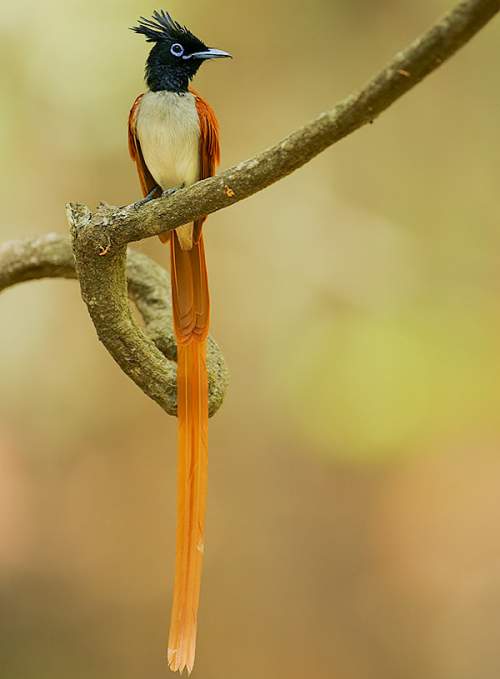
Indian paradise flycatcher - Terpsiphone paradisi
1.Image of Indian paradise flycatcher - Terpsiphone paradisi by Steve Garvie


Image of Indian paradise flycatcher - Terpsiphone paradisi
2.Image of Indian paradise flycatcher - Terpsiphone paradisi by soumyajit nandy

Image of Indian paradise flycatcher - Terpsiphone paradisi
3.Image of Indian paradise flycatcher - Terpsiphone paradisi by N A Nazeer

Origin, geographical range and distribution

These Indian paradise flycatcher species are distributed in Indian subcontinent, Afghanistan, China, Kazakhstan, Myanmar, Tajikistan and Turkmenistan.

The subspecies T. p. paradisi is distributed in Myanmar, central and south India, Bangladesh, Myanmar and Sri Lanka. The subspecies T. p. ceylonensis occurs in Sri Lanka.

The Indian paradise flycatcher subspecies T. p. leucogaster is distributed in Kazakhstan, Tajikistan, Turkmenistan, west China, north Afghanistan, north Pakistan, north India and Nepal. Non-breeding populations occur in eastern Pakistan and peninsular India.

Ecosystem and habitat

These Indian paradise flycatcher species have low forest dependence. They normally occur in altitudes from 0 to 2000 meters.

The artificial ecosystems and habitats of these paradise flycatcher species include heavily degraded forests, rural gardens, plantations, agricultural lands, parks and urban areas.

The natural ecosystems and habitats of these paradise flycatcher species include tropical and subtropical moist montane forests, foothill forests, moist lowland forests, temperate forests, mangroves and shrublands.

Diet and feeding behavior

The diet of these species consists mainly of insects. Flying insects, dragonflies, moths, beetles, winged termites and ants, grasshoppers, crickets, cicadas and locust are their primary food.

These paradise flycatcher species glean their prey from foliage as well as flycatch. They forage in undergrowth, lower and middle storeys. Occasionally they are seen flycatching in the canopy.

Reproduction and breeding habits

The breeding season of these Indian paradise flycatcher species is from March to August, with a peak period in May and June, in India and Pakistan. These species are monogamous and highly territorial.

The paradise flycatcher nesting sites are located on tree branches. The nest is a compact conical structure. Both the parents take part in nest building. The nest is built with grass, twigs, reeds, moss, leaves, plant fibers and cobwebs.

The clutch contains three eggs. The eggs are incubated by both the parents. The chicks hatch out after 14-16 days of incubation. The hatchlings are care for by both the parents.

Migration and movement patterns

These Indian paradise flycatcher species are partially migratory birds. The subspecies T. p. leucogaster and T. p. paradisi are migratory. The subspecies T. p. ceylonensis is resident and occurs in Sri Lanka.

Post breeding, resident paradise flycatcher juveniles may disperse and establish in new locations within the range. Within their range they may make local movements for feeding and breeding.

Indian paradise flycatcher - Quick Facts

  • Scientific name: Terpsiphone paradisi
  • Species author: (Linnaeus, 1758)
  • Synonyms/Protonym: Corvus paradisi Linnaeus, 1758
  • Family: Rhipiduridae › Passeriformes › Aves › Chordata › Animalia
  • Vernacular names: English: Indian paradise flycatcher, Chinese: 寿带, French: Tchitrec de paradis, German: Hainparadiesschnäpper, Spanish: Monarca del paraíso indio, Russian: Райская мухоловка, Japanese: カワリサンコウチョウ
  • Other names: Asian Paradise-flycatcher
  • Distribution: Kazakhstan, Uzbekistan, Kyrgyzstan, Tajikistan, Turkmenistan, Afghanistan, Indian subcontinent, Myanmar, China
  • Diet and feeding habits: insects, flying insects
  • IUCN status listing: Least Concern (LC)

Conservation and survival

The global population size of the Indian paradise flycatcher (Terpsiphone paradisi) has not been quantified. The overall population trend of the species is considered to be stable.

In most of its range, this species is reported to be common. The generation length is 5.8 years. Its distribution size is about 6,400,000 sq.km.

Habitat alteration and destruction, agricultural expansion, reduction in insect prey population are the main threats that are endangering the survival of these flycatcher species.

IUCN and CITES status

The Indian paradise flycatcher (Terpsiphone paradisi) does not approach the thresholds for being Vulnerable, either under the range size criterion, or under the population trend criterion or under the population size criterion.

The IUCN (International Union for Conservation of Nature) has categorized and evaluated the paradise flycatcher species and has listed it as of "Least Concern".

The CITES (Convention on International Trade in Endangered Species of Wild Fauna and Flora) status is ‘Not Evaluated’ for the Indian paradise flycatcher (Terpsiphone paradisi).
Taxonomy and scientific classification of Terpsiphone paradisi
Kingdom:Animalia
Phylum:Chordata
Class:Aves
Order:Passeriformes
Family:Monarchidae
Subfamily:-
Genus:Terpsiphone
Species:T. paradisi
Binomial name:Terpsiphone paradisi
IUCN status listing:
Least Concern
The Indian paradise flycatcher (Terpsiphone paradisi) is closely related to Chinese Paradise-flycatcher (Terpsiphone incei), Blyth's paradise flycatcher (Terpsiphone affinis) and Nusa Tenggara paradise-flycatcher (Terpsiphone floris).

The three recognized subspecies of the Indian paradise flycatcher (Terpsiphone paradisi) are: Terpsiphone paradisi paradisi (Linnaeus, 1758), Terpsiphone paradisi leucogaster (Swainson, 1838) and Terpsiphone paradisi ceylonensis (Zarudny & Härms, 1912).
Popular posts on Birds
Common redshank Black-naped tern
Brown-fronted woodpecker Pied triller
Pacific golden-plover Bar-tailed godwit
Yellow-footed green pigeon Brown hawk-owl
Sind woodpecker Long-tailed minivet
Black-headed cuckooshrike Mangrove whistler
White-tailed lapwing Black-tailed godwit
Little ringed plover Marsh sandpiper
Common tern Pin-tailed green pigeon
Grey-headed lapwing Common snipe
Mew gull Andaman cuckoo-dove
Hume's hawk-owl Himalayan woodpecker
Short-billed minivet Woodchat shrike
Blue-faced malkoha Himalayan owl
Brown-headed barbet Speckled piculet
Eurasian golden oriole Black drongo
Long-billed plover Tawny owl
Crab-plover Beach thick-knee
Ibisbill Black-winged stilt
Ashy minivet Grey plover

1.Indian paradise flycatcher image source: https://en.wikipedia.org/wiki/File:Terpsiphone_paradisi_-near_Amaya_Lake,_Dambulla,_Sri_Lanka-8.jpg (cropped)
Image author: Steve Garvie | License: CC BY-NC-SA 2.0 as on 4/25/18
2.Image source: https://www.flickr.com/photos/snandy_81/15099910331/ (cropped)
Image author: soumyajit nandy | License: CC BY-SA 2.0 as on 4/25/18
3.Image source: https://en.wikipedia.org/wiki/File:Asian_Paradise_Flycatcher_(Female)_by_N.A._Nazeer.jpg (cropped)
Image author: N A Nazeer | License: CC BY-SA 2.5 IN as on 4/25/18
Current topic: Indian paradise flycatcher - Terpsiphone paradisi.
Contact State Tourism or travel agents for bird watching and wildlife tours.

Black-naped monarch images

   ›      ›   Black-naped monarch - Hypothymis azurea images
Taxonomic classification   <>   Images
The black-naped monarch (Hypothymis azurea) belongs to the family Monarchidae under the order Passeriformes.

Black-naped monarch taxonomy

The family Monarchidae comprises more than 100 species of birds, including shrikebills, paradise flycatchers and magpie-larks.

The family Monarchidae was first described by Charles Lucien Jules Laurent Bonaparte (24 May 1803 – 29 July 1857), a French biologist and ornithologist, in the year 1854.

The family Monarchidae comprises two subfamilies, viz., Terpsiphoninae and Monarchinae. The subfamily Monarchinae comprises four genera, viz., Hypothymis, Eutrichomyias, Trochocercus and Terpsiphone.

The genus Hypothymis was first introduced by Friedrich Boie (4 June 1789 – 3 March 1870), a German entomologist, herpetologist, ornithologist and lawyer, in the year 1826.

The genus Hypothymis comprises four species, namely, Hypothymis azurea, Hypothymis puella, Hypothymis helenae and Hypothymis coelestis.

The species Hypothymis azurea was first described by Pieter Boddaert (1730 – 6 May 1795), a Dutch physician and naturalist, in the year 1783. The species Hypothymis azurea is polytypic and comprises 23 subspecies.
Taxonomic classification
Binomial name:Hypothymis azurea
Species:H. azurea
Genus:Hypothymis
Subfamily:-
Family:Monarchidae
Order:Passeriformes
Class:Aves
Phylum:Chordata
Kingdom:Animalia
Black-naped monarch - Hypothymis azurea
1.Black-naped monarch - Hypothymis azurea
Image by Rudraksha Chodankar


Hypothymis azurea
2.Black-naped monarch - Hypothymis azurea
Image by Vimal Rajyaguru

Hypothymis azurea
3.Black-naped monarch - Hypothymis azurea female
Image by Jason Thompson

Hypothymis azurea
4.Black-naped monarch - Hypothymis azurea
Image by Mprasannak

Hypothymis azurea
5.Black-naped monarch - Hypothymis azurea
Image by Ashish

Hypothymis azurea
6.Black-naped monarch - Hypothymis azurea
Image by JJ Harrison

Hypothymis azurea
7.Black-naped monarch - Hypothymis azurea
Image by shrikant rao

Hypothymis azurea
8.Black-naped monarch - Hypothymis azurea
Image by Tareq Uddin Ahmed

Hypothymis azurea nest
9.Hypothymis azurea nest
Image by Jason Thompson
Popular posts in Birds of India
Long-billed plover Tawny owl
Yellow-wattled lapwing Great snipe
Franklin's gull Barred cuckoo-dove
Blue-faced malkoha Himalayan owl
Brown-headed barbet Speckled piculet
Silver-breasted broadbill Blue pitta
Malabar woodshrike Ashy woodswallow
Ashy minivet Grey plover
Eurasian curlew River tern
Andaman green pigeon Boreal owl
Coppersmith barbet Darjeeling woodpecker
European turtle dove Asian emerald cuckoo
Brown skua Common gull-billed tern
Nicobar scops owl Andaman nightjar
White-throated needletail Oriental dwarf kingfisher
Asian green bee-eater Malabar grey hornbill
Arctic jaeger Spotted sandgrouse
Small minivet Common ringed plover
Spotted redshank Roseate tern
Thick-billed green pigeon Andaman hawk-owl
Great spotted woodpecker White-bellied minivet
Snow pigeon Grey-headed parakeet
Common hawk-cuckoo Sri Lanka bay owl
Collared scops owl European nightjar
Slaty-breasted rail Western water rail
Eastern water rail Corncrake
Brown crake White-browed crake
Brown-fronted woodpecker Pied triller
Pacific golden-plover Bar-tailed godwit
Sandwich tern Grey-fronted green pigeon

1.Image source: https://commons.wikimedia.org/wiki/File:Black-naped_Monarch-9097_(cropped).jpg (cropped)
Author: Rudraksha Chodankar | License: CC BY-SA 4.0 as on 4/1/18
2.Image source: https://commons.wikimedia.org/wiki/ (cropped)
Author: Vimal Rajyaguru | License: CC BY-SA 4.0 as on 4/1/18
3.Image source: https://www.flickr.com/photos/79492850@N00/8265579975 (cropped)
Author: Jason Thompson | License: CC BY 2.0 as on 4/1/18
4.Image source: https://en.wikipedia.org/wiki/ (cropped)
Author: Mprasannak | License: CC BY-SA 4.0 as on 4/1/18
5.Image source: https://commons.wikimedia.org/wiki/File:Black_naped_monarch.jpg (cropped)
Image author: Ashish | License: CC BY-SA 4.0 as on 4/1/18
6.Image source: https://en.wikipedia.org/wiki/File:Hypothymis_azurea_-_Kaeng_Krachan.jpg (cropped)
Author: JJ Harrison | License: CC BY-SA 4.0 as on 4/1/18
7.Image source: https://www.flickr.com/photos/9494793@N06/5587959174/ (cropped)
Author: shrikant rao | License: CC BY 2.0 as on 4/1/18
8.Image source: https://www.flickr.com/photos/90769516@N06/33331083292/ (cropped)
Author: Tareq Uddin Ahmed | License: CC BY 2.0 as on 4/1/18
9.Image source: https://www.flickr.com/photos/79492850@N00/6999400968 (cropped)
Author: Jason Thompson | License: CC BY 2.0 as on 4/1/18
Current topic in : Black-naped monarch - Hypothymis azurea images.
Contact State Tourism or travel agents for bird watching and wildlife tours.

Black-naped monarch

   ›      ›   Black-naped monarch - Hypothymis azurea

The black-naped monarch (Hypothymis azurea), also known as black-naped blue flycatcher, belongs to the family of monarch flycatchers, the Monarchidae.

The monarch species is distributed in Indian subcontinent, southeast Asia, Taiwan and China. These monarch species are insectivorous, often hunting by flycatching. These monarch species are polytypic species.
Overview & Quick Facts Description & Identification
Pictures of Black-naped Monarch Distribution & Range
Ecosystem & Habitat Diet & Feeding Behavior
Breeding Habits Migration & Movement Patterns
Conservation & Survival IUCN Status
Taxonomy & Classification Bird World

Appearance, physical description and identification

The black-naped monarch (Hypothymis azurea) is a small monarch, measuring 15 to 17 cm in length and weighing 9 to 13 grams. These species are sexually dimorphic.

The black-naped monarch male has pale azure blue head, face, upperparts, wings, throat and breast. There is a blackish patch on the nape and a blackish half collar at the throat. The forehead and chin have a small blackish patch near the bill.

The gape is surrounded by rows of long rictal bristles. The belly and vent region are white. The tail is long and the undertail is grayish. The female has grayish blue head and grayish brown upperparts. The throat and breast are grayish and the underparts are whitish.

The bill is blue in male and gray in female. The irises are dark brown. The feet are bluish gray in males and gray in female. The call of these monarch species is a sharp, clear ringing "we-we-we-we" sound.
Indian birds - Photo of Black-naped monarch - Hypothymis azurea
1.Birds of India - Image of Black-naped monarch - Hypothymis azurea by Vimal Rajyaguru


Birds of India - Image of Black-naped monarch - Hypothymis azurea
2.Indian birds - Image of Black-naped monarch - Hypothymis azurea by Rudraksha Chodankar

Indian birds - Image of Black-naped monarch - Hypothymis azurea female
3.Birds of India - Image of Black-naped monarch - Hypothymis azurea female by Jason Thompson

Origin, geographical range and distribution

These black-naped monarch species are distributed in India, Nepal, Bhutan, Bangladesh, Sri Lanka (H. a. ceylonensis), Myanmar, Thailand, Cambodia, Laos, Vietnam, Malaysia, Singapore, Brunei, Indonesia, Philippines, Taiwan (H. a. oberholseri) and China.

In India, these monarch species are distributed in most of the states except arid regions of Rajasthan, Jammu and Kashmir and Himachal Pradesh. These species also occur in Andaman (H. a. tytleri) and Nicobar (H. a. idiochroa and H. a. nicobarica) Islands.

Ecosystem and habitat

These black-naped monarch species have moderate forest dependence. They normally occur in altitudes from 0 to 1500 meters. The artificial ecosystems and habitats of these species include heavily degraded forests and plantations.

The natural ecosystems and habitats of these monarch species include tropical and subtropical dry forests, broadleaf evergreen forests, tropical and subtropical moist lowland forests, mangrove forests, riverine forests, rivers and streams.

Diet and feeding behavior

The diet of these black-naped monarch species consists mainly of insects. Flying insects, grasshoppers, moths, beetles, flying termites and ants, wasps and bees are their primary food. They hawk flying insects.

Reproduction and breeding habits

The breeding season of these black-naped monarch species is from March to September in India. The laying season is from March to August in southeast Asia. The breeding season is from April to July in Taiwan. These monarch species are monogamous and territorial.

The nesting site is usually a fork of a tree branch. The nest is a compact conical structure made with grass, twigs and rootlets and bound with spiderweb. The nest is covered with cobwebs and spider egg cases.

The clutch normally contains three eggs. Both the parents incubate the eggs and feed the young. The chicks hatch out after 12 days. The chicks produce faecal sacs and the parents collect and dispose them off.

Migration and movement patterns

These black-naped monarch species are non-migrant resident birds. The populations in higher altitudes descent to lower levels during winter.

Post breeding, the juveniles may disperse and establish in new locations within the range. Within their range they may make local movements for feeding and breeding.

Black-naped monarch - Quick Facts

  • Scientific name: Hypothymis azurea
  • Species author: (Boddaert, 1783)
  • Synonyms/Protonym: Muscicapa azurea Boddaert, 1783
  • Family: Monarchidae › Passeriformes › Aves › Chordata › Animalia
  • Vernacular names: English: Black-naped monarch, Chinese: 黑枕王鹟, French: Tchitrec azuré, German: Schwarznackenmonarch, Spanish: Monarca nuquinegro, Russian: Черноголовый монарх, Japanese: クロエリヒタキ, Indonesian: Kehicap Ranting
  • Other names: Black-naped monarch flycatcher, Philippin black-naped blue monarch
  • Distribution: Indian subcontinent, southeast Asia, China
  • Diet and feeding habits: insects, butterflies, moths, grasshoppers, beetles
  • IUCN status listing: Least Concern (LC)

Conservation and survival

The global population size of the black-naped monarch (Hypothymis azurea) has not been quantified. The overall population trend of the species is considered to be stable.

In most of its range, this species is reported to be widespread and common. The generation length is 4.2 years. Its distribution size is about 19,800,000 sq.km.

Habitat alteration and destruction, loss of insect populations due pesticide use, deforestation are the main threats that are endangering the survival of these monarch species.

IUCN and CITES status

The black-naped monarch (Hypothymis azurea) does not approach the thresholds for being Vulnerable, either under the range size criterion, or under the population trend criterion or under the population size criterion.

The IUCN (International Union for Conservation of Nature) has categorized and evaluated the species and has listed it as of "Least Concern".

The CITES (Convention on International Trade in Endangered Species of Wild Fauna and Flora) status is ‘Not Evaluated’ for the black-naped monarch (Hypothymis azurea).
Taxonomy and scientific classification of Hypothymis azurea
Kingdom:Animalia
Phylum:Chordata
Class:Aves
Order:Passeriformes
Family:Monarchidae
Subfamily:-
Genus:Hypothymis
Species:H. azurea
Binomial name:Hypothymis azurea
IUCN status listing:
Least Concern
The black-naped monarch (Hypothymis azurea) is closely related to the pale-blue monarch (Hypothymis puella). There are twenty three recognized subspecies of black-naped monarch.
Popular posts on Birds of India
Long-billed plover Tawny owl
Ashy minivet Grey plover
Eurasian curlew River tern
Andaman green pigeon Boreal owl
Coppersmith barbet Darjeeling woodpecker
Small minivet Common ringed plover
Spotted redshank Roseate tern
Asian dowitcher Grey-headed lapwing
Nicobar pigeon Greater coucal
Jungle owlet Golden-throated barbet
Grey-capped woodpecker Mangrove pitta
Thick-billed green pigeon Andaman hawk-owl
Great spotted woodpecker White-bellied minivet
Brown-fronted woodpecker Pied triller
Pacific golden-plover Bar-tailed godwit
Sandwich tern Grey-fronted green pigeon
Lesser coucal Forest owlet
Blue-eared barbet Fulvous-breasted woodpecker
Blue-winged pitta Rosy minivet
European golden-plover Whimbrel

1.Image source: https://commons.wikimedia.org/wiki/File:Black-naped_Monarch,_Ganeshgudi,_Vimal_Rajyaguru,_01.jpg (cropped)
Image author: Vimal Rajyaguru | License: CC BY-SA 4.0 as on 4/1/18
2.Image source: https://commons.wikimedia.org/wiki/File:Black-naped_Monarch-9097_(cropped).jpg (cropped)
Image author: Rudraksha Chodankar | License: CC BY-SA 4.0 as on 4/1/18
3.Image source: https://www.flickr.com/photos/79492850@N00/8265579975 (cropped)
Image author: Jason Thompson | License: CC BY 2.0 as on 4/1/18
Current topic in : Black-naped monarch - Hypothymis azurea.
Contact State Tourism or travel agents for bird watching and wildlife tours.