Showing posts with label Garrulus lanceolatus. Show all posts

Black-headed jay images

   ›      ›   Black-headed jay - Garrulus lanceolatus images
Taxonomic classification   < >   Images
The black-headed jay (Garrulus lanceolatus) belongs to the family Corvidae under the order Passeriformes.

Black-headed jay taxonomy

The Corvidae is the family of crows, ravens, rooks, jackdaws, magpies, treepies, choughs and nutcrackers.

The family Corvidae was introduced by William Elford Leach, MD, FRS (2 February 1791 – 25 August 1836), an English zoologist and marine biologist, in the year 1820.

The family Corvidae comprises 23 genera, including Garrulus. The genus Garrulus was first described by Mathurin Jacques Brisson (30 April 1723 – 23 June 1806), a French zoologist and natural philosopher, in the year 1760.

The genus Garrulus comprises three species, viz., Garrulus glandarius, Garrulus lidthi and Garrulus lanceolatus.

The species Garrulus lanceolatus was first described by Nicholas Aylward Vigors (1785 – 26 October 1840), an Irish zoologist and politician, in the year 1821. The species Garrulus lanceolatus is monotypic.

Taxonomic classification
Binomial name:Garrulus lanceolatus
Species:G. lanceolatus
Genus:Garrulus
Subfamily:-
Family:Corvidae
Order:Passeriformes
Class:Aves
Phylum:Chordata
Kingdom:Animalia
Black-headed jay - Garrulus lanceolatus
1.Black-headed jay - Garrulus lanceolatus
Image by Dibyendu Ash


Garrulus lanceolatus
2.Black-headed jay - Garrulus lanceolatus
Image by Rakeshkdogra

Garrulus lanceolatus
3.Black-headed jay - Garrulus lanceolatus
Image by Sumita Roy Dutta

Garrulus lanceolatus
4.Black-headed jay - Garrulus lanceolatus
Image by Koshy Koshy

Garrulus lanceolatus
5.Black-headed jay - Garrulus lanceolatus
Image by Dr. Raju Kasambe

Garrulus lanceolatus
6.Black-headed jay - Garrulus lanceolatus
Image by Himanshu Gupta

Garrulus lanceolatus
7.Black-headed jay - Garrulus lanceolatus
Image by ChanduBandi

Garrulus lanceolatus
8.Garrulus lanceolatus
Image by Srikaanth Sekar

Garrulus lanceolatus
9.Garrulus lanceolatus
Image by anuradhac
Popular posts in Birds World
White eared pheasant photos White-cheeked tern
Green imperial-pigeon Short-eared owl
Bean goose Lesser adjutant
Greater white-fronted goose Greater adjutant
Lesser white-fronted goose Flesh-footed Shearwater
Greylag goose Red-naped ibis
Cory's shearwater Glossy ibis
Red-breasted goose Eurasian spoonbill
Ruddy shelduck Grey heron
Common shelduck White-bellied heron
Scarlet-breasted woodpecker Grey-chinned minivet
Isabelline shrike Wedge-tailed shearwater
White-winged duck Great-billed heron
Knob-billed duck Goliath heron
Cotton pygmy-goose Purple heron
Buff-throated partridge Nicobar scrubfowl
White-bellied drongo White-browed fantail
Tropical shearwater Greater sand plover
Snow partridge Painted francolin
Chinese francolin Swamp francolin
Tibetan partridge Himalayan quail
Painted bush quail Manipur bush quail
Wood sandpiper Short-tailed shearwater
Mountain imperial-pigeon Rufous woodpecker
Chestnut-breasted partridge White-cheeked partridge
Koklass pheasant Western tragopan
Mrs. Hume's pheasant Green peafowl
Indian peafowl - Blue peacock Barau's petrel
Red-tailed shrike Nilgiri imperial-pigeon
White-throated fantail Streaked shearwater

1.Image source: https://en.wikipedia.org/wiki/File:Black-headed_Jay_Pangot_Uttarakhand_India_04.10.2014.jpg (cropped)
Author: Dibyendu Ash | License: CC BY-SA 3.0 as on 6/23/18
2.Image source: https://commons.wikimedia.org/(cropped)
Author: Rakeshkdogra | License: CC BY-SA 4.0 as on 6/23/18
3.Image source: https://en.wikipedia.org/wiki/File:Black-headed_jay_DSCN0166_1.jpg (cropped)
Author: Sumita Roy Dutta | License: CC BY-SA 1.0 as on 6/23/18
4.Image source: https://www.flickr.com/photos/kkoshy/31793584681/ (cropped)
Author: Koshy Koshy | License: CC BY 2.0 as on 6/23/18
5.Image source: https://commons.wikimedia.org/ (cropped)
Author: Dr. Raju Kasambe | License: CC BY-SA 4.0 as on 6/23/18
6.Image source: https://commons.wikimedia.org/ (cropped)
Author: Himanshu Gupta | License: CC BY-SA 4.0 as on 6/23/18
7.Image source: https://en.wikipedia.org/ (cropped)
Author: ChanduBandi | License: CC BY-SA 3.0 as on 6/23/18
8.Image source: https://www.flickr.com/photos/srikaanth-sekar/29228911560/ (cropped)
Author: Srikaanth Sekar | License: CC BY-SA 2.0 as on 6/23/18
9.Source: https://www.flickr.com/photos/anuradhac/25117780848/ (cropped)
Author: anuradhac | License: CC BY-NC 2.0 as on 6/23/18
Current topic in Birds of India: Black-headed jay - Garrulus lanceolatus images.
Contact State Tourism or travel agents for bird watching and wildlife tours.

Black-headed jay


   ›      ›   Black-headed jay - Garrulus lanceolatus

The black-headed jay (Garrulus lanceolatus) belongs to the family of jays and magpies, the Corvidae.

The black-headed jay species is distributed in India, Nepal, Pakistan and Afghanistan. These jay species are mostly found in Himalayan foothills at elevations from 1,500 to 3,000 meters. These jays are monotypic species.
Overview & Quick Facts Description & Identification
Pictures of Black-headed Jay Distribution & Range
Ecosystem & Habitat Diet & Feeding Behavior
Breeding Habits Migration & Movement Patterns
Conservation & Survival IUCN Status
Taxonomy & Classification Bird World

Appearance, physical description and identification

The black-headed jay (Garrulus lanceolatus) is a medium-sized jay, measuring 30 to 33 cm in length and weighing 80 to 100 grams.

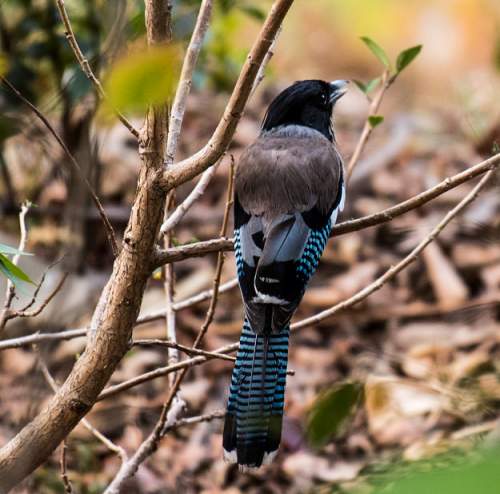
The black-headed jay has a blackish hood and erectable, blackish crest. The upperparts are greyish-pink and the underparts are pale fawn. The wings have dark gray and blue bars. The long, blue tail is barred.

The bill is short, thick and silvery white. The irises are blackish brown. The legs and feet are pale gray. The call of the jay is a unpleasant, grating "skaaaak" sound.
Indian birds - Image of Black-headed jay - Garrulus lanceolatus
1.Birds of India - Image of Black-headed jay - Garrulus lanceolatus by Rakeshkdogra


Birds of India - Image of Black-headed jay - Garrulus lanceolatus
2.Indian birds - Image of Black-headed jay - Garrulus lanceolatus by Dibyendu Ash

Indian birds - Image of Black-headed jay - Garrulus lanceolatus
3.Birds of India - Image of Black-headed jay - Garrulus lanceolatus by Sumita Roy Dutta

Origin, geographical range and distribution

The black-headed jay species are distributed in India, Nepal, Pakistan and Afghanistan. In India, they are distributed in the states of Jammu and Kashmir, Himachal Pradesh, Uttarakhand, Uttar Pradesh and Punjab.

The Important Bird and Biodiversity Area (IBA) of the black-headed jay species in Nepal are Annapurna Conservation Area, Phulchoki Mountain forests, Langtang National Park and Bardia National Park.

Ecosystem and habitat

These black-headed jay species have moderate forest dependence. They normally occur in altitudes from 1,500 to 3,000 meters. The artificial ecosystems and habitats of these species include agricultural lands.

The natural ecosystems and habitats of these species include tropical and subtropical moist montane forests, pine-oak forests and tropical and subtropical high altitude shrublands.

Diet and feeding behavior

The diet of these black-headed jay species consists mainly of invertebrates and seeds. Invertebrates, small vertebrates like lizards, small birds, eggs and hatchlings are their primary food.

These jays feed both on the ground and in trees. The wintering birds feed on seeds, berries and pine seeds. They sometimes get used to picking scrap food from human settlements.

Reproduction and breeding habits

The breeding season of the black-headed jay species is from April to June. These birds are monogamous and territorial. The breeding sites are located in trees and bushes.

They nest is a loose cup, built by both the parents. The clutch contains 4-6 dirty white eggs. Both the parents incubates the eggs and feed the young. The chicks hatch out after 16-19 days and fledge after 21–23 days.

Migration and movement patterns

These black-headed jay species are non-migratory resident birds. The populations in higher elevations may move to lower levels during winter.

Post breeding, the juveniles may disperse and establish in new locations within the range. Within their range they may make local movements for feeding and breeding.

Black-headed jay - Quick Facts

  • Scientific name: Garrulus lanceolatus
  • Species author: Vigors, 1831
  • Synonyms/Protonym: Garrulus lanceolatus Vigors, 1830
  • Family: Corvidae › Passeriformes › Aves › Chordata › Animalia
  • Vernacular names: English: Black-headed jay, Chinese: 黑头松鸦, French: Geai lancéolé, German: Strichelhäher, Spanish: Arrendajo cabecinegro, Russian: Гималайская сойка, Japanese: インドカケス
  • Other names: lanceolated jay, Black-headed Jay
  • Distribution: India, Nepal, Pakistan, Afghanistan
  • Diet and feeding habits: invertebrates, small lizards, bird eggs, nestlings
  • IUCN status listing: Least Concern (LC)

Conservation and survival

The global population size of the black-headed jay (Garrulus lanceolatus) has not been quantified. The overall population trend of the species is considered to be stable.

In most of its range, this species is reported as common. The generation length is 7.5 years. Its distribution size is about 639,000 sq.km.

Habitat alteration, fragmentation and destruction, hunting and capture for pet-trade are the main threats that are endangering the survival of these species.

IUCN and CITES status

The black-headed jay (Garrulus lanceolatus) does not approach the thresholds for being Vulnerable either under the range size criterion, or under the population trend criterion or under the population size criterion.

The IUCN (International Union for Conservation of Nature) has categorized and evaluated the species and has listed it as of "Least Concern".

The CITES (Convention on International Trade in Endangered Species of Wild Fauna and Flora) status is ‘Not Evaluated’ for the black-headed jay (Garrulus lanceolatus).
Taxonomy and scientific classification of Garrulus lanceolatus
Kingdom:Animalia
Phylum:Chordata
Class:Aves
Order:Passeriformes
Family:Corvidae
Subfamily:-
Genus:Garrulus
Species:G. lanceolatus
Binomial name:Garrulus lanceolatus
IUCN status listing:
Least Concern
The black-headed jay (Garrulus lanceolatus) is closely related to Lidth's jay (Garrulus lidthi) and Eurasian jay (Garrulus glandarius).
Popular posts in Bird World
White eared pheasant photos White-cheeked tern
Green imperial-pigeon Short-eared owl
Oriental darter Osprey
Jerdon's baza Collared falconet
Mandarin duck Eastern great egret
Eurasian wigeon Intermediate egret
Falcated duck Baikal teal
Pacific reef heron Eurasian teal
Indian pond heron Andaman teal
Chinese pond heron Mallard
Scarlet-breasted woodpecker Grey-chinned minivet
Isabelline shrike Lesser white-fronted goose
Spot-billed duck Cattle Egret
Striated heron Chinese spot-billed duck
Greater adjutant Northern pintail
Western reef heron Gadwall
White-bellied drongo White-browed fantail
Glossy ibis Greater sand plover
Little egret Garganey
Malayan night heron Northern shoveler
Marbled teal Red-crested pochard
Red-naped ibis Common pochard
Wood sandpiper Greater white-fronted goose
Mountain imperial-pigeon Rufous woodpecker
Ferruginous duck Baer's pochard
Fulvous whistling-duck White stork
Lesser whistling-duck Oriental stork
Greylag goose Lesser adjutant
Red-tailed shrike Nilgiri imperial-pigeon
White-throated fantail Bean goose

1.Image source: https://commons.wikimedia.org/wiki/File:Black-headed-jay-rkd_(cropped).jpg (cropped)
Image author: Rakeshkdogra | License: CC BY-SA 4.0 as on 6/23/18
2.Image source: https://en.wikipedia.org/ (cropped)
Image author: Dibyendu Ash | License: CC BY-SA 3.0 as on 6/23/18
3.Image source: https://en.wikipedia.org/wiki/File:Black-headed_jay_DSCN0166_1.jpg (cropped)
Image author: Sumita Roy Dutta | License: CC BY-SA 1.0 as on 6/23/18
Current topic in Birds of India: Black-headed jay - Garrulus lanceolatus.
Contact State Tourism or travel agents for bird watching and wildlife tours.