The family Campephagidae was first introduced by Nicholas Aylward Vigors (1785 – 26 October 1840), an Irish zoologist and politician, in the year 1825. The Campephagidae consists of five genera, viz., Coracina, Campochaera, Lalage, Campephaga and Pericrocotus.
The genus Lalage was first described by Friedrich Boie (4 June 1789 – 3 March 1870), a German entomologist, herpetologist, ornithologist and lawyer, in the year 1826. The genus Lalage consists of nearly 15 species. They are fairly small birds with mainly black, grey and white plumage.
The species Lalage nigra was first described (as Turdus niger) by Raymond Robert Forster, (19 June 1922 – 1 July 2000), an arachnologist and museum director, in the year 1781. The Lalage nigra is polytypic and has three subspecies, viz., L. n. davisoni, L. n. striga and L. n. nigra.
Taxonomic classification
Binomial name:
Lalage nigra
Species:
L. nigra
Genus:
Lalage
Subfamily:
-
Family:
Campephagidae
Order:
Passeriformes
Class:
Aves
Phylum:
Chordata
Kingdom:
Animalia
1.Pied triller - Lalage nigra 356 Photo by lonelyshrimp
Advertisement
Images
2.Pied triller - Lalage nigra Photo by Lip Kee
3.Pied triller - Lalage nigra Photo by Lip Kee
4.Pied triller - Lalage nigra Photo by ----- ^ _ ^ ------
5.Pied triller - Lalage nigra Photo by Lip Kee
6.Pied triller - Lalage nigra Photo by Francesco Veronesi
1.Photo source: https://www.flickr.com/photos/lonelyshrimp/33153884071/ (cropped)
Author: lonelyshrimp | License: Public domain as on 1/3/18
2.Pied triller photo source: https://www.flickr.com/photos/lipkee/1713452628/ (cropped)
Author: Lip Kee | License: CC BY-SA 2.0 as on 1/3/18
3.Source: https://www.flickr.com/photos/lipkee/457704639/ (cropped)
Author: Lip Kee | License: CC BY-SA 2.0 as on 1/3/18
4.Source: https://www.flickr.com/photos/oespena/14304296576/ (cropped)
Author: ----- ^ _ ^ ------ | License: CC BY 2.0 as on 1/3/18
5.Source: https://www.flickr.com/photos/lipkee/1837956597/ (cropped)
Author: Lip Kee | License: CC BY-SA 2.0 as on 1/3/18
6.Source: https://www.flickr.com/photos/francesco_veronesi/29210267043/ (cropped)
Author: Francesco Veronesi | License: CC BY-SA 2.0 as on 1/3/18
Current topic in Birds of India: Pied triller - Lalage nigra photos.
Contact State Tourism or travel agents for bird watching and wildlife tours.
The pied triller (Lalage nigra) belongs to the family of cuckooshrikes and trillers, the Campephagidae.
The pied triller species is distributed in India, Thailand, Malaysia, Singapore, Brunei, Indonesia and Philippines. In India, these triller species occur only in the Little Andaman Island and the Nicobar Islands. These trillers are polytypic species.
Appearance, physical description and identification
The pied triller (Lalage nigra) is a medium-sized triller, measuring 16 to 18 cm in length and weighing 20 to 30 grams.
The male pied triller has black forehead, crown, nape, mantle and scapulars. The rump and tail are gray. The wings have pied pattern. There is a dark eye-stripe passing through the eyes and extends up to the nape. There is a broad white supercilium.
The underparts are whitish in males. The female is similar, but has pale brown plumage. The females have fine black barring on the underparts.
The bill of the pied triller is pointed and dark gray. The irises are black. The feet are black. Their call is a nasal, chuckling "wheek.. wheek..wheek" sounds.
1.Birds of India - Image of Pied triller - Lalage nigra by Lip Kee
Advertisement
Photos
2.Indian birds - Picture of Pied triller - Lalage nigra by lonelyshrimp
3.Birds of India - Photo of Pied triller - Lalage nigra by Lip Kee
Origin, geographical range and distribution
The pied triller species is distributed in India, Thailand, Malaysia, Singapore, Brunei, Indonesia and Philippines. In India, these species occur only in the Little Andaman Island and the Nicobar Islands.
The pied triller nominate subspecies L. n. nigra is distributed in Borneo (Malaysia, Brunei and Indonesia), Philippines and neighboring islands. The subspecies L. n. davisoni is distributed in the Little Andaman Island and the Nicobar Islands.
The subspecies L. n. striga is distributed in southern Thailand, peninsular Malaysia, Singapore and Indonesia (Sumatra, Nias Island, Bangka Island, Belitung Island, Karimunjava archipelago and Western Java).
Ecosystem and habitat
These pied triller species have moderate forest dependence. They normally occur in altitudes from 0 to 100 meters. The artificial ecosystems and habitats of these species include plantations, agricultural lands, rural gardens and urban parks.
The natural ecosystems and habitats of these triller species include, subtropical and tropical moist lowland forests, subtropical and tropical mangroves, dry shrublands, dry deciduous forests, open woodlands and edge of forests.
Diet and feeding behavior
The diet of the pied triller consists mainly of insects. Lepidopteran caterpillars, grubs and insects like grasshoppers, locust, cicadas, crickets, dragonflies, ants, termites, bugs, moths, mantids and beetles are their primary food.
They also feed on fruits, berries, seeds, nuts and other plant matter. These trillers tend to forage on the lower branches of the trees. They also feed from the ground.
Reproduction and breeding habits
The breeding season of these pied triller species is from February to August in Malay Peninsula. These species breed during the month of May in Nicobar Islands. The laying season is from February to April and June to August in Sumatra.
These triller species are monogamous and territorial. The nesting sites include forked branches of trees 3-4 meters above the ground level. The nest is built with twigs, leaves and strands of creepers.
Both pair of the trillers take part in incubating eggs and rearing nestlings. The clutch usually consists of two to three eggs. The hatchlings are fed with insects. The nestlings produce fecal sacs (feces surrounded by a mucous membrane) and the parents dispose them some distance from the nest.
Migration and movement patterns
These pied triller species are non-migratory resident birds.
Post breeding, the juvenile trillers may disperse and establish in new locations within the range. They may make local movements for feeding and breeding within their range.
Pied triller - Quick Facts
Scientific name: Lalage nigra
Species author: (Forster, 1781)
Synonyms/Protonym: Turdus niger J. R. Forster, 1781
Family: Campephagidae › Passeriformes › Aves › Chordata › Animalia
Distribution: India, Thailand, Malaysia, Singapore, Brunei, Indonesia, Philippines
Diet and feeding habits: insects, insect larvae, caterpillars, fruits, berries
IUCN status listing: Least Concern (LC)
Conservation and survival
The global population size of the pied triller (Lalage nigra) has not been quantified. The overall population trend of the species is considered to be stable.
In most of its range, this species is reported to be common and locally uncommon to rare in certain areas. The generation length is 3.7 years. Its distribution size is about 7,010,000 sq.km.
Habitat alteration and destruction, deforestation and capture for pet-trade are the main threats that are endangering the survival of this triller species.
IUCN and CITES status
The pied triller (Lalage nigra) does not approach the thresholds for being Vulnerable either under the range size criterion, or under the population trend criterion or under the population size criterion.
The IUCN (International Union for Conservation of Nature) has categorized and evaluated the triller species and has listed it as of "Least Concern".
The CITES (Convention on International Trade in Endangered Species of Wild Fauna and Flora) status is ‘Not Evaluated’ for pied triller (Lalage nigra).
Taxonomy and scientific classification of Lalage nigra
Kingdom:
Animalia
Phylum:
Chordata
Class:
Aves
Order:
Passeriformes
Family:
Campephagidae
Subfamily:
-
Genus:
Lalage
Species:
L. nigra
Binomial name:
Lalage nigra
IUCN status listing:
Least Concern
The pied triller (Lalage nigra) is closely related to white-rumped triller (Lalage leucopygialis) and white-shouldered triller (Lalage sueurii).
The three recognized subspecies of pied triller (Lalage nigra) are: Lalage nigra nigra (J. R. Forster, 1781), Lalage nigra davisoni Kloss, 1926 and Lalage nigra striga (Horsfield, 1821).
1.Pied triller photo source: https://www.flickr.com/photos/lipkee/1713452628/ (cropped)
Photo author: Lip Kee | License: CC BY-SA 2.0 as on 1/3/18
2.Photo source: https://www.flickr.com/photos/lonelyshrimp/33153884071/ (cropped)
Photo author: lonelyshrimp | License: Public domain as on 1/3/18
3.Photo source: https://www.flickr.com/photos/lipkee/457704639/ (cropped)
Photo author: Lip Kee | License: CC BY-SA 2.0 as on 1/3/18
Current topic in Birds of India: Pied triller - Lalage nigra.
Contact State Tourism or travel agents for bird watching and wildlife tours.
The black-headed cuckooshrike (Lalage melanoptera) belongs to the family of cuckooshrikes, the Campephagidae.
The black-headed cuckooshrike species is distributed in India, Bangladesh, Myanmar, Sri Lanka, Nepal and Bhutan. These cuckooshrike species are partially migratory birds. These cuckooshrikes are polytypic species.
Appearance, physical description and identification
The black-headed cuckooshrike (Lalage melanoptera) is a medium-sized cuckooshrike, measuring 18 to 20 cm in length and weighing 25 to 35 grams. These species have sexually dimorphic plumage.
The adult male black-headed cuckooshrike has a dark slaty-gray head. The neck, throat and the upper chest are slaty gray. The rest of the upperparts and underparts are pale gray. The plumage is whitish towards the tail.
The female black-headed cuckooshrike has pale gray upper parts and whitish underparts. There is dark gray streaking on breast and underparts giving a scaly appearance.
The bill is dark gray. The irises are dark brown. The feet are pale gray. The cuckooshrike call is a repeated "twet..twet" or "wee..wee" sound.
1.Birds of India - Image of Black-headed cuckooshrike - Lalage melanoptera by Dr. Raju Kasambe
Advertisement
Images
2.Indian birds - Picture of Black-headed cuckooshrike - Lalage melanoptera by Sudhir Naik
3.Birds of India - Photo of Black-headed cuckooshrike - Lalage melanoptera by Pramuita
Origin, geographical range and distribution
The black-headed cuckooshrike species are distributed in India, Bangladesh, Myanmar, Sri Lanka, Nepal and Bhutan. The nominate subspecies L. m. melanoptera is distributed in northwest India (Himachal Pradesh, Uttar Pradesh, Uttarakhand).
The black-headed cuckooshrike subspecies L. m. sykesi is distributed in south Nepal, India (Rajasthan, Gujarat, Madhya Pradesh, Telangana, Chhattisgarh, Maharashtra), and Sri Lanka. Non-breeding populations are found in south Bangladesh and west and northwest Myanmar.
The Important Bird and Biodiversity Areas (IBA) of the black-headed cuckooshrike species in Nepal are Bardia National Park, Koshi Tappu Wildlife Reserve, Koshi Barrage, Barandabhar forests and wetlands, Dang Deukhuri foothill forests and west Rapti wetlands.
Ecosystem and habitat
These black-headed cuckooshrike species have moderate forest dependence. They normally occur in altitudes from 0 to 2000 meters. The artificial ecosystems and habitats of these cuckooshrike species include rural gardens, plantations, orchards and urban parks.
The natural ecosystems and habitats of these black-headed cuckooshrike species include, tropical and subtropical moist lowland forests, bamboo forests, tropical and subtropical moist montane forests, scrub jungles, moist shrublands and open forests.
Diet and feeding behavior
The diet of these black-headed cuckooshrikes consists mainly of insects. Caterpillars, insects, beetles, grasshoppers, cicadas, moths, butterflies and crickets are their primary food. They occasionally feed on fruits, berries and figs.
These black-headed cuckooshrike species hunt insect prey in the forests. They may form feeding flocks with other small birds. The cuckooshrikes hawk airborne insects and also glean their prey from the foliage and branches of trees.
Reproduction and breeding habits
The breeding season of the black-headed cuckooshrike species is from June to September in Nepal and north India. In central India the breeding season is from June to August. The laying season is during April-May in south India and from March and May in Sri Lanka.
The nest of the the black-headed cuckooshrike is a small cup-like structure, made of twigs, rootlets and plant fibers, and bound by cobwebs. The nest is constructed 3-8 meters above the ground. Both parents take part in building the nest on tree branches.
The clutch contains two or three eggs. The breeding pair take turns to incubate the eggs. The parents brood the chicks and keep feeding them till they fledge.
Migration and movement patterns
These black-headed cuckooshrike species are partially migratory birds. Breeding migratory populations are found in central India, north India, Nepal, northeast India and adjoining Myanmar. They migrate to coastal Bangladesh and north coastal Myanmar for wintering.
Resident non-migratory populations of black-headed cuckooshrike are distributed in Sri Lanka and the south Indian states of Telangana, Maharashtra, Goa, Karnataka, Andhra Pradesh, Tamil Nadu and Kerala.
Post breeding, the juvenile cuckooshrikes may disperse and establish in new locations within the range. They may make local movements for feeding and breeding within their range.
The global population size of the black-headed cuckooshrike (Lalage melanoptera) has not been quantified. The overall population trend of the species is considered to be stable.
Throughout its range, this species is reported to be scarce to locally common. The generation length is 4.6 years. Its distribution size is about 4,230,000 sq.km.
Habitat alteration and destruction, excessive use of pesticides and decrease in insect populations are the main threats that are endangering the survival of this cuckooshrike species.
IUCN and CITES status
The black-headed cuckooshrike (Lalage melanoptera) does not approach the thresholds for being Vulnerable either under the range size criterion, or under the population trend criterion or under the population size criterion.
The IUCN (International Union for Conservation of Nature) has categorized and evaluated the species and has listed it as of "Least Concern".
The CITES (Convention on International Trade in Endangered Species of Wild Fauna and Flora) status is ‘Not Evaluated’ for black-headed cuckooshrike (Lalage melanoptera).
Taxonomy and scientific classification of Lalage melanoptera
Kingdom:
Animalia
Phylum:
Chordata
Class:
Aves
Order:
Passeriformes
Family:
Campephagidae
Subfamily:
-
Genus:
Lalage
Species:
L. melanoptera
Binomial name:
Lalage melanoptera
IUCN status listing:
Least Concern
The black-headed cuckooshrike (Lalage melanoptera) is closely related to black-winged cuckooshrike (Lalage melaschistos) and lesser cuckooshrike (Lalage fimbriata).
The two recognized subspecies of Lalage melanoptera are: Lalage melanoptera melanoptera (Rüppell, 1839) and Lalage melanoptera sykesi Strickland, 1844.
The family Campephagidae was first introduced by Nicholas Aylward Vigors (1785 – 26 October 1840), an Irish zoologist and politician, in the year 1825.
The family Campephagidae comprises six genera, viz., Coracina, Campochaera, Lalage, Campephaga, Pericrocotus and Lobotos.
The genus Lalage was first described by Friedrich Boie (4 June 1789 – 3 March 1870), a German entomologist, herpetologist and ornithologist, in the year 1826.
The species Lalage melaschistos (as Volvocivora melaschistos) was first described by Brian Houghton Hodgson (1 February 1800 – 23 May 1894), a naturalist and ethnologist, in the year 1836.
This species is polytypic and comprises four subspecies, namely, Lalage melaschistos melaschistos, Lalage melaschistos intermedia, Lalage melaschistos avensis and Lalage melaschistos saturata.
Taxonomic classification
Binomial name:
Lalage melaschistos
Species:
L. melaschistos
Genus:
Lalage
Subfamily:
-
Family:
Campephagidae
Order:
Passeriformes
Class:
Aves
Phylum:
Chordata
Kingdom:
Animalia
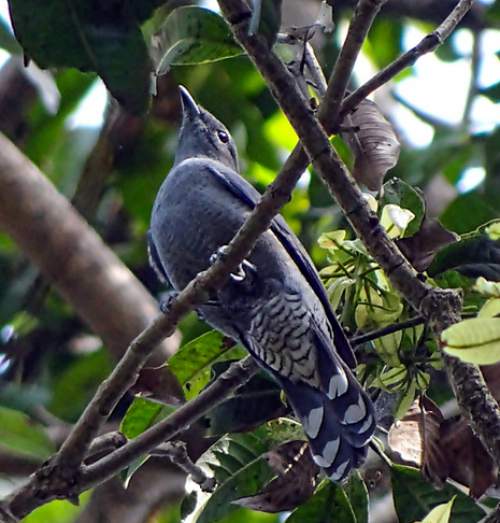
1.Black-winged Cuckooshrike - Lalage melaschistos 277 Photo by Jason Thompson
Advertisement
Photos
2.Black-winged Cuckooshrike - Lalage melaschistos Photo by Nabarunsadhya
3.Black-winged Cuckooshrike - Lalage melaschistos Photo by Jason Thompson
4.Black-winged Cuckooshrike - Lalage melaschistos Photo by Dr. Raju Kasambe
5.Black-winged Cuckooshrike - Lalage melaschistos Photo by nbu2012
6.Black-winged Cuckooshrike - Lalage melaschistos Photo by 孫鋒 林
The black-winged cuckooshrike (Lalage melaschistos) belongs to the family of trillers, minivets and cuckooshrikes, Campephagidae.
The black-winged cuckooshrike species is distributed in India, Pakistan, Nepal, Bhutan, Bangladesh, southeast Asia, China and Japan. This cuckooshrike species is unrelated to shrikes or cuckoos. These cuckooshrikes are polytypic species.
Appearance, physical description and identification
The black-winged cuckooshrike (Lalage melaschistos) is a medium-sized cuckooshrike, measuring 20 to 25 cm in length and weighing 35 to 40 grams. It has gray and white plumage.
The adult black-winged cuckooshrike has slaty gray upperparts and underparts. The wings and the tail are blackish. The vent region is white. The female is slightly lighter in color with light barring on the underparts. The undertail appears graduated and has white feather tips.
The black-winged cuckooshrike bill is blackish gray and slightly curved. The irises are blackish. There are two small white crescent shaped patches located above and below the eye-ring. The legs are blackish gray.
The black-winged cuckooshrike call is a high-pitched, descending, slurred whistles and loud "twit..twit" sound.
1.Birds of India - Image of Black-winged Cuckooshrike - Lalage melaschistos by Nabarunsadhya
Advertisement
Photos
2.Indian birds - Picture of Black-winged Cuckooshrike - Lalage melaschistos by Jason Thompson
3.Birds of India - Photo of Black-winged Cuckooshrike - Lalage melaschistos by Jason Thompson
Origin, geographical range and distribution
The black-winged cuckooshrike species are distributed in India, Bhutan, Bangladesh, Nepal, Pakistan, China, Taiwan, Japan, Myanmar, Thailand, Cambodia, Laos and Vietnam.
In India, these black-winged cuckooshrikes are distributed in the states of Jammu and Kashmir, Haryana, Punjab, Himachal Pradesh, Uttarakhand, Uttar Pradesh, Bihar, West Bengal, Odisha, Jharkhand, Chhattisgarh, Madhya Pradesh, Rajasthan, Gujarat, Maharashtra, Assam, Meghalaya, Arunachal Pradesh, Nagaland, Manipur, Tripura and Mizoram.
The black-winged cuckooshrike nominate subspecies L. m. melaschistos is distributed in northern Pakistan, Himalayan states of north and northwest India, north of northeast India, southern China and northwest Myanmar. Non breeding populations occur in northeast India, Bangladesh and northwest Thailand.
The black-winged cuckooshrike subspecies L. m. intermedia is distributed in central, east and southeast China. Non-breeding populations occur in southern Myanmar, southern Thailand, southern Vietnam, southern China and Taiwan.
The black-winged cuckooshrike subspecies L. m. avensis is distributed in southwest China, south Myanmar, north Thailand, northern Laos and north and central Vietnam. Non-breeding populations of these subspecies are found in southern Myanmar, southern Thailand and southern Vietnam and Cambodia.
The black-winged cuckooshrike subspecies L. m. saturata is distributed in northeast and central Vietnam and south China (Hainan). Non-breeding populations of L. m. saturata occur in west Thailand, southern Laos, Cambodia and central Vietnam.
The Important Bird and Biodiversity Areas (IBA) of the black-winged cuckooshrike in Cambodia are Snoul, Keo Sema and O Reang. Some of the IBA in Nepal are Bardia National Park, Chitwan National Park, Khaptad National Park, Langtang National Park and Mai Valley forests.
Ecosystem and habitat
These black-winged cuckooshrike species have moderate forest dependence. They normally occur in altitudes from 0 to 2500 meters. The artificial ecosystems and habitats of these species include rural gardens, cultivated lands and plantations.
The natural ecosystems and habitats of these cuckooshrike species include tropical and subtropical moist montane forests, moist shrublands, broad-leaved forests, secondary forests and tropical and subtropical moist lowland forests.
Diet and feeding behavior
The diet of black-winged cuckooshrike consists mainly of insects. Insects, caterpillars, beetles, grasshoppers, cicadas, moths, butterflies and crickets are their primary food. They occasionally feed on fruits.
These black-winged cuckooshrike species hunt insect prey in the forests. They form feeding flocks with other small birds. The cuckooshrikes hawk airborne insects and also glean their prey from the foliage and branches of trees.
Reproduction and breeding habits
The breeding season of the black-winged cuckooshrike species is from April to July in most of their breeding range. These birds are monogamous and highly territorial.
The nest of the the black-winged cuckooshrike is a small cup-like structure, made of twigs, rootlets and plant fibers, which are bound by cobwebs. The nest is constructed 3-8 meters above the ground. Both parents take part in building the nest on tree branches.
The cuckooshrike clutch is two or three eggs. The breeding pair take turns to incubate the eggs. The parents brood the chicks and keep feeding them till they fledge.
Migration and movement patterns
These black-winged cuckooshrike species are partially migratory birds. The breeding populations in higher altitudes move to lower levels and plains during winter.
The breeding populations in China and northern Vietnam are migratory and migrate southwards to Taiwan, central and east India, Bangladesh, southern Myanmar, southern Thailand, southern Vietnam and Cambodia for wintering.
Post breeding, the juveniles of the resident black-winged cuckooshrikes may disperse and establish in new locations within the range. They may make local movements for feeding and breeding within their range.
The global population size of the black-winged cuckooshrike (Lalage melaschistos) has not been quantified. The overall population trend of the species is considered to be stable.
Throughout its range, the cuckooshrike species is reported to be very rare to locally common. The generation length is 4.6 years. Its distribution size is about 8,370,000 sq.km.
Habitat alteration and destruction, deforestation and trapping for pet-trade are the main threats that may endanger the survival of this cuckooshrike species.
IUCN and CITES status
The black-winged cuckooshrike (Lalage melaschistos) does not approach the thresholds for being Vulnerable either under the range size criterion, or under the population trend criterion or under the population size criterion.
The IUCN (International Union for Conservation of Nature) has categorized and evaluated the cuckooshrike species and has listed it as of "Least Concern".
The CITES (Convention on International Trade in Endangered Species of Wild Fauna and Flora) status is ‘Not Evaluated’ for black-winged cuckooshrike (Lalage melaschistos).
Taxonomy and scientific classification of Lalage melaschistos
Kingdom:
Animalia
Phylum:
Chordata
Class:
Aves
Order:
Passeriformes
Family:
Campephagidae
Subfamily:
-
Genus:
Lalage
Species:
L. melaschistos
Binomial name:
Lalage melaschistos
IUCN status listing:
Least Concern
The black-winged cuckooshrike (Lalage melaschistos) is closely related to lesser cuckooshrike (Lalage fimbriata) and black-headed cuckooshrike (Lalage melanoptera).
The four recognized subspecies of the black-winged cuckooshrike (Lalage melaschistos) are: Lalage melaschistos melaschistos (Hodgson, 1836), Lalage melaschistos intermedia (A. O. Hume, 1877), Lalage melaschistos avensis (Blyth, 1852) and Lalage melaschistos saturata (Swinhoe, 1870).
1.Photo source: https://en.wikipedia.org/wiki/File:Black-winged_Cuckooshrike_female_Nabarun_Sadhya.jpg (cropped)
Photo author: Nabarunsadhya | License: CC BY-SA 3.0
2.Photo source: http://www.flickr.com/photos/79492850@N00/8473963482 (cropped)
Photo author: Jason Thompson | License: CC BY 2.0
3.Photo source: https://www.flickr.com/photos/79492850@N00/8470531530 (cropped)
Photo author: Jason Thompson | License: CC BY 2.0
Current topic in Birds of India: Black-winged Cuckooshrike - Lalage melaschistos.
Contact State Tourism or travel agents for bird watching and wildlife tours.