Indian birds ›
Isabelline shrike images ›
Black-naped oriole - Oriolus chinensis
The black-naped oriole (
Oriolus chinensis) belongs to the family of Old World orioles, the Oriolidae.
The black-naped oriole species is distributed in India, Bangladesh, southeast Asia, china, Russia, Taiwan, Japan, North Korea and South Korea. These oriole species are partially migratory. These orioles are polytypic species.
Appearance, physical description and identification
The black-naped oriole (
Oriolus chinensis) is a medium-sized oriole, measuring 25 to 30 cm in length and weighing 60 to 100 grams.
The adult black-naped oriole has bright golden-yellow head, upperparts and underparts. The wings have varying levels of blackness among the subspecies. There is a broad blackish band from the lores, passing through the eyes to meet at the nape.
The uppertail is blackish with yellow edges. The undertail is golden yellow. The juveniles have dull yellow plumage. In juveniles, the eye band is diffuse and the underparts have dark streaks.
The bill is stout, long and pinkish. The upper mandible is blackish in juveniles. The irises are red. The legs and feet are gray. The call of these species is a loud fluty whistling sound.
 |
| 1.Birds of India - Photo of Black-naped oriole - Oriolus chinensis by Lip Kee |
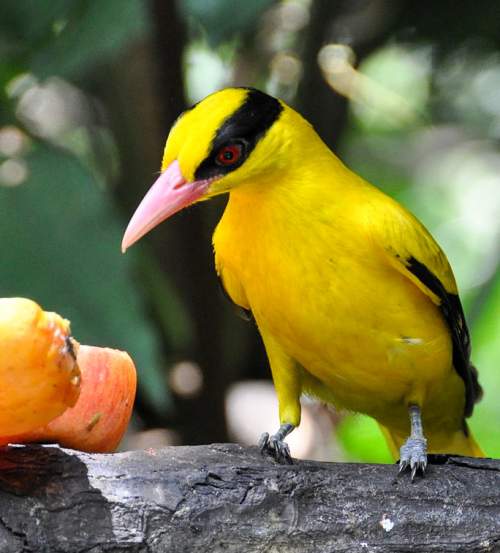 |
| 2.Indian birds - Photo of Black-naped oriole - Oriolus chinensis by Michael Gwyther-Jones |
 |
| 3.Birds of India - Photo of Black-naped oriole - Oriolus chinensis by Peter Gronemann |
Origin, geographical range and distribution
These black-naped oriole species are distributed in Russia, China, North Korea, South Korea, Taiwan, India, Bangladesh, Myanmar, Thailand, Cambodia, Laos, Vietnam, Malaysia, Singapore, Brunei, Indonesia and Philippines.
In India, wintering black-naped oriole species are distributed in the states of Gujarat, Madhya Pradesh, Maharashtra, Karnataka, Goa, Kerala, Tamil Nadu, Andhra Pradesh, Odisha, Jharkhand, West Bengal, Assam, Meghalaya, Nagaland, Manipur and Tripura.
The black-naped oriole nominate subspecies
O. c. chinensis is distributed in Philippines. The subspecies
O. c. diffusus is migratory and occurs in China, Russia, North Korea, South Korea and northern parts of Myanmar, Laos and Vietnam.
The oriole subspecies
O. c. andamanensis is endemic to the Andaman Islands. The subspecies
O. c. macrourus is endemic to the Nicobar Islands. The subspecies
O. c. melanisticus is distributed in the Talaud Islands of Philippines.
Ecosystem and habitat
These black-naped oriole species have moderate forest dependence. They normally occur in altitudes from 0 to 2000 meters. The artificial ecosystems and habitats of these species include urban areas, plantations and rural gardens.
The natural ecosystems and habitats of these black-naped oriole species include tropical and subtropical mangrove forests, evergreen forests, tropical and subtropical moist lowland forests, deciduous forests and moist montane forests.
Diet and feeding behavior
The diet of these black-naped oriole species consists mainly of fruits. Wild fruits, orchard fruits, berries and figs are their primary food. They are known to take nectar from large flowers of Salmalia and Erythrina species.
They feed from the canopy and rarely come to the ground. They also glean insects from the branches and foliage.
Reproduction and breeding habits
The breeding season of these black-naped oriole species is during May and June in Russia. The laying season is during June and July in China. The breeding season is from April to June in Andaman Islands.
These oriole species are monogamous and highly territorial. The nest is usually built in a fork of a tree. The deep cup-shaped nest is mostly built by the female.
The oriole clutch contains two or three pale pink eggs with red and dark blotches. The female oriole incubates the eggs. The chicks hatch out after 14 to 16 days and fledge after fifteen days.
Migration and movement patterns
These black-naped oriole species are partially migratory birds. The breeding populations of the subspecies
O. c. diffusus occur in China, Russia, North Korea, South Korea and northern parts of Myanmar, Laos and Vietnam.
These oriole species migrate southwards in September-October to India, Bangladesh, Cambodia, Thailand and southern parts of Myanmar, Laos and Vietnam. The return migration to the breeding grounds occurs in early summer.
There are resident populations of these black-naped orioles in Andaman and Nicobar Islands of India (
O. c. andamanensis and
O. c. macrourus), Malaysia, Singapore, Indonesia, Philippines, Taiwan, west central Myanmar and Hainan (China).
Black-naped oriole - Quick Facts
-
Scientific name: Oriolus chinensis
-
Species author: Linnaeus, 1766
-
Synonyms/Protonym: Oriolus chinensis Linnaeus, 1766
-
Family: Oriolidae › Passeriformes › Aves › Chordata › Animalia
-
Vernacular names: English: Black-naped oriole, Chinese: 黑枕黄鹂, French: Loriot de Chine, German: Schwarznackenpirol, Spanish: Oropéndola china, Russian: Китайская иволга, Japanese: コウライウグイス, Malay: Burung Dendang Selayang
-
Other names: Black-naped Oriole
-
Distribution: India, Bangladesh, southeast Asia, China, Taiwan, North Korea, South Korea, Japan, Russia
-
Diet and feeding habits: fruits, berries, figs
-
IUCN status listing: Least Concern (LC)
Conservation and survival
The global population size of the black-naped oriole (
Oriolus chinensis) has not been quantified. The overall population trend of the species is not known.
In most of its range, this species is reported to be common (Kennedy et al. 2,000). The generation length is 3.7 years. Its distribution size is about 21,100,000 sq.km.
Habitat alteration and destruction, deforestation and human intrusions and disturbance are the main threats that are endangering the survival of these oriole species.
IUCN and CITES status
The black-naped oriole (
Oriolus chinensis) does not approach the thresholds for being Vulnerable, either under the range size criterion, or under the population trend criterion or under the population size criterion.
The IUCN (International Union for Conservation of Nature) has categorized and evaluated the oriole species and has listed it as of "Least Concern".
The CITES (Convention on International Trade in Endangered Species of Wild Fauna and Flora) status is ‘Not Evaluated’ for the black-naped oriole (
Oriolus chinensis).
|
Taxonomy and scientific classification of Oriolus chinensis |
|---|
|
Kingdom: | Animalia |
|
Phylum: | Chordata |
|
Class: | Aves |
|
Order: | Passeriformes |
|
Family: | Oriolidae |
|
Subfamily: | - |
|
Genus: | Oriolus |
|
Species: | O. chinensis |
|
Binomial name: | Oriolus chinensis |
|
IUCN status listing: |

Least Concern
|
The black-naped oriole (
Oriolus chinensis) is closely related to slender-billed oriole (
Oriolus tenuirostris).
The twenty recognized subspecies of the black-naped oriole are:
O. c. chinensis Linnaeus, 1766 (Philippine black-naped oriole),
O. c. diffusus Sharpe, 1877 (Eastern black-naped oriole),
O. c. broderipi Bonaparte, 1850,
O. c. andamanensis Beavan, 1867
O. c. boneratensis A. B. Meyer & Wiglesworth, 1896,
O. c. macrourus Blyth, 1846,
O. c. frontalis Wallace, 1863 (Sulawesi black-naped oriole),
O. c. maculatus Vieillot, 1817,
O. c. stresemanni Neumann, 1939,
O. c. mundus Richmond, 1903,
O. c. celebensis (Walden, 1872),
O. c. richmondi Oberholser, 1912,
O. c. formosus Cabanis, 1872,
O. c. sipora Chasen & Kloss, 1926,
O. c. sangirensis A. B. Meyer & Wiglesworth, 1898,
O. c. lamprochryseus Oberholser, 1917,
O. c. melanisticus A. B. Meyer & Wiglesworth, 1894,
O. c. insularis Vorderman, 1893,
O. c. suluensis Sharpe, 1877 and
O. c. yamamurae Nagamichi Kuroda, 1927.
1.Black-naped oriole photo source: https://www.flickr.com/photos/lipkee/2129980801/ (cropped)
Photo author: Lip Kee | License:
CC BY-SA 2.0 as on 5/11/18
2.Photo source: https://www.flickr.com/photos/12587661@N06/7018843783/ (cropped)
Photo author: Michael Gwyther-Jones | License:
CC BY 2.0 as on 5/11/18
3.Photo source: https://www.flickr.com/photos/39463459@N08/6789344238/ (cropped)
Photo author: Peter Gronemann | License:
CC BY 2.0 as on 5/11/18
Current topic in Birds of India: Black-naped oriole -
Oriolus chinensis.


