Indian birds ›
Northern lapwing photos ›
Pintail snipe - Gallinago stenura
The pintail snipe (
Gallinago stenura) belongs to the family of sandpipers, curlew and snipes, Scolopacidae.
The pintail snipe species are distributed in north and northeast Russia, Mongolia, Indian subcontinent, southeast Asia and southeast China. These snipe species breed in Arctic and boreal wetlands. These snipes are monotypic species.
Pintail snipe - Overview
-
Scientific name: Gallinago stenura
-
Species author: (Bonaparte, 1831)
-
Synonyms/Protonym: Scolopax stenura Bonaparte, 1831
-
Family: Scolopacidae › Charadriiformes › Aves › Chordata › Animalia
-
Vernacular names: English: Pintail snipe, Chinese: 针尾沙锥, French: Bécassine à queue pointue, German: Spießbekassine, Spanish: Agachadiza colirrara, Russian: Азиатский бекас, Japanese: ハリオシギ, Indonesian: Berkik Ekorlidi
-
Other names: Pin-tailed Snipe, Asiatic Snipe
-
Distribution: north and northeast Russia, Mongolia, Indian subcontinent, southeast Asia, southeast China
-
Diet and feeding habits: molluscs, adult and larval insects, earthworms, crustaceans, seeds and other plant matter
-
IUCN status listing: Least Concern (LC)
Appearance, physical description and identification
The pintail snipe (
Gallinago stenura) is a medium-sized snipe, measuring 25 to 27 cm in length and weighing 80 to 180 grams. The wingspan is 45 to 50 cm.
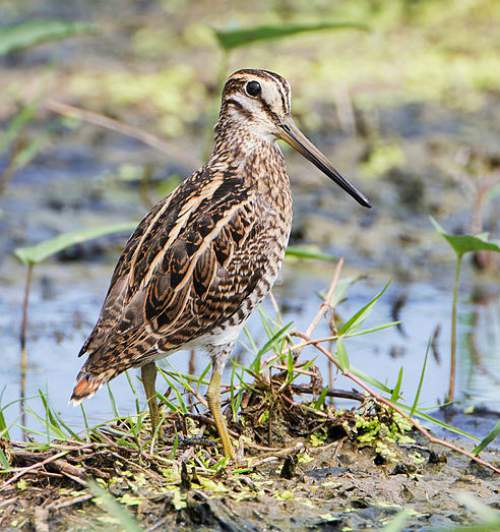
The pintail snipe species have brownish plumage. There is a buff central crown stripe and a brown eye stripe. The buff supercilium is broader than the crown and eye stripes. There is a pale buff stripe below the eye.
The upperparts are brown with blackish median stripe. Fine pale buff longitudinal stripes are present from mantle to rump. The underparts are whitish and finely barred. There are blackish brown bars on the flanks.
The primaries in pintail snipe are slightly longer than the tertials and the tail projects slightly beyond the folded wings. There is a broad rufous subterminal tail band. The underwing shows white barred wing coverts and blackish gray flight feathers.
The tail of pintail snipe has 24-28 feathers, of which 6-9 outer pairs are pin-shaped. The pin-shaped feature is rarely visible in the field conditions. If preening, this unique feature may be noticed. In flight, the toes project beyond the tail-tip.
The legs are grayish or yellowish green. The bill is of medium-length and is brown with dark tip. The lower mandible is yellowish brown at the base. The irises are blackish brown. The pintail snipe call is a hoarse squeaky "chek" sound when flushed.
 |
| 1.Birds of India - Image of Pintail snipe - Gallinago stenura by Don Miller |
 |
| 2.Indian birds - Picture of Pintail snipe - Gallinago stenura by Jason Thompson |
 |
| 3.Birds of India - Photo of Pintail snipe - Gallinago stenura by JJ Harrison |
Origin, geographical range and distribution
The pintail snipe species are distributed in Asia. Vagrant birds have been observed in Australia (mainland, Christmas Island), Africa (Tunisia, Somalia, Seychelles, Kenya, Comoros) and United States of America (USA, Northern Mariana Islands).
The breeding populations of pintail snipe species are distributed in Russia, Mongolia, eastern Kazakhstan and northwest China.
"The pintail snipe breeds widely across Siberia, from the western foothills of the Urals east to Anadyrland and the Sea of Okhotsk, north to the
southern Yamal Peninsula and about 71 ° on the Lena, south to the region of Tomsk and northwestern Manchuria." [
Ref]
The wintering pintail snipe populations are found in India, Sri Lanka, Maldives, Bangladesh, Andaman and Nicobar Islands (India), Myanmar, Thailand, Cambodia, Laos, Vietnam, Malaysia, Singapore, Brunei, Indonesia, Philippines, Timor Island, southeast China and Taiwan.
In India, these pintail snipe species are distributed in all the states, except Jammu and Kashmir, Punjab, Himachal Pradesh, Uttarakhand, Sikkim and Arunachal Pradesh.
The Important Bird and Biodiversity Areas (IBA) of the pintail snipe species in Russia are Kurkure mountain, Dzhulukul' depression, Nevskoye lake, Sayanski canyon of the Enisey river and Dvuob'ye.
Ecosystem and habitat
These pintail snipe species have low forest dependence. These species occur in altitudes from 0 to 2500 meters.
The artificial ecosystems of these snipe species include agricultural lands, pasture lands, irrigated lands and seasonally flooded fields.
The natural ecosystems of these pintail snipe species include boreal forests, temperate grasslands, temperate shrublands, tundra grasslands, boreal shrublands, Arctic and boreal wetlands, tropical and subtropical flooded grasslands, marshes, swamps and peatlands.
Diet and feeding behavior
The diet of the pintail snipe is mostly small invertebrates. Earthworms, insects and insect larvae, molluscs, crustaceans, seeds and other plant material are their primary food.
These birds have long sensitive bills allowing them to feel and probe the mud, soft soil and slush and pick up food. They normally forage on the muddy shorelines of swamps and along streams.
Reproduction and breeding habits
The breeding season of these pintail snipe species in most of its range is from May and August. These birds are mostly seasonally monogamous. The males display in groups. They make sounds by the vibration of the outer tail feathers.
These species breed in Arctic and boreal wetlands, even up to 2,300 meters above sea-level. The nesting sites include damp meadows, grassy swamps, mossy swamps, swamps in taiga forests, peat moss bogs and tundra with dwarf birch shrub patches.
The pintail snipe nest is a shallow ground scrape well concealed in dense cover. The typical clutch contains 3-4 eggs. Both the parents incubate the eggs for about three weeks. The hatchlings are lead by the parents for foraging.
Migration and movement patterns
The pintail snipe species are fully migrant birds.
The breeding populations of the pintail snipe are found in damp marshes, swampy taiga forest and tundra in Arctic and boreal Russia and Mongolia.
They migrate to their wintering grounds in India, Bangladesh, Sri Lanka, Nepal, southeast Asian countries, Taiwan and southeast China.
The snipes return to their breeding grounds from March to May. Some of the snipe populations may overwinters in small groups.
Conservation and survival
The global population size of the pintail snipe (
Gallinago stenura) is estimated to number 50,000 to 2,000,000 individual birds. The overall population trend of these snipe species is reported to be fluctuating.
Throughout its range this species is reported to be locally common to rare. The generation length is 4.8 years. Its distribution size is about 12,900,000 sq.km.
Sport-hunting, hunting for food, wetland drainage, pollution and predation are the main threats that may endanger the survival of these snipe species.
IUCN and CITES status
The pintail snipe (
Gallinago stenura) does not approach the thresholds for being Vulnerable, either under the range size criterion, or under the population trend criterion or under the population size criterion.
The IUCN (International Union for Conservation of Nature) has categorized and evaluated the species and has listed it as of "Least Concern". The CITES (Convention on International Trade in Endangered Species of Wild Fauna and Flora) status is ‘Not Evaluated’ for pintail snipe (
Gallinago stenura).
|
Taxonomy and scientific classification of Gallinago stenura |
|---|
|
Kingdom: | Animalia |
|
Phylum: | Chordata |
|
Class: | Aves |
|
Order: | Charadriiformes |
|
Family: | Scolopacidae |
|
Subfamily: | - |
|
Genus: | Gallinago |
|
Species: | G. stenura |
|
Binomial name: | Gallinago stenura |
|
IUCN status listing: |

Least Concern
|
The pintail snipe (
Gallinago stenura) is closely related to Latham's snipe (
Gallinago hardwickii) and Swinhoe's snipe (
Gallinago megala).
1.Pintail snipe image source: https://www.flickr.com/photos/donmillertogo/31281663753/ (cropped)
Image author: Don Miller | License:
CC BY 2.0 as on 6/28/17
2.Image source: https://commons.wikimedia.org/wiki/File:Pintail_Snipe.jpg (cropped)
Image author: Jason Thompson | License:
CC BY 2.0 as on 6/28/17
3.Image source: https://en.wikipedia.org/wiki/File:Gallinago_stenura_-_Laem_Pak_Bia.jpg (cropped)
Image author: JJ Harrison | License:
CC BY 3.0
Current topic in Birds of India: Pintail snipe -
Gallinago stenura.