Showing posts with label Parulidae. Show all posts

Black-and-white warbler images

   ›      ›   Black-and-white warbler (Mniotilta varia) images
Taxonomic classification   < >   Images

The black-and-white warbler (Mniotilta varia) belongs to the family Parulidae under the order Passeriformes.

Black-and-white warbler taxonomy

The Parulidae is the family of New World warblers.

The family Parulidae was first introduced by Frank Alexander Wetmore (June 18, 1886 – December 7, 1978), an American ornithologist and avian paleontologist, and his team in the year 1947.

The warbler family Parulidae comprises seventeen genera, including Mniotilta. The genus Mniotilta is monotypic and comprises one species, Mniotilta varia.

The genus Mniotilta was first described by Louis Pierre Vieillot (May 10, 1748 – August 24, 1830), a French ornithologist, in the year 1816.

The species Mniotilta varia was first described (as Motacilla varia) by Carl Linnaeus (23 May 1707 – 10 January 1778), a Swedish botanist, physician and zoologist, in the year 1766.

The species Mniotilta varia is monotypic; it is however known to hybridize with cerulean warbler (Setophaga cerulea), the Blackburnian Warbler (Setophaga fusca) and the black-throated green warbler (Setophaga virens).

Taxonomic classification
Binomial name:Mniotilta varia
Species:M. varia
Genus:Mniotilta
Subfamily:-
Family:Parulidae
Order:Passeriformes
Class:Aves
Phylum:Chordata
Kingdom:Animalia
Black-and-white warbler - Mniotilta varia
1.Black-and-white warbler - Mniotilta varia
Image by William H. Majoros


Mniotilta varia
2.Black-and-white warbler - Mniotilta varia
Picture by Wolfgang Wander

Mniotilta varia
3.Black-and-white warbler - Mniotilta varia
Photos by William H. Majoros

Mniotilta varia
4.Black-and-white warbler - Mniotilta varia
Image by William H. Majoros

Mniotilta varia
5.Black-and-white warbler - Mniotilta varia
Image by William H. Majoros

Mniotilta varia
6.Black-and-white warbler - Mniotilta varia
Image by William H. Majoros

Mniotilta varia
7.Mniotilta varia
Image by TonyCastro

Mniotilta varia
8.Mniotilta varia
Image by Mike & Chris

Mniotilta varia
9.Mniotilta varia
Image by Andy Reago & Chrissy McClarren
Popular posts in Bird World
Ashy wood pigeon Red-breasted parakeet
Himalayan cuckoo Eurasian eagle-owl
Jerdon's nightjar Silver-backed needletail
Brown-winged kingfisher Blue-cheeked bee-eater
Indian grey hornbill Long-tailed jaeger
Himalayan swiftlet Nilgiri wood pigeon
Lord Derby's parakeet Lesser cuckoo
Rock eagle-owl Indian nightjar
Brown-backed needletail Stork-billed kingfisher
Blue-tailed bee-eater Malabar pied hornbill

1.Source: https://en.wikipedia.org/wiki/File:Black-and-white-warbler-1.jpg (cropped)
Author: William H. Majoros | License: CC BY-SA 3.0 as on 1/9/19
2.Source: http://www.pbase.com/wwcsig/image/50151128 (cropped)
Author: Wolfgang Wander | License: CC BY-SA 3.0 and GFDL 1.2 as on 1/9/19
3.Source: https://commons.wikimedia.org/wiki/File:8G7D2762.jpg (cropped)
Author: William H. Majoros | License: CC BY-SA 3.0 as on 1/9/19
4.Source: https://commons.wikimedia.org/wiki/File:8G7D3001Z.jpg (cropped)
Author: William H. Majoros | License: CC BY-SA 3.0 as on 1/9/19
5.Image source: https://commons.wikimedia.org/ (cropped)
Author: William H. Majoros | License: CC BY-SA 3.0 as on 1/9/19
6.Source: https://commons.wikimedia.org/ (cropped)
Author: William H. Majoros | License: CC BY-SA 3.0 as on 1/9/19
7.Image source: https://commons.wikimedia.org/ (cropped)
Author: TonyCastro | License: CC BY-SA 4.0 as on 1/9/19
8.Source: https://commons.wikimedia.org/wiki/File:Mniotilta_varia_3.jpg (cropped)
Author: Mike & Chris | License: CC BY-SA 2.0 as on 1/9/19
9.Source: https://www.flickr.com/photos/wildreturn/32838593514/ (cropped)
Author: Andy Reago & Chrissy McClarren | License: CC BY 2.0 as on 1/9/19
Link to Creative Commons copyright licenses


Recently updated and current topic in Bird World: Black-and-white warbler (Mniotilta varia) images.

Contact State Tourism or travel agents for bird watching and wildlife tours.

Black-and-white warbler | American birds

   ›      ›   Black-and-white warbler - Mniotilta varia

The black-and-white warbler (Mniotilta varia) belongs to the family of New World warblers, the Parulidae.

The black-and-white warbler is distributed in North America, South America and the Caribbean Islands. These warbler species are fully migratory birds. These warblers are monotypic.

Overview & Quick Facts Description & Identification
Pictures of Black-and-white Warbler Distribution & Range
Ecosystem & Habitat Diet & Feeding Behavior
Breeding Habits Migration & Movement Patterns
Conservation & Survival IUCN Status
Taxonomy & Classification Bird World

Appearance, physical description and identification

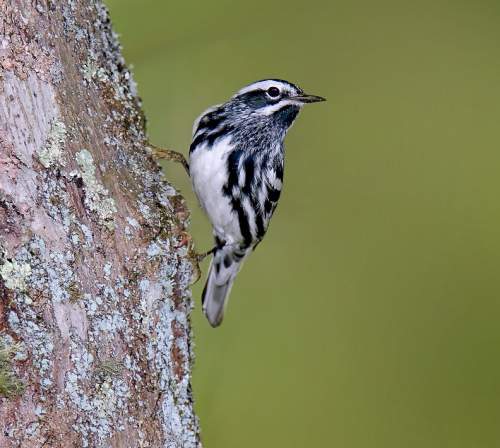
The black-and-white warbler (Mniotilta varia) is a stocky, relatively short-tailed New World warbler, measuring 10 to 13 cm in length and weighing 9 to 15 grams.

These black-and-white warbler species have black and white striped plumage. The crown is dark with a central white streak. There is a bold white supercilium and a black lore extending beyond the eye.

The upperparts and the flanks are boldly striped black and white. The underparts have milder striping. The vent and undertail regions have dark bars. The females and juveniles have duller streaking.

The bill is long, pointed and grayish. The legs and feet are blackish gray. The irises are dark. There is a whitish eye-ring. The warbler call is a loud "chee.. chee.. chee.. chee" sound.
Black-and-white warbler - Mniotilta varia
1.Black-and-white warbler - Mniotilta varia
Picture by Wolfgang Wander


Mniotilta varia
2.Black-and-white warbler - Mniotilta varia
Photo by William H. Majoros

Mniotilta varia
3.Black-and-white warbler - Mniotilta varia
Image by William H. Majoros

Origin, geographical range and distribution

The breeding populations of the black-and-white warbler species are distributed in southern, southwest and southeast Canada and central and eastern USA.

The wintering warbler populations occur in southern USA (Florida, southern Texas), central and southern Mexico, Belize, Guatemala, Honduras, El Salvador, Nicaragua, Costa Rica, Panama, Venezuela, Colombia, Ecuador, Peru and the Caribbean Islands.

Vagrant warblers occur in Faroe Islands (Denmark), Ireland and United Kingdom. Passage birds are found in central and south-central USA, southeast USA (Louisiana, Alabama, Georgia, South Carolina) and north Mexico.

Ecosystem and habitat

The black-and-white warbler species have moderate forest dependence. They normally occur in altitudes between 0 to 1000 meters.

The natural ecosystems and habitats of the warbler species include tropical and subtropical moist lowland forests, boreal forests, tropical and subtropical moist montane forests, deciduous forests and dry shrublands.

Diet and feeding behavior

The diet of the black-and-white warbler species consists mainly of insects. Caterpillars, insects, moths, butterflies, beetles, ants, spiders, fruits and berries are their primary food.

These species are mostly arboreal. Foraging on tree trunks and inner branches, they glean insects from the foliage. During breeding and migration, larval insects and caterpillars are the preferred diet.

Reproduction and breeding habits

The breeding season of these black-and-white warbler species is from April to June in most of their breeding range. They are monogamous solitary breeders. They males are highly territorial and perform display flights.

The breeding ecosystem includes boreal forests and montane forests. They mostly nest on the ground, among the roots of trees and in crevices on tree stumps.

The female black-and-white warbler constructs the cup-shaped nest with grass, leaves and rootlets. The nest is lined with fine grass, feathers, moss and rootlets. The female incubates the eggs.

The clutch may contain four to five eggs. The male may feed the female during incubation. The chicks hatch out after 10 days and the parents take care of the hatchlings. The young birds fledge after 10 days.

Migration and movement patterns

The black-and-white warbler species are fully migratory birds. They breed in southern, southwest and southeast Canada and central and eastern USA. They migrate southwards for wintering during July and August.

These warblers winter in southern regions of North America, Northern parts of South America and the Caribbean Islands. The return migration to the breeding grounds occurs in early summer.

Black-and-white warbler - Quick Facts

  • Scientific name: Mniotilta varia
  • Species author: (Linnaeus, 1766)
  • Synonyms/Protonym: Motacilla varia Linnaeus, 1766
  • Family: Parulidae › Passeriformes › Aves › Chordata › Animalia
  • Vernacular names: English: Black-and-white warbler, Chinese: 黑白森莺, French: Paruline noir et blanc, German: Kletterwaldsänger, Spanish: Reinita trepadora, Russian: Чёрно-белая древесница, Japanese: シロクロアメリカムシクイ
  • Other names: Black-and-white Warbler
  • Distribution:North America, South America, Caribbean Islands
  • Diet and feeding habits: insects, fruits, berries
  • IUCN status listing: Least Concern (LC)

Conservation and survival

The global population size of the black-and-white warbler (Mniotilta varia) has not been quantified. The overall population trend of the species is reported to be declining.

In most of its range, this warbler species is reported to be uncommon to common. The generation length is 4.6 years. Its distribution size is about 11,500,000 sq.km.

Ecosystem degradation, ecosystem conversion, deforestation, adverse weather and climate change are the main threats that may endanger the survival of the warbler species.

IUCN and CITES status

The black-and-white warbler (Mniotilta varia) species does not approach the thresholds for being Vulnerable either under the range size criterion or under the population trend criterion or under the population size criterion.

The IUCN (International Union for Conservation of Nature) has categorized and evaluated the species and has listed it as of "Least Concern (LC)".

The CITES (Convention on International Trade in Endangered Species of Wild Fauna and Flora) status is ‘Not Evaluated’ for the black-and-white warbler (Mniotilta varia).
Taxonomy and scientific classification of Mniotilta varia
Kingdom:Animalia
Phylum:Chordata
Class:Aves
Order:Passeriformes
Family:Parulidae
Subfamily:-
Genus:Mniotilta
Species:M. varia
Binomial name:Mniotilta varia
IUCN status listing:
Least Concern
The black-and-white warbler (Mniotilta varia) is known to hybridize with cerulean warbler (Setophaga cerulea), the Blackburnian Warbler (Setophaga fusca) and the black-throated green warbler (Setophaga virens).
Popular posts in Bird World
Crested kingfisher Wreathed hornbill
Pheasant-tailed jacana Solitary snipe
Bronze-winged jacana Greater painted-snipe
Narcondam hornbill Pied kingfisher
House swift Mottled wood owl
Vernal hanging parrot Grey-bellied cuckoo
Brown fish owl Common swift
Painted sandgrouse Austen's brown hornbill
Eurasian woodcock Indian courser
Pallas's gull Oriental turtle dove

1.Image source: http://www.pbase.com/wwcsig/image/50151128 (cropped)
Author: Wolfgang Wander | License: CC BY-SA 3.0 and GFDL 1.2 as on 1/9/19
2.Image source: https://en.wikipedia.org/wiki/File:Black-and-white-warbler-1.jpg (cropped)
Author: William H. Majoros | License: CC BY-SA 3.0 as on 1/9/19
3.Image source: https://commons.wikimedia.org/wiki/File:8G7D2762.jpg (cropped)
Author: William H. Majoros | License: CC BY-SA 3.0 as on 1/9/19
Link to Creative Commons copyright licenses


Recently updated and current topic in Bird World: Black-and-white warbler - Mniotilta varia.

Contact State Tourism or travel agents for bird watching and wildlife tours.

Blue-winged warbler images

   ›      ›   Blue-winged warbler - Vermivora cyanoptera images
Taxonomic classification   < >   Images

The blue-winged warbler (Vermivora cyanoptera) belongs to the family Parulidae under the order Passeriformes.

Blue-winged warbler taxonomy

The Parulidae is the family of New World warblers or wood-warblers. The family Parulidae was first described by Frank Alexander Wetmore (June 18, 1886 – December 7, 1978), an American ornithologist and avian paleontologist, in the year 1947.

The family Parulidae comprises seventeen genera, including genus Vermivora. The genus Vermivora comprises three species, viz., Vermivora bachmanii, Vermivora cyanoptera and Vermivora chrysoptera.

The genus Vermivora was first introduced by William John Swainson FLS, FRS (8 October 1789 – 6 December 1855), an English ornithologist, malacologist, conchologist and entomologist, in the year 1827.

The species Vermivora cyanoptera was first introduced by Storrs Lovejoy Olson, an American biologist and ornithologist and James Lauritz Reveal, a U.S. botanist, in the year 2009. The warbler species Vermivora cyanoptera is monotypic.

Taxonomic classification
Binomial name:Vermivora cyanoptera
Species:V. cyanoptera
Genus:Vermivora
Subfamily:-
Family:Parulidae
Order:Passeriformes
Class:Aves
Phylum:Chordata
Kingdom:Animalia
Blue-winged warbler - Vermivora cyanoptera
1.Blue-winged warbler - Vermivora cyanoptera
Image by Tom Murray


Vermivora cyanoptera
2.Blue-winged warbler - Vermivora cyanoptera
Image by Wwcsig

Vermivora cyanoptera
3.Blue-winged warbler - Vermivora cyanoptera
Image by Tommy P World

Vermivora cyanoptera
4.Blue-winged warbler - Vermivora cyanoptera
Image by Christopher Eliot

Vermivora cyanoptera
5.Blue-winged warbler - Vermivora cyanoptera
Image by TonyCastro

Vermivora cyanoptera
6.Blue-winged warbler - Vermivora cyanoptera
Image by Melissa McMasters

Vermivora cyanoptera
7.Vermivora cyanoptera
Image by Steven Kersting

Vermivora cyanoptera
8.Vermivora cyanoptera
Image by Big Dipper 2

Vermivora cyanoptera
9.Vermivora cyanoptera
Image by budgora
Popular posts in Bird World
Brown-backed needletail Stork-billed kingfisher
Rock dove Malabar pied hornbill
Himalayan swiftlet Ward's trogon
European roller Blyth's kingfisher
Pallas's sandgrouse Yellow-eyed pigeon
Plum-headed parakeet Whistling hawk-cuckoo
Pallid scops owl Sykes's nightjar
Edible-nest swiftlet Indian roller
Common kingfisher South polar skua
Pin-tailed sandgrouse Common wood pigeon
Blossom-headed parakeet Indian cuckoo
Oriental scops owl Large-tailed nightjar
White-rumped spinetail Oriental dollarbird
Common hoopoe Common cuckoo

1.Image source: https://www.flickr.com/photos/tmurray74/34437261785/ (cropped)
Author: Tom Murray | License: CC BY-NC 2.0 as on 11/29/18
2.Image source: https://commons.wikimedia.org/wiki/File:Blue-winged_Warbler.jpg (cropped)
Author: Wwcsig | License: CC BY-SA 3.0 as on 11/29/18
3.Image source: https://www.flickr.com/photos/tommype5/14296018630/in/photostream/ (cropped)
Author: Tommy P World | License: CC BY-NC 2.0 as on 11/29/18
4.Image source: https://www.flickr.com/photos/eliotc/14114548722/ (cropped)
Author: Christopher Eliot | License: CC BY 2.0 as on 11/29/18
5.Image source: https://en.wikipedia.org/ (cropped)
Author: TonyCastro | License: CC BY-SA 4.0 as on 11/29/18
6.Source: https://www.flickr.com/photos/cricketsblog/26372906640/ (cropped)
Author: Melissa McMasters | License: CC BY 2.0 as on 11/29/18
7.Source: https://www.flickr.com/photos/skersting/34642521996/
Author: Steven Kersting | License: CC BY-NC-ND 2.0 as on 11/29/18
8.Source: https://www.flickr.com/photos/bigdipper22/26717976146/
Author: Big Dipper 2 | License: CC BY-NC-ND 2.0 as on 11/29/18
9.Source: https://www.flickr.com/photos/53816456@N08/41221529320/in/photostream/
Author: budgora | License: CC BY-NC-ND 2.0 as on 11/29/18
Website for detailed description and information on distribution, habitat, behavior, feeding and breeding habits, migration and conservation status of beautiful birds with their images.


Recently updated and current topic in Bird World: Blue-winged warbler - Vermivora cyanoptera images.

Contact State Tourism or travel agents for bird watching and wildlife tours.

Blue-winged warbler | American birds

   ›      ›   Blue-winged warbler - Vermivora cyanoptera

The blue-winged warbler (Vermivora cyanoptera) belongs to the family of New World warblers, the Parulidae.

The blue-winged warbler is distributed in Canada, USA, Mexico, Belize, Guatemala, El Salvador, Honduras, Nicaragua, Costa Rica, Panama, Colombia and Caribbean Islands. These warbler species are fully migratory. These warblers are monotypic species.

Overview & Quick Facts Description & Identification
Pictures of Blue-winged Warbler Distribution & Range
Ecosystem & Habitat Diet & Feeding Behavior
Breeding Habits Migration & Movement Patterns
Conservation & Survival IUCN Status
Taxonomy & Classification Bird World

Appearance, physical description and identification

The blue-winged warbler (Vermivora cyanoptera) is a small warbler, measuring 10 to 12 cm in length and weighing 7 to 11 grams.

The male blue-winged warbler has bright yellow head, throat, breast and underparts. The nape, flanks and the upperparts are olive green. The wings and tail are pale grayish blue.

The wings have two white patches. There is a black eye stripe. The female is duller, with less yellow on the crown. The juveniles are olive green with pale grayish blue wings.

The bill is sharp, pointed and dark gray in color. The short legs and feet are flesh colored. The irises are blackish. There is a yellowish eye-ring. Their call is a series of buzzing notes and a sharp "chipp" sound.
American birds - Blue-winged warbler - Vermivora cyanoptera
1.American birds - Blue-winged warbler - Vermivora cyanoptera
Image by Wwcsig


American birds - Blue-winged warbler - Vermivora cyanoptera
2.American birds - Blue-winged warbler - Vermivora cyanoptera
Image by Tom Murray

American birds - Blue-winged warbler - Vermivora cyanoptera
3.American birds - Blue-winged warbler - Vermivora cyanoptera
Image by Tommy P World

Origin, geographical range and distribution

The blue-winged warbler is distributed in southeast Canada, eastern USA, Mexico, Belize, Guatemala, El Salvador, Honduras, Nicaragua, Costa Rica, Panama, Colombia and several Caribbean Islands.

Ecosystem and habitat

These warbler species do not normally occur in forests. They normally occurs in altitudes between 0 to 100 meters.

The natural ecosystems and habitats of these species include temperate grasslands, temperate shrublands, edges of forests, clearings in forests and neglected fields with scrub growth.

Diet and feeding behavior

The diet of these blue-winged warbler species consists mainly of invertebrates. Insects, insect larvae, caterpillars, beetles, crickets, grasshoppers and spiders are their primary food. They forage on the ground and in bushes.

Reproduction and breeding habits

The breeding season of these warbler species is from May to July in most of their breeding range. They are monogamous and solitary nesters. They nest on the ground or on low bushes, hidden from predators.

The nest is a cone-shaped cup, built with leaves, bark stripes and plant fibers. It is lined with feathers and fine rootlets. The clutch contains four to six eggs.

The female warbler incubates the eggs. The chicks hatch out after 10 days of incubation. The hatchlings are altricial, depending completely on parents for brooding, feeding and protection. They fledge after 10 days.

Migration and movement patterns

These blue-winged warbler species are fully migratory birds. The breeding populations occur in northeast USA and southeast Canada (Ontario and Quebec provinces). Populations under migration are found in southeast USA.

They leave breeding grounds during August to winter in southeastern USA, central America, Colombia and Caribbean islands. The return migration to the breeding grounds takes place in early summer.

Blue-winged warbler - Quick Facts

  • Scientific name: Vermivora cyanoptera
  • Species author: (Olson & Reveal, 2009)
  • Synonyms/Protonym: Certhia cyanoptera Olson and Reveal, 2009
  • Family: Parulidae › Passeriformes › Aves › Chordata › Animalia
  • Vernacular names: English: Blue-winged warbler, Chinese: 蓝翅虫森莺, French: Paruline à ailes bleues, German: Blauflügel-Waldsänger, Spanish: Reinita aliazul, Russian: Сосновая червеедка, Japanese: アオバネアメリカムシクイ
  • Other names: Blue-winged Warbler, Brewster's Warbler, Lawrence's Warbler
  • Distribution: Canada, USA, Mexico, Belize, Guatemala, El Salvador, Honduras, Nicaragua, Costa Rica, Panama, Colombia, Caribbean Islands
  • Diet and feeding habits: insects, invertebrates, spiders
  • IUCN status listing: Least Concern (LC)

Conservation and survival

The global population size of the blue-winged warbler (Vermivora cyanoptera) has not been quantified. The overall population trend of the species is reported to be decreasing.

In most of its range, this species is reported to be fairly common to common. The generation length is 3.7 years. Its distribution size is about 2,040,000 sq.km.

Ecosystem degradation, ecosystem conversion and trapping of adults and juveniles for pet-trade are the main threats that may endanger the survival of the warbler species.

IUCN and CITES status

The blue-winged warbler (Vermivora cyanoptera) species does not approach the thresholds for being Vulnerable either under the range size criterion, or under the population trend criterion or under the population size criterion.

The IUCN (International Union for Conservation of Nature) has categorized and evaluated the species and has listed it as of "Least Concern".

The CITES (Convention on International Trade in Endangered Species of Wild Fauna and Flora) status is ‘Not Evaluated’ for the blue-winged warbler (Vermivora cyanoptera).
Taxonomy and scientific classification of Vermivora cyanoptera
Kingdom:Animalia
Phylum:Chordata
Class:Aves
Order:Passeriformes
Family:Parulidae
Subfamily:-
Genus:Vermivora
Species:V. cyanoptera
Binomial name:Vermivora cyanoptera
IUCN status listing:
Least Concern
The blue-winged warbler (Vermivora cyanoptera) is closely related to golden-winged warbler (Vermivora chrysoptera) and forms two distinctive hybrids with V. chrysoptera.
Popular posts in Bird World
Pallas's sandgrouse Yellow-eyed pigeon
Plum-headed parakeet Whistling hawk-cuckoo
Pallid scops owl Sykes's nightjar
Edible-nest swiftlet Indian roller
Common kingfisher South polar skua
Pin-tailed sandgrouse Common wood pigeon
Blossom-headed parakeet Indian cuckoo
Oriental scops owl Large-tailed nightjar
White-rumped spinetail Oriental dollarbird
Common cuckoo Speckled wood pigeon
Common hoopoe Indian skimmer
Pomarine jaeger Chestnut-bellied sandgrouse

1.Image source: https://commons.wikimedia.org/wiki/File:Blue-winged_Warbler.jpg (cropped)
Image author: Wwcsig | License: CC BY-SA 3.0 as on 11/29/18
2.Image source: https://www.flickr.com/photos/tmurray74/34437261785/ (cropped)
Image author: Tom Murray | License: CC BY-NC 2.0 as on 11/29/18
3.Image source: https://www.flickr.com/photos/tommype5/14296018630/in/photostream/ (cropped)
Image author: Tommy P World | License: CC BY-NC 2.0 as on 11/29/18
Website for detailed description and information on distribution, habitat, behavior, feeding and breeding habits, migration and conservation status of beautiful birds with their images.


Recently updated and current topic in American birds: Blue-winged warbler - Vermivora cyanoptera.

Contact State Tourism or travel agents for bird watching and wildlife tours.

Golden-winged warbler images

   ›      ›   Golden-winged warbler - Vermivora chrysoptera images

The golden-winged warbler (Vermivora chrysoptera) belongs to the family Parulidae under the order Passeriformes.

Golden-winged warbler taxonomy

The Parulidae is the family of New World warblers or wood-warblers. The family Parulidae was first described by Frank Alexander Wetmore (June 18, 1886 – December 7, 1978), an American ornithologist and avian paleontologist, in the year 1947.

The family Parulidae comprises seventeen genera, including genus Vermivora. The genus Vermivora comprises three species, viz., Vermivora bachmanii, Vermivora cyanoptera and Vermivora chrysoptera.

The genus Vermivora was first introduced by William John Swainson FLS, FRS (8 October 1789 – 6 December 1855), was an English ornithologist, malacologist, conchologist and entomologist, in the year 1827.

The species Vermivora chrysoptera was first introduced (as Motacilla chrysoptera) by Carl Linnaeus (23 May 1707 – 10 January 1778), a Swedish botanist, physician and and zoologist, in the year 1766. The species Vermivora chrysoptera is monotypic.

Taxonomic classification
Binomial name:Vermivora chrysoptera
Species:V. chrysoptera
Genus:Vermivora
Subfamily:-
Family:Parulidae
Order:Passeriformes
Class:Aves
Phylum:Chordata
Kingdom:Animalia
Golden-winged warbler - Vermivora chrysoptera
1.Golden-winged warbler - Vermivora chrysoptera
Image by Bettina Arrigoni


Vermivora chrysoptera
2.Golden-winged warbler - Vermivora chrysoptera
Image by California Department of Fish and Wildlife

Vermivora chrysoptera
3.Golden-winged warbler - Vermivora chrysoptera
Image by Kent McFarland

Vermivora chrysoptera
4.Golden-winged warbler - Vermivora chrysoptera
Image by Kent McFarland

Vermivora chrysoptera
5.Golden-winged warbler - Vermivora chrysoptera
Image by Andrew Cannizzaro

Vermivora chrysoptera
6.Golden-winged warbler - Vermivora chrysoptera
Image by Andy Reago & Chrissy McClarren

Vermivora chrysoptera
7.Vermivora chrysoptera
Image by Bettina Arrigoni

Vermivora chrysoptera
8.Vermivora chrysoptera
Image by William H. Majoros

Vermivora chrysoptera
9.Golden-winged warbler - Vermivora chrysoptera
Image by Paul Hurtado
Popular posts in Bird World
Small minivet Common ringed plover
Spotted redshank Roseate tern
Thick-billed green pigeon Andaman hawk-owl (Andaman boobook)
Great spotted woodpecker White-bellied minivet
Brown-fronted woodpecker Pied triller
Jungle owlet Bar-tailed godwit
Sandwich tern Grey-fronted green pigeon
Lesser coucal Forest owlet
Blue-eared barbet Fulvous-breasted woodpecker
Mew gull Rosy minivet
Indian pitta Whimbrel
Great crested tern Ashy-headed green pigeon

1.Golden-winged warbler image source: https://www.flickr.com/photos/barrigoni/41190419195/in/photostream/ (cropped)
Author: Bettina Arrigoni | License: CC BY 2.0 as on 11/13/18
2.Image source: https://www.flickr.com/photos/californiadfg/22436077317/ (cropped)
Author: California Department of Fish and Wildlife | License: CC BY 2.0 as on 11/13/18
3.Image source: https://www.flickr.com/photos/vtebird/5710109295/in/photostream/ (cropped)
Author: Kent McFarland | License: CC BY-NC 2.0 as on 11/13/18
4.Image source: https://www.flickr.com/photos/vtebird/5710110271/ (cropped)
Author: Kent McFarland | License: CC BY-NC 2.0 as on 11/13/18
5.Image source: https://www.flickr.com/photos/acryptozoo/14229915863/ (cropped)
Author: Andrew Cannizzaro | License: CC BY 2.0 as on 11/13/18
6.Source: https://www.flickr.com/photos/wildreturn/37454053405/ (cropped)
Author: Andy Reago & Chrissy McClarren | License: CC BY 2.0 as on 11/13/18
7.Image source: https://www.flickr.com/photos/barrigoni/27221201027/in/photostream/ (cropped)
Author: Bettina Arrigoni | License: CC BY 2.0 as on 11/13/18
8.Image source: https://commons.wikimedia.org/wiki/File:8G7D2461.jpg (cropped)
Author: William H. Majoros | License: CC BY-SA 3.0 as on 11/13/18
9.Source: https://www.flickr.com/photos/pauljhurtado/14373516504/ (cropped)
Author: Paul Hurtado | License: CC BY-SA 2.0 as on 11/13/18
Website for detailed description and information on distribution, habitat, behavior, feeding and breeding habits, migration and conservation status of beautiful birds with their images.


Recently updated and current topic in Bird World: Golden-winged warbler - Vermivora chrysoptera images.

Contact State Tourism or travel agents for bird watching and wildlife tours.

Golden-winged warbler | American birds

   ›      ›   Golden-winged warbler - Vermivora chrysoptera

The golden-winged warbler (Vermivora chrysoptera) belongs to the family of New World warblers, the Parulidae.


The golden-winged warbler is distributed in USA, Canada, Mexico, Guatemala, Honduras, Nicaragua, Costa Rica, Panamá, Colombia, Venezuela, Ecuador and Caribbean islands. These species hybridize with blue-winged warblers. These warblers are monotypic species.
Overview & Quick Facts Description & Identification
Pictures of Golden-winged Warbler Distribution & Range
Ecosystem & Habitat Diet & Feeding Behavior
Breeding Habits Migration & Movement Patterns
Conservation & Survival IUCN Status
Taxonomy & Classification Bird World

Appearance, physical description and identification

The golden-winged warbler (Vermivora chrysoptera) is a small New World warbler, measuring 11 to 12 cm in length and weighing 7 to 12 grams.

The male golden-winged warbler has bright golden-yellow patch on the forecrown. There is also a golden patch on the wing. There is a black throat patch and an black ear patch. There is a white supercilium.

The upperparts are bluish gray and the underparts are whitish gray. In females, the black patches are replaced by grayish patches.

The steel-gray bill is slender and sharp pointed. The legs are gray. The irises are blackish. There is a gray eye-ring. Their call is a trilling buzzy note or a buzzy "chip.. chip" sound.
Bird World - Image of Golden-winged warbler - Vermivora chrysoptera
1.Bird World - Golden-winged warbler - Vermivora chrysoptera
Image by California Department of Fish and Wildlife


Bird World - Image of Golden-winged warbler - Vermivora chrysoptera
2.Bird World - Golden-winged warbler - Vermivora chrysoptera
Image by Bettina Arrigoni

Bird World - Image of Golden-winged warbler - Vermivora chrysoptera
3.Bird World - Golden-winged warbler - Vermivora chrysoptera
Image by Kent McFarland

Origin, geographical range and distribution

The golden-winged warbler is distributed in northern USA, southern Canada, Mexico, Guatemala, Honduras, Nicaragua, Costa Rica, Panama, Colombia, Venezuela, Ecuador and several Caribbean islands.

Vagrant birds have been recorded in United Kingdom, Trinidad and Tobago, Sint Maarten (Netherlands), Barbados, Curaçao (Netherlands) and French Polynesia.

Ecosystem and habitat

The golden-winged warbler species have moderate forest dependence. They normally occurs in altitudes between 0 to 2000 meters. The artificial ecosystems and habitats of these species include pasturelands.

The natural ecosystems and habitats of these warbler species include tropical and subtropical moist lowland forests, temperate forests, grasslands and shrublands, moist shrublands and wetlands.

Diet and feeding behavior

The diet of these golden-winged warbler species consists mainly of insects. Larval insects, insects, moths, caterpillars, grasshoppers and spiders are their primary food.

They mostly forage for insects in the middle and lower canopy. They occasionally descent to the floor to feed on insects and small invertebrates.

Reproduction and breeding habits

The breeding season of the golden-winged warbler species is from May to July in most of their breeding range. These birds are monogamous and nest solitarily. The breeding habitat is on the ground, hidden in bushes.

The nest is a bulky cup made with grass, rootlets and plant fiber. It is lined with hair, fine grass, shreds of bark and fine rootlets.

These species hybridize with blue-winged warbler to form two distinctive hybrids, the genetically dominant Brewster's warbler and the genetically recessive Lawrence's warbler.

Migration and movement patterns

These warbler species are fully migratory birds. The breeding populations occur in northern USA and southern Canada. They migrate to the wintering grounds in August and September.

The wintering populations of these species are distributed in Central America from southern Mexico to Panama, Caribbean islands and northern parts of South America. The return migration occurs in early summer.

Golden-winged warbler - Quick Facts

  • Scientific name: Vermivora chrysoptera
  • Species author: (Linnaeus, 1766)
  • Synonyms/Protonym: Motacilla chrysoptera Linnaeus, 1766
  • Family: Parulidae › Passeriformes › Aves › Chordata › Animalia
  • Vernacular names: English: Golden-winged warbler, Chinese: 金翅虫森莺, French: Paruline à ailes dorées, German: Goldflügel-Waldsänger, Spanish: Reinita alidorada, Russian: Золотистокрылая червеедка, Japanese: キンバネアメリカムシクイ
  • Other names: Golden-winged Warbler
  • Distribution: North America, South America
  • Diet and feeding habits: insects, larval insects, caterpillars, spiders
  • IUCN status listing: Near Threatened (NT)

Conservation and survival

The global population size of the golden-winged warbler (Vermivora chrysoptera) has not been quantified. The overall population trend of the species is considered to be decreasing.

In most of its range, this species is reported to be uncommon. The generation length is 3.8 years. Its distribution size is about 2,080,000 sq.km.

Ecosystem degradation, ecosystem conversion, severe weather, climate change and agricultural expansion are the main threats that may endanger the survival of the warbler species.

IUCN and CITES status

The golden-winged warbler (Vermivora chrysoptera) species is approaching the thresholds for being Vulnerable under the range size criterion, under the population trend criterion and under the population size criterion.

The IUCN (International Union for Conservation of Nature) has categorized and evaluated the species and has listed it as "Near Threatened".

The CITES (Convention on International Trade in Endangered Species of Wild Fauna and Flora) status is ‘Not Evaluated’ for the golden-winged warbler (Vermivora chrysoptera).

Taxonomy and scientific classification of Vermivora chrysoptera
Kingdom:Animalia
Phylum:Chordata
Class:Aves
Order:Passeriformes
Family:Parulidae
Subfamily:-
Genus:Vermivora
Species:V. chrysoptera
Binomial name:Vermivora chrysoptera
IUCN status listing: Near Threatened
The golden-winged warbler (Vermivora chrysoptera) is closely related to the blue-winged warbler (Vermivora cyanoptera).
Popular posts in Bird World
Lesser whistling-duck Oriental stork
White-headed duck Black-necked stork
Bean goose Lesser adjutant
Greater white-fronted goose Greater adjutant
Lesser white-fronted goose Black-headed ibis
Greylag goose Red-naped ibis
Bar-headed goose Glossy ibis
Red-breasted goose Eurasian spoonbill
Ruddy shelduck Grey heron
Common shelduck White-bellied heron
1.Image source: https://www.flickr.com/photos/californiadfg/22436077317/ (cropped)
Image author: California Department of Fish and Wildlife | License: CC BY 2.0 as on 11/3/18
2.Image source: https://www.flickr.com/photos/barrigoni/41190419195/in/photostream/ (cropped)
Image author: Bettina Arrigoni | License: CC BY 2.0 as on 11/3/18
3.Image source: https://www.flickr.com/photos/vtebird/5710109295/in/photostream/ (cropped)
Image author: Kent McFarland | License: CC BY-NC 2.0 as on 11/3/18
Website for detailed description and information on distribution, habitat, behavior, feeding and breeding habits, migration and conservation status of beautiful birds with their images.


Recently updated and current topic in Bird World: Golden-winged warbler - Vermivora chrysoptera

Contact State Tourism or travel agents for bird watching and wildlife tours.