Showing posts with label sandpiper. Show all posts

Red knot images

   ›      ›   Red knot - Calidris canutus images
Taxonomic classification   < >   Images

The red knot (Calidris canutus) belongs to the family Scolopacidae under the order Charadriiformes.

Red knot taxonomy

The Scolopacidae is the family of sandpipers, curlews, snipes, knots and turnstones.

The family Scolopacidae was first introduced by Constantine Samuel Rafinesque-Schmaltz (22 October 1783 – 18 September 1840), a zoologist, botanist, writer and polyglot, in the year 1815.

The family Scolopacidae comprises fifteen genera, including genus Calidris. The genus Calidris is the genus of knots and sandpipers. The genus Calidris comprises twenty-four species, including Calidris canutus.

The genus Calidris was first described by Blasius Merrem (4 February 1761 – 23 February 1824), a German naturalist, zoologist, ornithologist, mathematician and herpetologist, in the year 1804.

The species Calidris canutus was first described by Carl Linnaeus (23 May 1707 – 10 January 1778), a Swedish botanist, physician and zoologist, in the year 1758. The knot species Calidris canutus is polytypic and comprises six subspecies.

Taxonomic classification
Binomial name:Calidris canutus
Species:C. canutus
Genus:Calidris
Subfamily:-
Family:Scolopacidae
Order:Charadriiformes
Class:Aves
Phylum:Chordata
Kingdom:Animalia
Bird World - Red knot - Calidris canutus
1.Bird World - Red knot - Calidris canutus
Image by Hans Hillewaert


Bird World - Calidris canutus
2.Bird World - Red knot - Calidris canutus
Image by DickDaniels (http://carolinabirds.org/)

Bird World - Calidris canutus
3.Bird World - Red knot - Calidris canutus
Image by DickDaniels (http://carolinabirds.org/)

Bird World - Calidris canutus
4.Bird World - Red knot - Calidris canutus
Image by Chuck Homler d/b/a Focus On Wildlife

Bird World - Calidris canutus
5.Bird World - Red knot - Calidris canutus
Image by Andrea Westmoreland

Bird World - Calidris canutus
6.Bird World - Red knot - Calidris canutus
Image by Andrea Westmoreland

Bird World - Calidris canutus
7.Bird World - Red knot - Calidris canutus
Image by Juan Emilio

Bird World - Calidris canutus
8.Bird World - Red knot - Calidris canutus
Image by Juan Emilio

Bird World - Calidris canutus
9.Calidris canutus
Image by Hans Hillewaert
Popular posts in Bird World
Jerdon's nightjar Silver-backed needletail
Brown-winged kingfisher Blue-cheeked bee-eater
Indian grey hornbill Long-tailed jaeger
Black-bellied sandgrouse Nilgiri wood pigeon
Lord Derby's parakeet Lesser cuckoo
Rock eagle-owl Indian nightjar
Brown-backed needletail Stork-billed kingfisher
Blue-tailed bee-eater Malabar pied hornbill
Himalayan swiftlet Ward's trogon
European roller Blyth's kingfisher
Pallas's sandgrouse Yellow-eyed pigeon
Plum-headed parakeet Whistling hawk-cuckoo
Pallid scops owl Sykes's nightjar
Edible-nest swiftlet Indian roller

1.Image source: https://en.wikipedia.org/wiki/File:Calidris_canutus_(summer).jpg (cropped)
Author: Hans Hillewaert | License: CC BY-SA 4.0 as on 11/26/18
2.Image source: https://commons.wikimedia.org/wiki/File:Red_Knot_2012c_RWD.jpg (cropped)
Author: DickDaniels (http://carolinabirds.org/) | License: CC BY-SA 3.0 as on 11/26/18
3.Image source: https://commons.wikimedia.org/ (cropped)
Author: DickDaniels (http://carolinabirds.org/) | License: CC BY-SA 3.0 as on 11/26/18
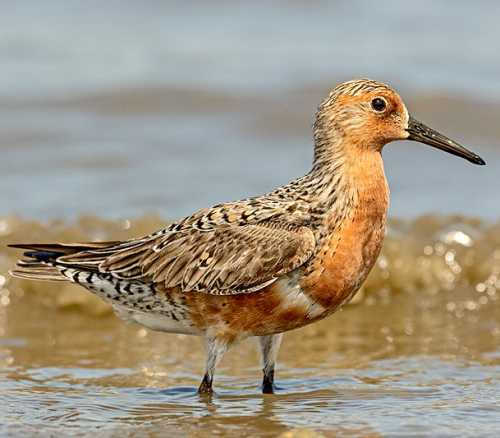
4.Image source: https://commons.wikimedia.org/ (cropped)
Author: Chuck Homler d/b/a Focus On Wildlife | License: CC BY-SA 4.0 as on 11/26/18
5.Image source: https://commons.wikimedia.org/ (cropped)
Author: Andrea Westmoreland | License: CC BY-SA 2.0 as on 11/26/18
6.Image source: https://commons.wikimedia.org/wiki/ (cropped)
Author: Andrea Westmoreland | License: CC BY-SA 2.0 as on 11/26/18
7.Image source: https://www.flickr.com/photos/juan_e/3852983479/ (cropped)
Author: Juan Emilio | License: CC BY-SA 2.0 as on 11/26/18
8.Source: https://www.flickr.com/photos/juan_e/3835265024/ (cropped)
Author: Juan Emilio | License: CC BY-SA 2.0 as on 11/26/18
9.Source: https://commons.wikimedia.org/wiki/File:Calidris_canutus_(breeding_plumage).jpg (cropped)
Author: Hans Hillewaert | License: CC BY-SA 3.0 as on 11/26/18
Website for detailed description and information on distribution, habitat, behavior, feeding and breeding habits, migration and conservation status of beautiful birds with their images.


Recently updated and current topic in Bird World: Red knot images.

Contact State Tourism or travel agents for bird watching and wildlife tours.

Common sandpiper images


   ›      ›   Common sandpiper - Actitis hypoleucos images
Taxonomic classification   < >   Images

The common sandpiper (Actitis hypoleucos) belongs to the family Scolopacidae under the order Charadriiformes.

Common sandpiper taxonomy

The Scolopacidae is the family of sandpipers, curlews and snipes. The family Scolopacidae was first described by Constantine Samuel Rafinesque-Schmaltz (22 October 1783 – 18 September 1840), a zoologist, botanist, writer and polyglot, in the year 1815.

The family Scolopacidae comprise fifteen genera, including genus Actitis. The genus Actitis is polytypic containing two species, Actitis hypoleucos and Actitis macularia.

The genus Actitis was first introduced by Johann Karl Wilhelm Illiger (19 November 1775 – 10 May 1813), a German entomologist and zoologist, in the year 1811.

The species Actitis hypoleucos was first described (as Tringa hypoleucos) by Carl Linnaeus (23 May 1707 – 10 January 1778), a Swedish botanist, physician and zoologist, in the year 1758.

The species Actitis hypoleucos is closely related to the spotted sandpiper (A. macularia).

Taxonomic classification
Binomial name:Actitis hypoleucos
Species:A. hypoleucos
Genus:Actitis
Subfamily:-
Family:Scolopacidae
Order:Charadriiformes
Class:Aves
Phylum:Chordata
Kingdom:Animalia
Common sandpiper - Actitis hypoleucos
1.Common sandpiper - Actitis hypoleucos
Image by Vengolis


Actitis hypoleucos
2.Common sandpiper - Actitis hypoleucos
Image by Juan Emilio

Actitis hypoleucos
3.Common sandpiper - Actitis hypoleucos
Image by Dr. Raju Kasambe

Actitis hypoleucos
4.Common sandpiper - Actitis hypoleucos
Image by Alpsdake

Actitis hypoleucos
5.Actitis hypoleucos
Image by JJ Harrison

Actitis hypoleucos
6.Common sandpiper - Actitis hypoleucos
Image by Charles J Sharp

Actitis hypoleucos
7.Common sandpiper - Actitis hypoleucos
Image by Bernard DUPONT

Actitis hypoleucos
8.Actitis hypoleucos
Image by Alun Williams333

Actitis hypoleucos
9.Actitis hypoleucos
Image by Derek Keats
Popular posts in Bird World
Chestnut-winged cuckoo European nightjar
Mountain scops-owl Hodgson's frogmouth
Jungle nightjar Glossy swiftlet
Malabar trogon Hill pigeon
Slaty-headed parakeet Large hawk-cuckoo
Oriental bay owl Indian scops owl
Grey nightjar Indian swiftlet
Red-headed trogon Tibetan sandgrouse
Snow pigeon Grey-headed parakeet
Collared scops owl Sri Lanka bay owl

1.Image source: https://wikimedia.org/wiki/File:Actitis_hypoleucos_2.jpg (cropped)
Author: Vengolis | License: CC BY-SA 3.0 as on 10/17/18
2.Source: https://www.flickr.com/photos/juan_e/5012875116/ (cropped)
Author: Juan Emilio | License: CC BY-SA 2.0 as on 10/17/18
3.Image source: https://wikimedia.org/wiki/File:Common_Sandpiper_Actitis_hypoleucos_by_Dr._Raju_Kasambe_DSCN3001_(19).jpg (cropped)
Author: Dr. Raju Kasambe | License: CC BY-SA 4.0 as on 10/17/18
4.Image source: https://wikimedia.org/wiki/File:Actitis_hypoleucos_a2.jpg (cropped)
Author: Alpsdake | License: CC BY-SA 4.0 as on 10/17/18
5.Image source: https://en.wikipedia.org/wiki/File:Actitis_hypoleucos_-_Laem_Pak_Bia.jpg (cropped)
Author: JJ Harrison | License: CC BY 3.0 as on 10/17/18
6.Source: https://wikimedia.org/ (cropped)
Author: Charles J Sharp | License: CC BY-SA 4.0 as on 10/17/18
7.Source: https://www.flickr.com/photos/berniedup/16383064138/ (cropped)
Author: Bernard DUPONT | License: CC BY-SA 2.0 as on 10/17/18
8.Source: https://wikimedia.org/wiki/File:Actitis_hypoleucos_pibydd_y_dorlan.jpg (cropped)
Author: Alun Williams333 | License: CC BY-SA 4.0 as on 10/17/18
9.Source: https://www.flickr.com/photos/dkeats/36684180261/in/photostream/ (cropped)
Author: Derek Keats | License: CC BY 2.0 as on 10/17/18
Detailed description and information on distribution, habitat, behavior, feeding and breeding habits, migration and conservation status of beautiful birds with their images.
Recently updated and current topic in Bird World: Common sandpiper - Actitis hypoleucos images.
Contact State Tourism or travel agents for bird watching and wildlife tours.

Common sandpiper


   ›      ›   Common sandpiper - Actitis hypoleucos

The common sandpiper (Actitis hypoleucos) belongs to the family of snipes and sandpipers, the Scolopacidae.

The common sandpiper is distributed in Europe, Asia, Africa, Indian subcontinent, southeast Asia and Australia. These sandpiper species are fully migratory birds. These sandpipers are monotypic species.

Overview & Quick Facts Description & Identification
Pictures of Common Sandpiper Distribution & Range
Ecosystem & Habitat Diet & Feeding Behavior
Breeding Habits Migration & Movement Patterns
Conservation & Survival IUCN Status
Taxonomy & Classification Bird World

Appearance, physical description and identification

The common sandpiper (Actitis hypoleucos) is a small sandpiper, measuring 18 to 22 cm in length and weighing 30 to 90 grams. The wingspan is 37 to 42 cm.

The common sandpiper has grayish brown upperparts, throat and breast. The underparts are white. The wintering birds are paler and have more conspicuous barring. There is a dark lore extending beyond the eye. There is a pale supercilium.

The grayish bill is long and sharp. The irises are blackish. There is a white eye-ring. The legs and feet are short and grayish yellow. The call is a loud, rapid squeaking sound.
Bird World - Image of Common sandpiper - Actitis hypoleucos
1.Bird World - Common sandpiper - Actitis hypoleucos
Image by Dr. Raju Kasambe


Bird World - Image of Common sandpiper - Actitis hypoleucos
2.Bird World - Common sandpiper - Actitis hypoleucos
Image by Vengolis

Bird World - Image of Common sandpiper - Actitis hypoleucos
3.Bird World - Common sandpiper - Actitis hypoleucos
Image by Juan Emilio

Origin, geographical range and distribution

The common sandpiper is distributed in Arctic, subarctic and temperate regions of Europe and Asia. The wintering populations are distributed in Africa, Arabian Peninsula, Indian subcontinent, southeast Asia, southern China and Australia.

Vagrant populations are found in USA, Samoa, New Zealand, Kiribati, Iceland, French Southern Territories, Fiji and Faroe Islands (Denmark).

The Important Bird and Biodiversity Areas (IBA) of this species in Russia is Forty islands. The IBA in Austria are, Tyrolian Lech valley and Pielachtal.

Ecosystem and habitat

The sandpiper species have low forest dependence. They normally occur in altitudes between 0 to 100 meters.

The artificial ecosystems and habitats of these species include aquatic ponds, water storage areas, wastewater treatment areas and rural gardens.

The natural ecosystems and habitats of these species include tundra grasslands, Arctic tundra, temperate grasslands, coastal lagoons, coastal lakes, intertidal shoreline, tidepools, estuaries and freshwater lakes.

Diet and feeding behavior

The diet of the common sandpiper species consists mainly of invertebrates. Insects, insect larvae, crustaceans, molluscs, annelids and spiders are their primary food. These species occasionally take small vertebrates and seeds.

Reproduction and breeding habits

The breeding season of this sandpiper species is from May to July in most of its breeding range. These species are mostly monogamous. In some instances polyandry has been observed.

The nesting sites are located in sandy, rocky margins of rivers and waterbodies. The nest is a shallow scrape on the ground and the clutch contains 3 to 6 white eggs with brown blotches.

Migration and movement patterns

The common sandpiper species is fully migratory. The breeding populations occur in Arctic, subarctic and temperate regions of Europe and Asia. After breeding and rearing the young, they migrate southwards.

These sandpiper species winter in sub-saharan Africa, coastal Arabian peninsula, Indian subcontinent, southern parts of China, Southeast Asia and Australia. The return migration to the breeding grounds takes place in early summer.

Common sandpiper - Quick Facts

  • Scientific name: Actitis hypoleucos
  • Species author: (Linnaeus, 1758)
  • Synonyms/Protonym: Tringa Hypoleucos Linnaeus, 1758
  • Family: Scolopacidae › Charadriiformes › Aves › Chordata › Animalia
  • , Vernacular names: English: Common sandpiper, Chinese: 矶鹬, French: Chevalier guignette, German: Flussuferläufer, Spanish: Andarríos chico, Russian: Перевозчик, Japanese: イソシギ
  • Other names: Common Sandpiper, Eurasian Sandpiper
  • Distribution: Asia, Europe, Africa, Indian Subcontinent, southeast Asia, Australia
  • Diet and feeding habits: insects, spiders, molluscs, crustaceans, invertebrates, small vertebrates
  • IUCN status listing: Least Concern (LC)

Conservation and survival

The global population size of the common sandpiper (Actitis hypoleucos) is estimated to number about 2,600,000 to 3,200,000 individual birds (Wetlands International 2015). The overall population trend of the species is considered to be decreasing.

In most of its range, this species is reported to be widespread and common. The generation length is 6.8 years. Its distribution size is about 47,200,000 sq.km.

Habitat alteration, climate change, severe weather, human disturbance, recreational activities and trapping of adults and juveniles for pet-trade are the main threats that are endangering the survival of this sandpiper species.

IUCN and CITES status

The common sandpiper (Actitis hypoleucos) does not approach the thresholds for being Vulnerable, either under the range size criterion, or under the population trend criterion or under the population size criterion.

The IUCN (International Union for Conservation of Nature) has categorized and evaluated the sandpiper species and has listed it as of "Least Concern".

The CITES (Convention on International Trade in Endangered Species of Wild Fauna and Flora) status is ‘Not Evaluated’ for the common sandpiper (Actitis hypoleucos).
Taxonomy and scientific classification of Actitis hypoleucos
Kingdom:Animalia
Phylum:Chordata
Class:Aves
Order:Charadriiformes
Family:Scolopacidae
Subfamily:-
Genus:Actitis
Species:A. hypoleucos
Binomial name:Actitis hypoleucos
IUCN status listing:
Least Concern
The common sandpiper (Actitis hypoleucos) is closely related to the spotted sandpiper (Actitis macularius).
Popular posts in Bird World
Mountain hawk-eagle Peregrine falcon
Saker falcon Laggar falcon
Oriental hobby Eurasian hobby
Merlin Amur falcon
Upland buzzard Black eagle
Indian spotted eagle Greater spotted eagle
Tawny eagle Steppe eagle
Eastern imperial eagle Golden eagle
Bonelli's eagle Booted eagle
Andaman serpent eagle Eastern marsh harrier

1.Image source: https://wikimedia.org/wiki/File:Common_Sandpiper_Actitis_hypoleucos_by_Dr._Raju_Kasambe_DSCN3001_(19).jpg (cropped)
Author: Dr. Raju Kasambe | License: CC BY-SA 4.0 as on 10/17/18
2.Image source: https://wikimedia.org/wiki/File:Actitis_hypoleucos_2.jpg (cropped)
Author: Vengolis | License: CC BY-SA 3.0 as on 10/17/18
3.Image source: https://www.flickr.com/photos/juan_e/5012875116/ (cropped)
Author: Juan Emilio | License: CC BY-SA 2.0 as on 10/17/18
Detailed description and information on distribution, habitat, behavior, feeding and breeding habits, migration and conservation status of beautiful birds with their images.
Recently updated and current topic in Bird World: Common sandpiper - Actitis hypoleucos.
Contact State Tourism or travel agents for bird watching and wildlife tours.

Terek sandpiper images


   ›      ›   Terek sandpiper - Xenus cinereus images
Taxonomic classification   < >   Images

The Terek sandpiper (Xenus cinereus) belongs to the family Scolopacidae under the order Charadriiformes.

Terek sandpiper taxonomy

The Scolopacidae is the family of sandpipers, curlews and snipes. The family Scolopacidae was first described by Constantine Samuel Rafinesque-Schmaltz (22 October 1783 – 18 September 1840), a zoologist, botanist, writer and polyglot, in the year 1815.

The family Scolopacidae comprise fifteen genera, including genus Xenus. The genus Xenus is monotypic containing one species, Xenus cinereus.

The genus Xenus was first introduced by Johann Jakob von Kaup[1] (10 April 1803 – 4 July 1873), a German naturalist, in the year 1829.

The species Xenus cinereus was first described (as Scolopax cinerea) by Johann Anton Güldenstädt (26 April 1745 in Riga, Latvia – 23 March 1781 in St. Petersburg, Russia), a German naturalist, in the year 1775. It is also known by Synonym Tringa cinerea.

Taxonomic classification
Binomial name:Xenus cinereus
Species:X. cinereus
Genus:Xenus
Subfamily:-
Family:Scolopacidae
Order:Charadriiformes
Class:Aves
Phylum:Chordata
Kingdom:Animalia
Terek sandpiper - Xenus cinereus
1.Terek sandpiper - Xenus cinereus
Image by Koskikara at Finnish Wikipedia


Xenus cinereus
2.Terek sandpiper - Xenus cinereus
Image by Alpsdake

Xenus cinereus
3.Terek sandpiper - Xenus cinereus
Image by Alpsdake

Xenus cinereus
4.Terek sandpiper - Xenus cinereus
Image by Alpsdake

Xenus cinereus
5.Terek sandpiper - Xenus cinereus
Image by Alnus

Xenus cinereus
6.Terek sandpiper - Xenus cinereus
Image by Ekaterina Chernetsova (Papchinskaya)

Xenus cinereus
7.Xenus cinereus
by Ekaterina Chernetsova (Papchinskaya)

Xenus cinereus
8.Xenus cinereus
Image by Ron Knight

Xenus cinereus
9.Xenus cinereus
Image by Ron Knight
Popular posts in Bird World
Chestnut-winged cuckoo Common barn-owl
Mountain scops-owl Hodgson's frogmouth
Jungle nightjar Glossy swiftlet
Malabar trogon Hill pigeon
Slaty-headed parakeet Large hawk-cuckoo
Oriental bay owl Indian scops owl
Grey nightjar Indian swiftlet
Red-headed trogon Tibetan sandgrouse
Snow pigeon Grey-headed parakeet
Common hawk-cuckoo Sri Lanka bay owl

1.Terek sandpiper image source: https://en.wikipedia.org/wiki/File:Xenus_cinereus_Lapland.JPG (cropped)
Author: Koskikara at Finnish Wikipedia | License: CC BY-SA 3.0 as on 10/11/18
2.Image source: https://en.wikipedia.org/wiki/File:Xenus_cinereus_eating_ragworm.JPG (cropped)
Author: Alpsdake | License: CC BY-SA 3.0 as on 10/11/18
3.Source: https://commons.wikimedia.org/wiki/File:Xenus_cinereus_in_Sh%C5%8Dnai_River.JPG (cropped)
Author: Alpsdake | License: CC BY-SA 3.0 as on 10/11/18
4.Image source: https://commons.wikimedia.org/wiki/File:Xenus_cinereus_(restig).jpg (cropped)
Author: Alpsdake | License: CC BY-SA 3.0 as on 10/11/18
5.Source: https://en.wikipedia.org/wiki/File:Xenus_cinereus_(Alnus).jpg (cropped)
Author: Alnus | License: CC BY-SA 3.0 as on 10/11/18
6.Image source: https://www.flickr.com/photos/katechka/34172082804/ (cropped)
Author: Ekaterina Chernetsova (Papchinskaya) | License: CC BY 2.0 as on 10/11/18
7.Source: https://www.flickr.com/photos/katechka/34172096534/ (cropped)
Author: Ekaterina Chernetsova (Papchinskaya) | License: CC BY 2.0 as on 10/11/18
8.Image source: https://www.flickr.com/photos/sussexbirder/14180524430/in/photostream/ (cropped)
Author: Ron Knight | License: CC BY 2.0 as on 10/11/18
9.Source: https://www.flickr.com/photos/sussexbirder/14366192444/in/photostream/ (cropped)
Author: Ron Knight | License: CC BY 2.0 as on 10/11/18

Detailed description and information on distribution, habitat, behavior, feeding and breeding habits, migration and conservation status of beautiful birds with their images.
Recently updated and current topic in Bird World: Terek sandpiper - Xenus cinereus images.
Contact State Tourism or travel agents for bird watching and wildlife tours.

Terek sandpiper


   ›      ›   Terek sandpiper - Xenus cinereus

The Terek sandpiper (Xenus cinereus) belongs to the family of curlews and sandpipers, the Charadriidae.

The Terek sandpiper is distributed in Europe, Asia, Africa, Indian subcontinent, southeast Asia and Australia. These sandpiper species are fully migratory. These sandpipers are monotypic species.

Overview & Quick Facts Description & Identification
Pictures of Terek Sandpiper Distribution & Range
Ecosystem & Habitat Diet & Feeding Behavior
Breeding Habits Migration & Movement Patterns
Conservation & Survival IUCN Status
Taxonomy & Classification Bird World

Appearance, physical description and identification

The Terek sandpiper (Xenus cinereus) is a small-sized sandpiper, measuring 20 to 25 cm in length and weighing 50 to 120 grams. The wingspan 55 to 60 cm.

The Terek sandpiper has pale grayish brown upperparts, head and breast. There is fine dark streaking on the head, neck, throat and breast. The underparts are white.

The long, upcurved, dark bill is dirty orange at the base. The irises are brownish black. There is a white eye-ring. The legs and feet are orange or greenish yellow. Their call is a sharp twittering sound.
Bird World - Image of Terek sandpiper - Xenus cinereus
1.Bird World - Image of Terek sandpiper - Xenus cinereus by Alpsdake


Bird World - Image of Terek sandpiper - Xenus cinereus
2.Bird World - Image of Terek sandpiper - Xenus cinereus by Koskikara at Finnish Wikipedia

Bird World - Image of Terek sandpiper - Xenus cinereus
3.Bird World - Image of Terek sandpiper - Xenus cinereus by Alpsdake

Origin, geographical range and distribution

The Terek sandpiper species is distributed in Finland, Belarus, Ukraine, Kazakhstan and in the coastal regions of southeast Africa, Madagascar, Arabian peninsula, Indian subcontinent, southeast Asia and Australia.

Vagrant populations of these species occur in Canada, Argentina, Denmark, France, Germany, Belgium, Bulgaria, Spain, United Kingdom, Libya, Morocco, Botswana, Gambia, Maldives, Mauritius, Nepal and USA.

The Important Bird and Biodiversity Areas (IBA) of these sandpiper species in Australia is Eighty Mile Beach. The IBA in Russia are Lower Ob', Dvuob'ye and Basins of the Schuchya and Khadytayakha rivers.

The IBA of these sandpiper species in Tanzania are Mafia Island, Zanzibar Island-South Coast and Rufiji Delta. The IBA in Japan are Shirakawa estuary, Kumakawa estuary, Hakata bay and Fujimae tidal flat.

Ecosystem and habitat

The Terek sandpiper species have low forest dependence. They normally occur in altitudes between 0 to 100 meters. The artificial ecosystems and habitats of these species include salt production ponds.

The natural ecosystems and habitats of these species include boreal forests, subarctic shrublands, tundra wetlands, mangrove forests, freshwater lakes, marine lakes, estuaries, marshes and intertidal mudflats.

Diet and feeding behavior

The diet of these Terek sandpiper species consists mainly of invertebrates. Insects, larval insects, beetles, flies, crustaceans, molluscs, arachnids and seeds are their primary food.

These sandpiper species forage solitarily at high and low tide. They catch the crabs on the ground by running after them. They also peck and poke deeply into the ground for worms.

Reproduction and breeding habits

The breeding season of these Terek sandpiper species is from May to August in most of their breeding range. They are monogamous and breed in small colonies.

The breeding habitats include extensive open flat grounds near water with sparse vegetation. The nest is a shallow depression on the ground. It is lined with grass and plant matter.

The clutch contains two to five eggs. The female sandpipers incubate the eggs. The chicks hatch out after 24 days of incubation and fledge after 15 days. Both the parents take care of the young.

Migration and movement patterns

These Terek sandpiper species are fully migratory birds (del Hoyo et al. 1996). The breeding populations occur in Arctic tundra and subArctic northern Russia, Finland, Kazakhstan and Ukraine.

These sandpipers leave the breeding grounds by the end of July and migrate to coastal regions of Africa, Indian subcontinent, Arabian peninsula, southeast Asia and Australia for wintering.

The return migration to the breeding grounds takes place during March and April. Non-breeders and several one-year old sub-adults remain back in the wintering grounds.

Terek sandpiper - Quick Facts

  • Scientific name: Xenus cinereus
  • Species author: (Güldenstädt, 1775)
  • Synonyms/Protonym: Scolopax cinerea Güldenstädt, 1775
  • Family: Scolopacidae › Charadriiformes › Aves › Chordata › Animalia
  • , Vernacular names: English: Terek sandpiper, Chinese: 翘嘴鹬, French: Chevalier bargette, German: Terekwasserläufer, Spanish: Andarríos del Terek, Russian: Мородунка, Japanese: ソリハシシギ
  • Other names: Terek Sandpiper
  • Distribution: Europe, Africa, Asia, Australia
  • Diet and feeding habits: invertebrates, small molluscs, larval insects, seeds
  • IUCN status listing: Least Concern (LC)

Conservation and survival

The global population size of the Terek sandpiper (Xenus cinereus) is estimated to be about 160,000 to 1,200,000 individual birds (Wetlands International 2015). The overall population trend of the species is considered to be declining.

In most of its range, this species is reported to be locally uncommon to rare. The generation length is 6.4 years. Its distribution size is about 14,600,000 sq.km.

Habitat alteration, human disturbance, pollution and climate change are the main threats that are endangering the survival of this sandpiper species.

IUCN and CITES status

The Terek sandpiper (Xenus cinereus) does not approach the thresholds for being Vulnerable, either under the range size criterion, or under the population trend criterion or under the population size criterion.

The IUCN (International Union for Conservation of Nature) has categorized and evaluated the sandpiper species and has listed it as of "Least Concern".

The CITES (Convention on International Trade in Endangered Species of Wild Fauna and Flora) status is ‘Not Evaluated’ for the Terek sandpiper (Xenus cinereus).
Taxonomy and scientific classification of Xenus cinereus
Kingdom:Animalia
Phylum:Chordata
Class:Aves
Order:Charadriiformes
Family:Scolopacidae
Subfamily:-
Genus:Xenus
Species:X. cinereus
Binomial name:Xenus cinereus
IUCN status listing:
Least Concern
The Terek sandpiper (Xenus cinereus) is closely related to the spotted sandpiper (Actitis macularius) and the common sandpiper (Actitis hypoleucos).
Popular posts in Bird World
Falcated duck Baikal teal
Pacific reef heron Eurasian teal
Indian pond heron Andaman teal
Chinese pond heron Mallard
Spot-billed duck Cattle Egret
Striated heron Chinese spot-billed duck
Black-crowned night heron Northern pintail
Western reef heron Gadwall
Little egret Garganey
Malayan night heron Northern shoveler

1.Terek sandpiper image source: https://en.wikipedia.org/wiki/File:Xenus_cinereus_eating_ragworm.JPG (cropped)
Image author: Alpsdake | License: CC BY-SA 3.0 as on 10/11/18
2.Image source: https://en.wikipedia.org/wiki/File:Xenus_cinereus_Lapland.JPG (cropped)
Image author: Koskikara at Finnish Wikipedia | License: CC BY-SA 3.0 as on 10/11/18
3.Image source: https://commons.wikimedia.org/wiki/File:Xenus_cinereus_in_Sh%C5%8Dnai_River.JPG (cropped)
Image author: Alpsdake | License: CC BY-SA 3.0 as on 10/11/18

Detailed description and information on distribution, habitat, behavior, feeding and breeding habits, migration and conservation status of beautiful birds with their images.
Recently updated and current topic in Bird World: Terek sandpiper - Xenus cinereus.
Contact State Tourism or travel agents for bird watching and wildlife tours.

Wood sandpiper photos

   ›      ›   Wood sandpiper - Tringa glareola photos
Taxonomic classification   < >   Photos
The wood sandpiper (Tringa glareola) belongs to the family Scolopacidae under the order Charadriiformes.

Wood sandpiper taxonomy

The family Scolopacidae comprises sandpipers, curlews and snipes. The family Scolopacidae was first described by Constantine Samuel Rafinesque-Schmaltz (October 22, 1783 – September 18, 1840), a zoologist, botanist, writer and polyglot, in the year 1815.

The family Scolopacidae contains fifteen genera, including genus Tringa. The genus Tringa was first described by Carl Linnaeus (23 May 1707 – 10 January 1778), a Swedish botanist, physician and zoologist, in the year 1758.

The genus Tringa comprises fourteen species, including Tringa glareola. The species Tringa glareola was first described by Carl Linnaeus in the year 1758. The species Tringa glareola is monotypic species.

The genus name Tringa is based on Ancient Greek trungas, a thrush-sized, white-rumped, tail-bobbing wading bird mentioned by Aristotle.
Taxonomic classification
Binomial name:Tringa glareola
Species:T. glareola
Genus:Tringa
Subfamily:-
Family:Scolopacidae
Order:Charadriiformes
Class:Aves
Phylum:Chordata
Kingdom:Animalia
Wood sandpiper - Tringa glareola
1.Wood sandpiper - Tringa glareola 306
Photo by JJ Harrison


Tringa glareola
2.Wood sandpiper - Tringa glareola
Photo by Shantanu Kuveskar

Tringa glareola
3.Wood sandpiper - Tringa glareola
Photo by Alpsdake

Tringa glareola
4.Wood sandpiper - Tringa glareola
Photo by Alpsdake

Tringa glareola
5.Wood sandpiper - Tringa glareola
Photo by Alpsdake

Tringa glareola
6.Wood sandpiper - Tringa glareola
Photo by Alpsdake

Tringa glareola
7.Wood sandpiper - Tringa glareola
Photo by Amara Bharathy

Tringa glareola
8.Wood sandpiper - Tringa glareola
Photo by Dr. Raju Kasambe

Tringa glareola
9.Tringa glareola
Photo by Mark S Jobling
Popular posts in Birds of India
White-throated fantail Black-naped monarch
Himalayan swiftlet Ward's trogon
European roller Blyth's kingfisher
Pallas's sandgrouse Yellow-eyed pigeon
Plum-headed parakeet Whistling hawk-cuckoo
Kentish plover Common greenshank
Arctic tern Wedge-tailed green pigeon
Common kingfisher South polar skua
Pin-tailed sandgrouse Hen harrier
Blossom-headed parakeet Indian cuckoo
Oriental scops owl Large-tailed nightjar
Northern long-eared owl Western marsh harrier
Orange minivet Red-backed shrike
Eastern water rail Corncrake
Brown crake White-browed crake
White-breasted waterhen Black-tailed crake
Little crake Baillon's crake
Indian golden oriole Ashy drongo
White-spotted fantail Indian paradise flycatcher
Siberian crane Sarus crane
Common crane Black-necked crane
Hooded crane Slaty-legged crake
Yellow-legged buttonquail Common buttonquail
Lesser sand-plover Pallid harrier
Common redshank Black-naped tern
Upland buzzard Black eagle
Indian spotted eagle Greater spotted eagle
Tawny eagle Steppe eagle
Eastern imperial eagle Golden eagle
Yellow-footed (legged) green pigeon Brown hawk-owl (Brown boobook)

1.Photo source: https://en.wikipedia.org/wiki/File:Tringa_glareola_-_Laem_Phak_Bia.jpg (cropped)
Author: JJ Harrison | License: CC BY-SA 3.0 as on 5/19/18
2.Photo source: https://en.wikipedia.org/wiki/File:Wood_Sandpiper_Photograph_By_Shantanu_Kuveskar.jpg (cropped)
Author: Shantanu Kuveskar | License: CC BY-SA 3.0 as on 5/19/18
3.Photo source: https://commons.wikimedia.org/wiki/File:Tringa_glareola_lengthened_neck.JPG (cropped)
Author: Alpsdake | License: CC BY-SA 3.0 as on 5/19/18
4.Photo source: https://commons.wikimedia.org/wiki/File:Tringa_glareola_a4.JPG (cropped)
Author: Alpsdake | License: CC BY-SA 3.0 as on 5/19/18
5.Photo source: https://commons.wikimedia.org/wiki/File:Tringa_glareola_a2.JPG (cropped)
Author: Alpsdake | License: CC BY-SA 3.0 as on 5/19/18
6.Photo source: https://commons.wikimedia.org/wiki/File:Tringa_glareola_eating.JPG (cropped)
Author: Alpsdake | License: CC BY-SA 3.0 as on 5/19/18
7.Photo source: https://en.wikipedia.org/ (cropped)
Author: Amara Bharathy | License: CC BY-SA 4.0 as on 5/19/18
8.Photo source: https://commons.wikimedia.org/ (cropped)
Author: Dr. Raju Kasambe | License: CC BY-SA 4.0 as on 5/19/18
9.Source: https://commons.wikimedia.org/ (cropped)
Author: Mark S Jobling | License: CC BY 3.0 as on 5/19/18
Current topic in Birds of India: Wood sandpiper - Tringa glareola photos.
Contact State Tourism or travel agents for bird watching and wildlife tours.