Showing posts with label Birds of Africa. Show all posts

Little stint (Calidris minuta)

   ›      ›   Little stint - Calidris minuta

The little stint (Calidris minuta) belongs to the family of sandpipers, snipes and stints, the Scolopacidae.

The little stint is distributed in Africa, Europe, Asia and Indian subcontinent. The stint species is fully migratory. This stint species is monotypic.

Key Facts Description
Pictures of Little Stint Distribution
Ecosystem & Habitat Conservation

Little stint - Description and identification

The little stint (Calidris minuta) is a small stint, measuring 10 to 15 cm in length and weighing 20 to 45 grams. The wingspan is 25 to 30 cm.

These stint species have brown upperparts with black, dark brown and white mottling. The head, neck and upper breast have brown striations. There is a brown lore. The underparts are white. The non-breeding birds are paler.

The bill is long, dark and black. The legs and feet are long and blackish. The irises are dark. There is a whitish eye-ring. The call is a loud high-pitched trilling sound.
Image of Little stint - Calidris minuta
1.Little stint - Calidris minuta
Image by Ken Billington


Image of Calidris minuta by Zeynel Cebeci
2.Little stint - Calidris minuta
Image by Zeynel Cebeci

Image of Calidris minuta
3.Little stint - Calidris minuta
Image by Davidvraju

Little stint - Geographical range and distribution

The breeding populations of the little stint species are distributed in Arctic Europe and Arctic Asia.

The wintering populations are distributed in southern Europe, Mediterranean region, Africa, Madagascar, Middle East, Indian subcontinent and coastal Myanmar.

The Important Bird and Biodiversity Areas (IBA) of the little stint in Russia are, Torna-Shoina watershed, Dvuob'ye, Lapland Biosphere Reserve, Lower Ob', Upper and Middle Yuribey, Lower Yuribey and Bolshaya Rogovaya river.

The IBA of these stint species in Norway are, Varanger Peninsula, Slettnes and Røst. The IBA in India are, Krishnarajasagar Reservoir, Kaliveli Tank and Yeduyanthittu estuary.

The IBA of these species in Kazakhstan are, Korgalzhyn State Nature Reserve, Kushmurun Lake and Zhumay-Mayshukyr Lake System. The IBA in Pakistan are, Rann of Kutch Wildlife Sanctuary and Indus Dolphin Reserve and Kandhkot wetlands.

Ecosystem and habitat

The little stint species do not occur in forests. They normally occur in altitudes between 0 to 1000 meters. The artificial ecosystems include freshwater ponds, wastewater treatment ponds and irrigated agricultural fields.

The natural ecosystems and habitats of the stint species include Arctic tundra, Arctic coastlines, tundra wetlands, tundra grasslands, estuaries, mudflats, salt-marshes, freshwater lakes, rivers and streams.

Diet and feeding behavior

The diet of the little stint species consists mainly of invertebrates. Larval and adult flies, small beetles, larvae of mosquitoes, craneflies, annelids, ants, crustaceans, molluscs and plant matter are their primary food.

Reproduction and breeding habits

The breeding season of these little stint species is during June and July in most of their breeding range. Monogamous, polygynous and polyandrous behavior had been observed. Males and females may incubate separate clutches.

The breeding ecosystem includes low altitude Arctic tundra, Arctic grassy islands and icy tundra. The nest is a cup-like shallow depression on open elevated ground, which may be covered by vegetation.

The clutch may contain three to five off-white colored oval eggs with dark patches. The chicks hatch out after 20 to 25 days of incubation. The hatchlings are precocial, able to feed themselves almost immediately.

Migration and movement patterns

The little stint species are fully migratory birds. They breed in Arctic Europe and Arctic Asia. They migrate southwards during July to September and arrive at the wintering grounds in late September and October.

These stint species winter in Africa, west coast of Europe, Indian subcontinent, Arabian peninsula, Mediterranean region and coastal Myanmar.

The return migration to the Arctic breeding grounds occurs in early summer, from mid-May to early-June (del Hoyo et al. 1996). The immature birds stay back and spend the summer in the wintering grounds.

Little stint - Quick Facts

  • Scientific name: Calidris minuta
  • Species author: (Leisler, 1812)
  • Synonyms/Protonym: Tringa minuta Leisler, 1812
  • Family: Scolopacidae › Charadriiformes › Aves › Chordata › Animalia
  • Vernacular names: English: Little stint, Chinese: 小滨鹬, French: Bécasseau minute, German: Zwergstrandläufer, Spanish: Correlimos menudo, Russian: Кулик-воробей, Japanese: ヨーロッパトウネン
  • Other names: Little Stint
  • Distribution: Africa, Asia, Europe
  • Diet and feeding habits: invertebrates, insects, larval insects
  • IUCN status listing: Least Concern (LC)

Little stint - Conservation and survival

The global population size of the little stint (Calidris minuta) is estimated to number about 1,500,000 to 1,600,000 individual birds (Wetlands International 2015). The overall population trend of the species is considered to be increasing.

In most of its range, this stint species is reported to be common to fairly common. The generation length is 6.8 years. Its distribution size is about 4,750,000 sq.km.

Ecosystem degradation, ecosystem conversion, adverse weather, climate change, hunting for food and sport hunting are the main threats that may endanger the survival of the stint species.

IUCN and CITES status

The little stint (Calidris minuta) species does not approach the thresholds for being Vulnerable either under the range size criterion or under the population trend criterion or under the population size criterion.

The IUCN (International Union for Conservation of Nature) has categorized and evaluated the species and has listed it as of "Least Concern (LC)".

The CITES (Convention on International Trade in Endangered Species of Wild Fauna and Flora) status is ‘Not Evaluated’ for the little stint (Calidris minuta).
Taxonomy and scientific classification of Calidris minuta
Kingdom:Animalia
Phylum:Chordata
Class:Aves
Order:Charadriiformes
Family:Scolopacidae
Subfamily:-
Genus:Calidris
Species:C. minuta
Binomial name:Calidris minuta
IUCN status listing:
Least Concern
The little stint (Calidris minuta) was earlier included in the genus Erolia.
Popular posts in Bird World
Blue-eared barbet Fulvous-breasted woodpecker
Blue-winged pitta Rosy minivet
European golden-plover Whimbrel
Great crested tern Ashy-headed green pigeon
Indian pitta Malabar barbet
Stripe-breasted woodpecker Blue-throated barbet
Black-headed cuckooshrike Mangrove whistler
White-tailed lapwing Black-tailed godwit
Sabine's gull Orange-breasted green pigeon
Andaman coucal Spotted owlet
Sirkeer malkoha Asian barred owlet
White-cheeked barbet Brown-capped pygmy woodpecker

1.Image source: https://en.wikipedia.org/wiki/File:Little_Stint_(Calidris_minuta)_(1).jpg (cropped)
Image author: Ken Billington | License: CC BY-SA 3.0 as on 1/14/19
2.Image source: https://commons.wikimedia.org (cropped)
Image author: Zeynel | License: CC BY-SA 4.0 as on 1/14/19
3.Image source: https://commons.wikimedia.org (cropped)
Image author: | License: CC BY-SA 4.0 as on 1/14/19
Link to Creative Commons copyright licenses


Recently updated and current topic in Bird World: Little stint - Calidris minuta.

Contact State Tourism or travel agents for bird watching and wildlife tours.

List of Indian pelican species - Images

   ›      ›   List of Indian pelicans with images

The Indian pelicans are grouped in the family Pelecanidae under the order Pelecaniformes.

All the pelican species are classified under a single genus, the Pelecanus. There are eight extant and about ten fossil species of Pelecanus. Three of the extant species of Pelecanus species occur in India.

The pelicans have typical characteristics like long, large bill, large throat pouch and webbed feet. They are generally gregarious, moving and hunting in flocks. Their principal diet is fish.

Alphabetical list of Indian pelicans

  • Dalmatian pelican (Pelecanus crispus)
  • Great white pelican (Pelecanus onocrotalus)
  • Spot-billed pelican (Pelecanus philippensis)


Images of Indian pelican species with brief account
Dalmatian pelican (Pelecanus crispus)
1.Dalmatian pelican (Pelecanus crispus)
1.The Pelecanus crispus breeds in central Asia and winters in southeast Europe, Middle East, northwest Africa (Egypt), Iraq, Iran, Afghanistan, Indian subcontinent and southeast China. The International Union for Conservation of Nature (IUCN) lists it as of Least Concern(LC). This species in monotypic.
Image by Shizhao | License CC BY-SA 3.0.
More detailed information > > >


Pelecanus onocrotalus
2.Great white pelican (Pelecanus onocrotalus)
2.The Pelecanus onocrotalus is distributed in the Indian subcontinent, Africa, West Asia, Middle East and southeast Asia. There is patchy distribution. The IUCN lists this species as of "Least Concern" (LC). These are monotypic species.
Image by Andrew massyn | License: CC BY-SA 3.0.
More detailed information > > >

Pelecanus philippensis
3.Spot-billed pelican (Pelecanus philippensis)
3.The species Pelecanus philippensis, is distributed in India, Sri Lanka, Pakistan, Nepal, Bhutan, Bangladesh and southeast India. The International Union for Conservation of Nature (IUCN) lists this species as "Near Threatened" (NT). It is monotypic species.
Image by Avinash Mishra| License: CC BY-SA 4.0.
More detailed information > > >

Similar lists of Indian birds:
Popular posts in Bird World
Jungle nightjar Glossy swiftlet
Malabar trogon Hill pigeon
Slaty-headed parakeet Large hawk-cuckoo
Oriental bay owl White-breasted waterhen
Grey nightjar Black-tailed crake
Red-headed trogon Tibetan sandgrouse
Snow pigeon Grey-headed parakeet
Common hawk-cuckoo Sri Lanka bay owl
Collared scops owl European nightjar
Slaty-breasted rail Western water rail
Eastern water rail Corncrake
Brown crake White-browed crake

1.Image source: https://en.wikipedia.org/wiki/File:Pelecanus_crispus_at_Beijing_Zoo.JPG (cropped)
Author: Shizhao | License CC BY-SA 3.0. as on 12/7/18
2.Image source: https://commons.wikimedia.org/wiki/File:Pelecanus_onocrotalus_Great_White_Pelecan_Liesbeek.JPG (cropped)
Author: Andrew massyn | License: CC BY-SA 3.0 as on 12/7/18
3.Image source: https://commons.wikimedia.org/ (cropped)
Author: Avinash Mishra | License: CC BY-SA 4.0 as on 12/7/18


Recently updated and current topic in Bird World: List of Indian pelicans and images.

Contact State Tourism or travel agents for bird watching and wildlife tours.

Sanderling images

   ›      ›   Sanderling - Calidris alba images
Taxonomic classification   < >   Images

The Sanderling (Calidris alba) belongs to the family Scolopacidae under the order Charadriiformes.

Sanderling taxonomy

The Scolopacidae is the family of sandpipers, curlews, snipes, sanderlings and turnstones.

The family Scolopacidae was first introduced by Constantine Samuel Rafinesque-Schmaltz (22 October 1783 – 18 September 1840), a zoologist, botanist, writer and polyglot, in the year 1815.

The family Scolopacidae comprises fifteen genera, including genus Calidris. The genus Calidris is the genus of knots and sanderlings. The genus Calidris comprises twenty-four species, including Calidris alba.

The genus Calidris was first described by Blasius Merrem (4 February 1761 – 23 February 1824), a German naturalist, zoologist, ornithologist, mathematician and herpetologist, in the year 1804.

The species Calidris alba was first described by Peter Simon Pallas FRS FRSE (22 September 1741 – 8 September 1811), a Prussian zoologist and botanist, in the year 1764.

The sanderling species Calidris alba is polytypic and comprises two subspecies.

Taxonomic classification
Binomial name:Calidris alba
Species:C. alba
Genus:Calidris
Subfamily:-
Family:Scolopacidae
Order:Charadriiformes
Class:Aves
Phylum:Chordata
Kingdom:Animalia
Sanderling - Calidris alba
1.Sanderling - Calidris alba
Image by Hans Hillewaert


Calidris alba
2.Sanderling - Calidris alba
Image by Hansueli Krapf

Calidris alba
3.Sanderling - Calidris alba
Image by Hans Hillewaert

Calidris alba
4.Sanderling - Calidris alba
Image by Dick Daniels (http://carolinabirds.org/)

Calidris alba
5.Sanderling - Calidris alba
Image by JJ Harrison

Calidris alba
6.Sanderling - Calidris alba
Image by Ianaré Sévi

Calidris alba
7.Sanderling - Calidris alba
Image by Hansueli Krapf

Calidris alba
8.Calidris alba
Image by Ianaré Sévi

Calidris alba
9.Calidris alba
Image by Amada44
Popular posts in Bird World
Eastern water rail Corncrake
Brown crake White-browed crake
White-breasted waterhen Black-tailed crake
Little crake Baillon's crake
Ruddy-breasted crake Watercock
Common moorhen Common coot
Siberian crane Sarus crane
Common crane Black-necked crane
Hooded crane Slaty-legged crake
Yellow-legged buttonquail Common buttonquail

1.Image source: https://commons.wikimedia.org/wiki/File:Calidris_alba_(breeding_plumage).jpg (cropped)
Author: Hans Hillewaert | License: CC BY-SA 4.0 as on 11/27/18
2.Image source: https://commons.wikimedia.org/wiki/File:2012-01-18_13-07-14_Spain_Canarias_Jand%C3%ADa.jpg (cropped)
Author: Hansueli Krapf | License: CC BY-SA 3.0 as on 11/27/18
3.Image source: https://commons.wikimedia.org/wiki/File:Calidris_alba_(adult_summer),_Sanibel_Island,_Florida.jpg (cropped)
Author: Hans Hillewaert | License: CC BY-SA 3.0 as on 11/27/18
4.Image source: https://commons.wikimedia.org/wiki/File:Sanderling_(Calidris_alba)_RWD3.jpg (cropped)
Author: Dick Daniels (http://carolinabirds.org/) | License: CC BY-SA 3.0 as on 11/27/18
5.Image source: https://en.wikipedia.org/wiki/File:Calidris_alba_-_Laem_Phak_Bia.jpg (cropped)
Author: JJ Harrison | License: CC BY-SA 3.0 as on 11/27/18
6.Source: https://commons.wikimedia.org/wiki/File:Calidris_alba_running_5.jpg (cropped)
Author: Ianaré Sévi | License: CC BY-SA 3.0 as on 11/27/18
7.Source: https://commons.wikimedia.org/wiki/File:2012-01-18_13-06-17_Spain_Canarias_Jand%C3%ADa.jpg (cropped)
Author: Hansueli Krapf | License: CC BY-SA 3.0 as on 11/27/18
8.Source: https://commons.wikimedia.org/wiki/File:Calidris_alba_running_6.jpg (cropped)
Author: Ianaré Sévi | License: CC BY-SA 3.0 as on 11/27/18
9.Source: https://commons.wikimedia.org/wiki/File:Calidris_alba_-_6235.jpg (cropped)
Author: Amada44 | License: CC BY-SA 3.0 as on 11/27/18
Website for detailed description and information on distribution, habitat, behavior, feeding and breeding habits, migration and conservation status of beautiful birds with their images.


Recently updated and current topic in Bird World: Sanderling - Calidris alba images.

Contact State Tourism or travel agents for bird watching and wildlife tours.

Sanderling | American birds

   ›      ›   Sanderling - Calidris alba

The sanderling (Calidris alba) belongs to the family of knots, curlews and sanderlings, the Scolopacidae.

The sanderling is distributed in North America, South America, Europe, Africa, Asia, Indian subcontinent and Australia. The sanderling species is fully migratory. This sanderling species is polytypic.

Overview & Quick Facts Description & Identification
Pictures of Sanderling Distribution & Range
Ecosystem & Habitat Diet & Feeding Behavior
Breeding Habits Migration & Movement Patterns
Conservation & Survival IUCN Status
Taxonomy & Classification Bird World

Appearance, physical description and identification

The sanderling (Calidris alba) is a medium-sized sanderling, measuring 20 to 25 cm in length and weighing 40 to 100 grams. The wingspan is 35 to 40 cm.

The adult breeding sanderling has mottled red-brown crown, throat, upper breast and upperparts. The face is reddish brown. There is a blurred lore. The entire belly and vent region is whitish.

There is varying levels of redness among the subspecies. The wintering birds have pale gray mottled upperparts and whitish underparts. The juveniles are pale gray and white.

The dark bill is short and thick. The short legs and feet are blackish. The irises are blackish. There is a grayish eye-ring. The sanderling call is a repeated, plaintive, nasal, piping sound.
Bird World - Image of Sanderling - Calidris alba
1.Bird World - Sanderling - Calidris alba
Image by Hansueli Krapf


Bird World - Image of Sanderling - Calidris alba
2.Bird World - Sanderling - Calidris alba
Image by Hans Hillewaert

Bird World - Image of Sanderling - Calidris alba
3.Bird World - Sanderling - Calidris alba
Image by Hans Hillewaert

Origin, geographical range and distribution

The sanderling is distributed in North America, South America, Europe, Africa, Asia, Indian subcontinent and Australia and surrounding islands.

The nominate sanderling subspecies C. a. alba is distributed in extreme central and north Russia (Severnaya Zemlya Islands and Taymyr Peninsula), Svalbard (Norway), Greenland and extreme north Canada (Ellesmere Island).

This subspecies winters on west and south European coasts, coastal Africa, Coast of Arabian peninsula, coastal Indian subcontinent, southern Asian islands, Australia, New Zealand and some Pacific islands.

The sanderling subspecies C. a. rubida is distributed in northeast Russia (Lena Delta and New Siberian Islands), Alaska (USA) and parts of northern Canada. It winters in coastal north and south Americas and eastern coastal Asia.

The Important Bird and Biodiversity Areas (IBA) of sanderling in USA are, Cape Hatteras National Seashore and Cape Lookout National Seashore. The IBA in Spain are, Costa da Morte and Ferrolterra-Valdoviño coast.

The IBA of these species in United Kingdom are, Ribble and Alt Estuaries, The Wash, Swansea Bay - Blackpill and South Westray Coast. The IBA in South Africa are West Coast National Park and Saldanha Bay islands.

The IBA of the sanderling in Mexico are, Ría Lagartos, Bay Santa María, Estero Cardonal, Delta of the River Colorado and Coastal hunedals of the North of the Peninsula of Yucatan.

Ecosystem and habitat

The sanderling species do not normally occur in forests. They normally occurs in altitudes between 0 to 200 meters.

The natural ecosystems and habitats of these sanderling species include tundra grasslands, tundra wetlands, tidal flats, shorelines, estuaries, tide pools, marine lakes and coastal freshwater lakes.

Diet and feeding behavior

The diet of these sanderling species consists mainly of invertebrates. Insects, larval insects, beetles, ants, termites, spiders, crabs, snails, worms, grass, seeds, moss and sedges are their primary food.

Reproduction and breeding habits

The breeding season of these sanderling species is during June and July in most of their breeding range. These birds are mostly monogamous; occasional polyandry is observed. They nest solitarily or in small groups.

The nesting sites are located in Arctic on barren, stony tundra, gentle slopes or level alluvial plains. The nest is a shallow depression on the bare ground. Sometimes the nest is lined with grass.

The nest is usually built by the female. The clutch contains four olive green eggs, with dark blotches. Both the sanderling parents incubate the eggs. The chicks hatch out after 24 days and fledge after 17 days.

Migration and movement patterns

These sanderling species are fully migratory birds. The breeding populations are found in Arctic and subarctic North America, Europe and Asia. They migrate to the wintering grounds in August and September.

These sanderling species return to the breeding grounds in early Arctic summer. They travel in stages through a few stop-over sites during their movements between breeding and wintering grounds.

Sanderling - Quick Facts

  • Scientific name: Calidris alba
  • Species author: (Pallas, 1764)
  • Synonyms/Protonym: Tringa alba Pallas, 1764
  • Family: Scolopacidae › Charadriiformes › Aves › Chordata › Animalia
  • Vernacular names: English: Sanderling, Chinese: 三趾滨鹬, French: Bécasseau sanderling, German: Sanderling, Spanish: Correlimos tridáctilo, Russian: Песчанка, Japanese: ミユビシギ
  • Other names: Sanderling, Ruddy Plover
  • Distribution: North America, South America, Europe, Asia, Indian subcontinent, Africa and Australia
  • Diet and feeding habits: insects, beetles, spiders, bees, crustaceans, molluscs, worms
  • IUCN status listing: Least Concern (LC)

Conservation and survival

The global population size of the sanderling (Calidris alba) is estimated at 620,000 to 700,000 individual birds (Wetlands International 2015). The overall population trend of the species is reported to be stable.

In most of its range, this sanderling species is reported to be uncommon to locally common. The generation length is 8.1 years. Its distribution size is about 13,600,000 sq.km.

Ecosystem degradation, ecosystem conversion, severe weather, climate change, pollution, sport hunting and susceptibility to avian influenza are the main threats that may endanger the survival of the sanderling species.

IUCN and CITES status

The sanderling (Calidris alba) species does not approach the thresholds for being Vulnerable either under the range size criterion, or under the population trend criterion or under the population size criterion.

The IUCN (International Union for Conservation of Nature) has categorized and evaluated the species and has listed it as of "Least Concern".

The CITES (Convention on International Trade in Endangered Species of Wild Fauna and Flora) status is ‘Not Evaluated’ for the sanderling (Calidris alba).
Taxonomy and scientific classification of Calidris alba
Kingdom:Animalia
Phylum:Chordata
Class:Aves
Order:Charadriiformes
Family:Scolopacidae
Subfamily:-
Genus:Calidris
Species:C. alba
Binomial name:Calidris alba
IUCN status listing:
Least Concern
The two recognized subspecies of the sanderling (Calidris alba) are:
C. a. alba (Pallas, 1764) and
C. a. rubida (J. F. Gmelin, 1789).
Popular posts in Bird World
Black-winged kite Red kite
Black kite Brahminy kite
White-bellied sea eagle Pallas's fish eagle
White-tailed sea-eagle Lesser fish eagle
Grey-headed fish-eagle Bearded vulture
Tufted duck Greater scaup
Long-tailed duck Common goldeneye
Smew Common merganser
Tundra swan Mute swan
Whooper swan Yellow bittern
Common little bittern Cinnamon bittern
Black bittern Eurasian bittern
Great white pelican Spot-billed pelican
Dalmatian pelican Lesser frigatebird

1.Sanderling image source: https://commons.wikimedia.org/wiki/File:2012-01-18_13-07-14_Spain_Canarias_Jand%C3%ADa.jpg (cropped)
Image author: Hansueli Krapf | License: CC BY-SA 3.0 as on 11/27/18
2.Image source: https://commons.wikimedia.org/wiki/File:Calidris_alba_(breeding_plumage).jpg (cropped)
Image author: Hans Hillewaert | License: CC BY-SA 4.0 as on 11/27/18
3.Image source: https://commons.wikimedia.org/wiki/File:Calidris_alba_(adult_summer),_Sanibel_Island,_Florida.jpg (cropped)
Image author: Hans Hillewaert | License: CC BY-SA 3.0 as on 11/27/18
Website for detailed description and information on distribution, habitat, behavior, feeding and breeding habits, migration and conservation status of beautiful birds with their images.


Recently updated and current topic in Bird World: Sanderling - Calidris alba.

Contact State Tourism or travel agents for bird watching and wildlife tours.

Red knot images

   ›      ›   Red knot - Calidris canutus images
Taxonomic classification   < >   Images

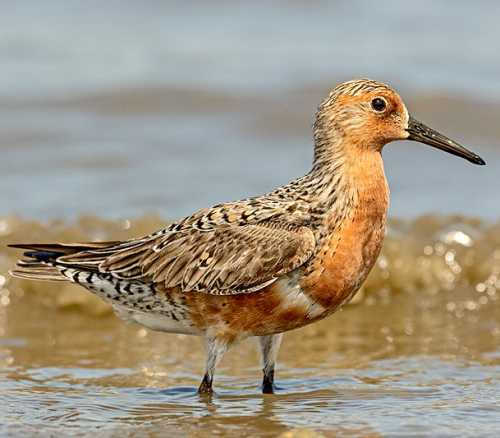
The red knot (Calidris canutus) belongs to the family Scolopacidae under the order Charadriiformes.

Red knot taxonomy

The Scolopacidae is the family of sandpipers, curlews, snipes, knots and turnstones.

The family Scolopacidae was first introduced by Constantine Samuel Rafinesque-Schmaltz (22 October 1783 – 18 September 1840), a zoologist, botanist, writer and polyglot, in the year 1815.

The family Scolopacidae comprises fifteen genera, including genus Calidris. The genus Calidris is the genus of knots and sandpipers. The genus Calidris comprises twenty-four species, including Calidris canutus.

The genus Calidris was first described by Blasius Merrem (4 February 1761 – 23 February 1824), a German naturalist, zoologist, ornithologist, mathematician and herpetologist, in the year 1804.

The species Calidris canutus was first described by Carl Linnaeus (23 May 1707 – 10 January 1778), a Swedish botanist, physician and zoologist, in the year 1758. The knot species Calidris canutus is polytypic and comprises six subspecies.

Taxonomic classification
Binomial name:Calidris canutus
Species:C. canutus
Genus:Calidris
Subfamily:-
Family:Scolopacidae
Order:Charadriiformes
Class:Aves
Phylum:Chordata
Kingdom:Animalia
Bird World - Red knot - Calidris canutus
1.Bird World - Red knot - Calidris canutus
Image by Hans Hillewaert


Bird World - Calidris canutus
2.Bird World - Red knot - Calidris canutus
Image by DickDaniels (http://carolinabirds.org/)

Bird World - Calidris canutus
3.Bird World - Red knot - Calidris canutus
Image by DickDaniels (http://carolinabirds.org/)

Bird World - Calidris canutus
4.Bird World - Red knot - Calidris canutus
Image by Chuck Homler d/b/a Focus On Wildlife

Bird World - Calidris canutus
5.Bird World - Red knot - Calidris canutus
Image by Andrea Westmoreland

Bird World - Calidris canutus
6.Bird World - Red knot - Calidris canutus
Image by Andrea Westmoreland

Bird World - Calidris canutus
7.Bird World - Red knot - Calidris canutus
Image by Juan Emilio

Bird World - Calidris canutus
8.Bird World - Red knot - Calidris canutus
Image by Juan Emilio

Bird World - Calidris canutus
9.Calidris canutus
Image by Hans Hillewaert
Popular posts in Bird World
Jerdon's nightjar Silver-backed needletail
Brown-winged kingfisher Blue-cheeked bee-eater
Indian grey hornbill Long-tailed jaeger
Black-bellied sandgrouse Nilgiri wood pigeon
Lord Derby's parakeet Lesser cuckoo
Rock eagle-owl Indian nightjar
Brown-backed needletail Stork-billed kingfisher
Blue-tailed bee-eater Malabar pied hornbill
Himalayan swiftlet Ward's trogon
European roller Blyth's kingfisher
Pallas's sandgrouse Yellow-eyed pigeon
Plum-headed parakeet Whistling hawk-cuckoo
Pallid scops owl Sykes's nightjar
Edible-nest swiftlet Indian roller

1.Image source: https://en.wikipedia.org/wiki/File:Calidris_canutus_(summer).jpg (cropped)
Author: Hans Hillewaert | License: CC BY-SA 4.0 as on 11/26/18
2.Image source: https://commons.wikimedia.org/wiki/File:Red_Knot_2012c_RWD.jpg (cropped)
Author: DickDaniels (http://carolinabirds.org/) | License: CC BY-SA 3.0 as on 11/26/18
3.Image source: https://commons.wikimedia.org/ (cropped)
Author: DickDaniels (http://carolinabirds.org/) | License: CC BY-SA 3.0 as on 11/26/18
4.Image source: https://commons.wikimedia.org/ (cropped)
Author: Chuck Homler d/b/a Focus On Wildlife | License: CC BY-SA 4.0 as on 11/26/18
5.Image source: https://commons.wikimedia.org/ (cropped)
Author: Andrea Westmoreland | License: CC BY-SA 2.0 as on 11/26/18
6.Image source: https://commons.wikimedia.org/wiki/ (cropped)
Author: Andrea Westmoreland | License: CC BY-SA 2.0 as on 11/26/18
7.Image source: https://www.flickr.com/photos/juan_e/3852983479/ (cropped)
Author: Juan Emilio | License: CC BY-SA 2.0 as on 11/26/18
8.Source: https://www.flickr.com/photos/juan_e/3835265024/ (cropped)
Author: Juan Emilio | License: CC BY-SA 2.0 as on 11/26/18
9.Source: https://commons.wikimedia.org/wiki/File:Calidris_canutus_(breeding_plumage).jpg (cropped)
Author: Hans Hillewaert | License: CC BY-SA 3.0 as on 11/26/18
Website for detailed description and information on distribution, habitat, behavior, feeding and breeding habits, migration and conservation status of beautiful birds with their images.


Recently updated and current topic in Bird World: Red knot images.

Contact State Tourism or travel agents for bird watching and wildlife tours.

Ruddy turnstone images


   ›      ›   Ruddy turnstone - Arenaria interpres images
Taxonomic classification   < >   Images

The ruddy turnstone (Arenaria interpres) belongs to the family Scolopacidae under the order Charadriiformes.

Ruddy turnstone taxonomy

The Scolopacidae is the family of sandpipers, curlews, snipes and turnstones.

The family Scolopacidae was first introduced by Constantine Samuel Rafinesque-Schmaltz (22 October 1783 – 18 September 1840), a zoologist, botanist, writer and polyglot, in the year 1815.

The family Scolopacidae comprises fifteen genera, including genus Arenaria. The genus Arenaria is the genus of turnstones. The genus Arenaria comprises two species, Arenaria interpres and Arenaria melanocephala.

The genus Arenaria was first described by Mathurin Jacques Brisson (30 April 1723 – 23 June 1806), a French zoologist and natural philosopher, in the year 1760.

The species Arenaria interpres was first described (as Tringa interpres) by Carl Linnaeus (23 May 1707 – 10 January 1778), a Swedish botanist, physician and zoologist, in the year 1758.

The species Arenaria interpres is polytypic and contains two subspecies, viz., Arenaria interpres interpres and Arenaria interpres morinella.

Taxonomic classification
Binomial name:Arenaria interpres
Species:A. interpres
Genus:Arenaria
Subfamily:-
Family:Scolopacidae
Order:Charadriiformes
Class:Aves
Phylum:Chordata
Kingdom:Animalia
Ruddy turnstone - Arenaria interpres
1.Ruddy turnstone - Arenaria interpres
Image by Hans Hillewaert


Arenaria interpres
2.Ruddy turnstone - Arenaria interpres
Image by Juan Emilio

Arenaria interpres
3.Ruddy turnstone - Arenaria interpres
Image by Tim Bowman

Arenaria interpres
4.Ruddy turnstone - Arenaria interpres
Image by Gareth Rasberry

Arenaria interpres
5.Ruddy turnstone - Arenaria interpres
Image by neekoh.fi

Arenaria interpres
6.Ruddy turnstone - Arenaria interpres
Image by Arnstein Rønning

Arenaria interpres
7.Arenaria interpres
Image by Dr. Raju Kasambe

Arenaria interpres
8.Arenaria interpres
Image by Peter Wallack

Arenaria interpres
9.Arenaria interpres
Image by Mark Peck
Popular posts in Bird World
Great white pelican Spot-billed pelican
Dalmatian pelican Lesser frigatebird
Great frigatebird Christmas frigatebird
Masked booby Red-footed booby
Brown booby Indian cormorant
Great cormorant Little cormorant
Oriental darter Osprey
Jerdon's baza Collared falconet
Mandarin duck Eastern great egret
Eurasian wigeon Intermediate egret

1.Ruddy turnstone image source: https://en.wikipedia.org/wiki/File:Arenaria_interpres_(habitus).jpg (cropped)
Author: Hans Hillewaert | License: CC BY-SA 4.0 as on 10/20/18
2.Image source: https://www.flickr.com/photos/juan_e/3952541885/ (cropped)
Author: Juan Emilio | License: CC BY-SA 2.0 as on 10/20/18
3.Image source: https://commons.wikimedia.org/wiki/File:Arenaria_interpres3.jpg (cropped)
Author: Tim Bowman | License: Public domain as on 10/20/18
4.Image source: https://en.wikipedia.org/ (cropped)
Author: Gareth Rasberry | License: CC BY-SA 3.0 as on 10/20/18
5.Source: https://www.flickr.com/photos/neekohfi/7817350240/ (cropped)
Author: neekoh.fi | License: CC BY 2.0 as on 10/20/18
6.Source: https://commons.wikimedia.org/wiki/File:Arenaria_interpres_no.JPG (cropped)
Author: Arnstein Rønning | License: CC BY 3.0 as on 10/20/18
7.Source: https://en.wikipedia.org/ (cropped)
Author: Dr. Raju Kasambe | License: CC BY-SA 4.0 as on 10/20/18
8.Source: https://commons.wikimedia.org/ (cropped)
Author: Peter Wallack | License: CC BY-SA 3.0 as on 10/20/18
9.Source: https://www.flickr.com/photos/76929746@N04/15302095130/ (cropped)
Author: Mark Peck | License: CC BY-NC-SA 2.0 as on 10/20/18
Website for detailed description and information on distribution, habitat, behavior, feeding and breeding habits, migration and conservation status of beautiful birds with their images.
Recently updated and current topic in Bird World: Ruddy turnstone - Arenaria interpres images.
Contact State Tourism or travel agents for bird watching and wildlife tours.