Showing posts with label oriole. Show all posts

Slender-billed oriole

   ›      ›   Slender-billed oriole - Oriolus tenuirostris

The slender-billed oriole (Oriolus tenuirostris) belongs to the family of figbirds and orioles, the Oriolidae.

The slender-billed oriole species is distributed in India, Nepal, Bhutan, Bangladesh, Myanmar, Thailand, Laos, Vietnam and China. These oriole species were formerly considered conspecific with Oriolus chinensis. These orioles are polytypic species.
Overview & Quick Facts Description & Identification
Pictures of Slender-billed Oriole Distribution & Range
Ecosystem & Habitat Diet & Feeding Behavior
Breeding Habits Migration & Movement Patterns
Conservation & Survival IUCN Status
Taxonomy & Classification Bird World

Appearance, physical description and identification

The slender-billed oriole (Oriolus tenuirostris) is a medium-sized oriole, measuring 20 to 25 cm in length and weighing 70 to 90 grams.

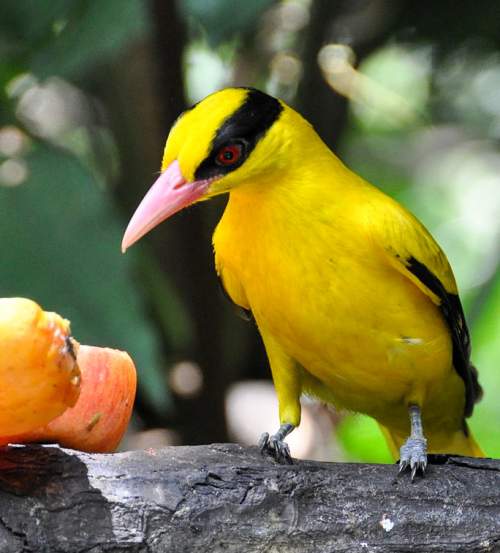
The adult slender-billed oriole has bright golden-yellow head, upperparts and underparts. The wings have black patches. There is a broad blackish band from the lores, passing through the eyes to meet at the nape.

The uppertail is blackish with yellow edges. The undertail is golden yellow. The juveniles have dull yellow plumage. In juveniles, the eye band is diffuse and the underparts have dark streaks.

The bill is slender, long and pinkish. The irises are reddish. The legs and feet are gray. The call of these slender-billed oriole species is a loud fluty whistling "wheeow" sound.
Birds of India - Image of Slender-billed oriole - Oriolus chinensis
Birds of India - Image of Slender-billed oriole - Oriolus tenuirostris by Peter Gronemann


Origin, geographical range and distribution

These slender-billed oriole species are distributed in India, Nepal, Bhutan, Bangladesh, Myanmar, Thailand, Laos, Vietnam and China. Vagrant birds have been observed in Sri Lanka.

In India, these slender-billed oriole species are distributed in the states of northern West Bengal, Sikkim, Assam, Meghalaya, Arunachal Pradesh, Nagaland, Manipur, Tripura and Mizoram.

The slender-billed oriole nominate subspecies O. t. tenuirostris is distributed in Nepal, Bhutan, northeast India, Myanmar, Thailand, Laos, Vietnam and China. The subspecies O. t. invisus is distributed in southern Vietnam.

The Important Bird and Biodiversity Areas (IBA) of the slender-billed oriole species in Nepal are Dang Deukhuri foothill forests and west Rapti wetlands. The IBA in Laos is Phou Loeuy.

Ecosystem and habitat

These slender-billed oriole species have moderate forest dependence. They normally occur in altitudes from 0 to 2000 meters. The artificial ecosystems and habitats of these species include heavily degraded forests.

The natural ecosystems and habitats of these slender-billed oriole species include tropical and subtropical moist lowland forests, evergreen forests, tropical and subtropical moist montane forests and dry deciduous forests.

Diet and feeding behavior

The diet of these slender-billed oriole species consists mainly of fruits. Wild fruits, berries and figs are their primary food. They are arboreal and known to feed on nectar from the flowers of the Salmalia sp. and Erythrina sp.

Reproduction and breeding habits

The breeding season of these slender-billed oriole species is from April to June in much of their range. These oriole species are monogamous and territorial.

The slender-billed oriole nesting sites include fork and branches of trees. The nest is a deep-cup built with grass stems, leaves, roots and plant fibers. The clutch contains two or three eggs. Both the parents incubate the eggs.

Migration and movement patterns

These slender-billed oriole species are partially migratory birds. The breeding populations in northeast Myanmar and the adjoining southern China (Yunnan) are migratory.

They move to northeast India, Nepal, Bhutan, Bangladesh and southern Myanmar and northwest Thailand for wintering. Much of the oriole populations in Myanmar, Laos and Vietnam are resident.

Post breeding, the juveniles of the resident slender-billed orioles may disperse and establish in new locations within the range. Within their range they may make local movements for feeding and breeding.

Slender-billed oriole - Quick Facts

  • Scientific name: Oriolus tenuirostris
  • Species author: Blyth, 1846
  • Synonyms/Protonym: Oriolus tenuirostris Blyth, 1846
  • Family: Oriolidae › Passeriformes › Aves › Chordata › Animalia
  • Vernacular names: English: Slender-billed oriole, Chinese: 细嘴黄鹂, French: Loriot à bec effilé, German: Dünnschnabelpirol, Spanish: Oropéndola picofina, Russian: Тонкоклювая иволга, Japanese: ミナミコウライウグイス
  • Other names: Slender-billed Oriole
  • Distribution: India, Nepal, Bhutan, Bangladesh, Myanmar, Thailand, Laos, Vietnam, China
  • Diet and feeding habits: fruits, berries, figs, nutmegs
  • IUCN status listing: Least Concern (LC)

Conservation and survival

The global population size of the slender-billed oriole (Oriolus tenuirostris) has not been quantified. The overall population trend of the species is not known.

In most of its range, this oriole species is reported as scarce to locally fairly common (Grimmett et al. 1998). The generation length is 3.7 years. Its distribution size is about 1,600,000 sq.km.

Habitat alteration, fragmentation and destruction, deforestation, human intrusions and disturbance and capture for pet-trade are the main threats that are endangering the survival of these oriole species.

IUCN and CITES status

The slender-billed oriole (Oriolus tenuirostris) does not approach the thresholds for being Vulnerable, either under the range size criterion, or under the population trend criterion or under the population size criterion.

The IUCN (International Union for Conservation of Nature) has categorized and evaluated the oriole species and has listed it as of "Least Concern".

The CITES (Convention on International Trade in Endangered Species of Wild Fauna and Flora) status is ‘Not Evaluated’ for the slender-billed oriole (Oriolus tenuirostris).
Taxonomy and scientific classification of Oriolus tenuirostris
Kingdom:Animalia
Phylum:Chordata
Class:Aves
Order:Passeriformes
Family:Oriolidae
Subfamily:-
Genus:Oriolus
Species:O. tenuirostris
Binomial name:Oriolus tenuirostris
IUCN status listing:
Least Concern
The slender-billed oriole (Oriolus tenuirostris) species were formerly considered conspecific with the black-naped oriole (Oriolus chinensis).

The two recognized subspecies of the slender-billed oriole (Oriolus tenuirostris) are:
O. t. tenuirostris Blyth, 1846 and
O. t. invisus Riley, 1940.
Popular posts in Birds of India
White eared pheasant photos White-cheeked tern
Green imperial-pigeon Short-eared owl
Brown fish owl Common swift
Black-capped kingfisher Austen's brown hornbill
Eurasian woodcock Indian courser
Pallas's gull Oriental turtle dove
Painted sandgrouse Pale-capped pigeon
Nicobar parakeet Banded bay cuckoo
Spot-bellied eagle-owl Savanna nightjar
Asian palm-swift Ruddy kingfisher
Scarlet-breasted woodpecker Grey-chinned minivet
Isabelline shrike Egyptian vulture
White-rumped spinetail Oriental dollarbird
Blue-eared kingfisher Blue-bearded bee-eater
Common hoopoe Indian skimmer
Pomarine jaeger Chestnut-bellied sandgrouse
White-bellied drongo White-browed fantail
Eurasian jay Greater sand plover
Grey nightjar Indian swiftlet
Red-headed trogon Tibetan sandgrouse
Snow pigeon Grey-headed parakeet
Common hawk-cuckoo Sri Lanka bay owl
Wood sandpiper Black-bellied tern
Mountain imperial-pigeon Rufous woodpecker
Chinese sparrowhawk Japanese sparrowhawk
Besra Northern goshawk
Eurasian sparrowhawk White-eyed buzzard
Eurasian buzzard Long-legged buzzard
Red-tailed shrike Nilgiri imperial-pigeon
White-throated fantail Black-naped monarch

Image source: https://www.flickr.com/photos/39463459@N08/6935459331/ (cropped)
Image author: Peter Gronemann | License: CC BY 2.0 as on 5/11/18
Current topic in Birds of India: Slender-billed oriole - Oriolus tenuirostris.
Contact State Tourism or travel agents for bird watching and wildlife tours.

Black-naped oriole images

   ›      ›   Black-naped oriole - Oriolus chinensis images
Taxonomic classification   < >   Images
The black-naped oriole (Oriolus chinensis) belongs to the family Oriolidae under the order Passeriformes.

Black-naped oriole taxonomy

The family Oriolidae was first described by Nicholas Aylward Vigors (1785 – 26 October 1840), an Irish zoologist and politician, in the year 1825. The Oriolidae comprises two extinct genera and three extant genera, including genus Oriolus.

The genus Oriolus (type species Coracias oriolus) was first introduced by Carl Linnaeus (23 May 1707 – 10 January 1778), a Swedish botanist, physician and zoologist, in the year 1758.

The genus Oriolus comprises twenty-nine species, including species Oriolus chinensis. The species Oriolus chinensis was first described by Carl Linnaeus in the year 1766.

The Oriolus chinensis comprises twenty subspecies, viz., O. c. chinensis, O. c. diffusus, O. c. broderipi, O. c. andamanensis, O. c. boneratensis, O. c. macrourus, O. c. frontalis, O. c. maculatus, O. c. stresemanni, O. c. mundus, O. c. celebensis, O. c. richmondi, O. c. formosus, O. c. sipora, O. c. sangirensis, O. c. lamprochryseus, O. c. melanisticus, O. c. insularis, O. c. suluensis and O. c. yamamurae.
Taxonomic classification
Binomial name:Oriolus chinensis
Species:O. chinensis
Genus:Oriolus
Subfamily:-
Family:Oriolidae
Order:Passeriformes
Class:Aves
Phylum:Chordata
Kingdom:Animalia
Black-naped oriole - Oriolus chinensis
1.Black-naped oriole - Oriolus chinensis
Image by Michael Gwyther-Jones


Oriolus chinensis
2.Black-naped oriole - Oriolus chinensis
Image by Lip Kee

Oriolus chinensis
3.Black-naped oriole - Oriolus chinensis
Image by Peter Gronemann

Oriolus chinensis
4.Black-naped oriole - Oriolus chinensis
Image by J.M.Garg

Oriolus chinensis
5.Black-naped oriole - Oriolus chinensis
Image by Prof Dr Kamarudin Mat-Salleh

Oriolus chinensis
6.Black-naped oriole - Oriolus chinensis
Image by Peter Gronemann

Oriolus chinensis
7.Black-naped oriole - Oriolus chinensis
Image by Peter Gronemann

Oriolus chinensis
8.Black-naped oriole - Oriolus chinensis
Image by J.M.Garg

Oriolus chinensis
9.Oriolus chinensis
Image by J.M.Garg
Popular posts in Birds of India
White-throated fantail Common swift
Ashy minivet Grey plover
Eurasian curlew River tern
Andaman green pigeon Boreal owl
Coppersmith barbet Darjeeling woodpecker
Kentish plover Common greenshank
Arctic tern Wedge-tailed green pigeon
Little owl Malabar barbet
Stripe-breasted woodpecker Blue-throated barbet
Brown fish owl Mangrove whistler
White-tailed lapwing Grey-bellied cuckoo
Northern long-eared owl Rufous-bellied woodpecker
Orange minivet Red-backed shrike
Andaman cuckooshrike Long-billed dowitcher
Red-wattled lapwing Vernal hanging parrot
Long-tailed broadbill Common emerald dove
Eurasian woodcock Large woodshrike
Indian courser Ashy drongo
White-spotted fantail Indian paradise flycatcher
Square-tailed drongo-cuckoo Red turtle dove
House swift Collared pratincole
Wood snipe Indian thick-knee
Eurasian oystercatcher Great thick-knee
Lesser sand-plover Green sandpiper
Common redshank Mottled wood owl
Crested kingfisher Wreathed hornbill
Pheasant-tailed jacana Solitary snipe
Bronze-winged jacana Greater painted-snipe
Narcondam hornbill Pied kingfisher
Yellow-footed green pigeon Brown hawk-owl

1.Black-naped oriole image source: https://www.flickr.com/photos/12587661@N06/7018843783/ (cropped)
Author: Michael Gwyther-Jones | License: CC BY 2.0 as on 5/11/18
2.Image source: https://www.flickr.com/photos/lipkee/2129980801/ (cropped)
Author: Lip Kee | License: CC BY-SA 2.0 as on 5/11/18
3.Image source: https://www.flickr.com/photos/39463459@N08/6789344238/ (cropped)
Author: Peter Gronemann | License: CC BY 2.0 as on 5/11/18
4.Image source: https://commons.wikimedia.org/ (cropped)
Author: J.M.Garg | License: CC BY-SA 3.0 as on 5/11/18
5.Image source: https://www.flickr.com/photos/kmatsalleh/1911802715/in/photostream/ (cropped)
Author: Prof Dr Kamarudin Mat-Salleh | License: CC BY 2.0 as on 5/11/18
6.Image source: https://www.flickr.com/photos/39463459@N08/6935459331/ (cropped)
Author: Peter Gronemann | License: CC BY 2.0 as on 5/11/18
7.Image source: https://www.flickr.com/photos/39463459@N08/6789345074/ (cropped)
Author: Peter Gronemann | License: CC BY 2.0 as on 5/11/18
8.Image source: https://commons.wikimedia.org/ (cropped)
Author: J.M.Garg | License: CC BY-SA 3.0 as on 5/11/18
9.Source: https://en.wikipedia.org/ (cropped)
Author: J.M.Garg | License: CC BY-SA 3.0 as on 5/11/18
Current topic in Birds of India: Black-naped oriole - Oriolus chinensis images.
Contact State Tourism or travel agents for bird watching and wildlife tours.

Black-naped oriole

   ›      ›   Black-naped oriole - Oriolus chinensis

The black-naped oriole (Oriolus chinensis) belongs to the family of Old World orioles, the Oriolidae.

The black-naped oriole species is distributed in India, Bangladesh, southeast Asia, china, Russia, Taiwan, Japan, North Korea and South Korea. These oriole species are partially migratory. These orioles are polytypic species.
Overview & Quick Facts Description & Identification
Pictures of Black-naped Oriole Distribution & Range
Ecosystem & Habitat Diet & Feeding Behavior
Breeding Habits Migration & Movement Patterns
Conservation & Survival IUCN Status
Taxonomy & Classification Bird World

Appearance, physical description and identification

The black-naped oriole (Oriolus chinensis) is a medium-sized oriole, measuring 25 to 30 cm in length and weighing 60 to 100 grams.

The adult black-naped oriole has bright golden-yellow head, upperparts and underparts. The wings have varying levels of blackness among the subspecies. There is a broad blackish band from the lores, passing through the eyes to meet at the nape.

The uppertail is blackish with yellow edges. The undertail is golden yellow. The juveniles have dull yellow plumage. In juveniles, the eye band is diffuse and the underparts have dark streaks.

The bill is stout, long and pinkish. The upper mandible is blackish in juveniles. The irises are red. The legs and feet are gray. The call of these species is a loud fluty whistling sound.
Indian birds - Photo of Black-naped oriole - Oriolus chinensis
1.Birds of India - Photo of Black-naped oriole - Oriolus chinensis by Lip Kee


Birds of India - Photo of Black-naped oriole - Oriolus chinensis
2.Indian birds - Photo of Black-naped oriole - Oriolus chinensis by Michael Gwyther-Jones

Indian birds - Photo of Black-naped oriole - Oriolus chinensis
3.Birds of India - Photo of Black-naped oriole - Oriolus chinensis by Peter Gronemann

Origin, geographical range and distribution

These black-naped oriole species are distributed in Russia, China, North Korea, South Korea, Taiwan, India, Bangladesh, Myanmar, Thailand, Cambodia, Laos, Vietnam, Malaysia, Singapore, Brunei, Indonesia and Philippines.

In India, wintering black-naped oriole species are distributed in the states of Gujarat, Madhya Pradesh, Maharashtra, Karnataka, Goa, Kerala, Tamil Nadu, Andhra Pradesh, Odisha, Jharkhand, West Bengal, Assam, Meghalaya, Nagaland, Manipur and Tripura.

The black-naped oriole nominate subspecies O. c. chinensis is distributed in Philippines. The subspecies O. c. diffusus is migratory and occurs in China, Russia, North Korea, South Korea and northern parts of Myanmar, Laos and Vietnam.

The oriole subspecies O. c. andamanensis is endemic to the Andaman Islands. The subspecies O. c. macrourus is endemic to the Nicobar Islands. The subspecies O. c. melanisticus is distributed in the Talaud Islands of Philippines.

Ecosystem and habitat

These black-naped oriole species have moderate forest dependence. They normally occur in altitudes from 0 to 2000 meters. The artificial ecosystems and habitats of these species include urban areas, plantations and rural gardens.

The natural ecosystems and habitats of these black-naped oriole species include tropical and subtropical mangrove forests, evergreen forests, tropical and subtropical moist lowland forests, deciduous forests and moist montane forests.

Diet and feeding behavior

The diet of these black-naped oriole species consists mainly of fruits. Wild fruits, orchard fruits, berries and figs are their primary food. They are known to take nectar from large flowers of Salmalia and Erythrina species.

They feed from the canopy and rarely come to the ground. They also glean insects from the branches and foliage.

Reproduction and breeding habits

The breeding season of these black-naped oriole species is during May and June in Russia. The laying season is during June and July in China. The breeding season is from April to June in Andaman Islands.

These oriole species are monogamous and highly territorial. The nest is usually built in a fork of a tree. The deep cup-shaped nest is mostly built by the female.

The oriole clutch contains two or three pale pink eggs with red and dark blotches. The female oriole incubates the eggs. The chicks hatch out after 14 to 16 days and fledge after fifteen days.

Migration and movement patterns

These black-naped oriole species are partially migratory birds. The breeding populations of the subspecies O. c. diffusus occur in China, Russia, North Korea, South Korea and northern parts of Myanmar, Laos and Vietnam.

These oriole species migrate southwards in September-October to India, Bangladesh, Cambodia, Thailand and southern parts of Myanmar, Laos and Vietnam. The return migration to the breeding grounds occurs in early summer.

There are resident populations of these black-naped orioles in Andaman and Nicobar Islands of India (O. c. andamanensis and O. c. macrourus), Malaysia, Singapore, Indonesia, Philippines, Taiwan, west central Myanmar and Hainan (China).

Black-naped oriole - Quick Facts

  • Scientific name: Oriolus chinensis
  • Species author: Linnaeus, 1766
  • Synonyms/Protonym: Oriolus chinensis Linnaeus, 1766
  • Family: Oriolidae › Passeriformes › Aves › Chordata › Animalia
  • Vernacular names: English: Black-naped oriole, Chinese: 黑枕黄鹂, French: Loriot de Chine, German: Schwarznackenpirol, Spanish: Oropéndola china, Russian: Китайская иволга, Japanese: コウライウグイス, Malay: Burung Dendang Selayang
  • Other names: Black-naped Oriole
  • Distribution: India, Bangladesh, southeast Asia, China, Taiwan, North Korea, South Korea, Japan, Russia
  • Diet and feeding habits: fruits, berries, figs
  • IUCN status listing: Least Concern (LC)

Conservation and survival

The global population size of the black-naped oriole (Oriolus chinensis) has not been quantified. The overall population trend of the species is not known.

In most of its range, this species is reported to be common (Kennedy et al. 2,000). The generation length is 3.7 years. Its distribution size is about 21,100,000 sq.km.

Habitat alteration and destruction, deforestation and human intrusions and disturbance are the main threats that are endangering the survival of these oriole species.

IUCN and CITES status

The black-naped oriole (Oriolus chinensis) does not approach the thresholds for being Vulnerable, either under the range size criterion, or under the population trend criterion or under the population size criterion.

The IUCN (International Union for Conservation of Nature) has categorized and evaluated the oriole species and has listed it as of "Least Concern".

The CITES (Convention on International Trade in Endangered Species of Wild Fauna and Flora) status is ‘Not Evaluated’ for the black-naped oriole (Oriolus chinensis).
Taxonomy and scientific classification of Oriolus chinensis
Kingdom:Animalia
Phylum:Chordata
Class:Aves
Order:Passeriformes
Family:Oriolidae
Subfamily:-
Genus:Oriolus
Species:O. chinensis
Binomial name:Oriolus chinensis
IUCN status listing:
Least Concern
The black-naped oriole (Oriolus chinensis) is closely related to slender-billed oriole (Oriolus tenuirostris).

The twenty recognized subspecies of the black-naped oriole are:
O. c. chinensis Linnaeus, 1766 (Philippine black-naped oriole),
O. c. diffusus Sharpe, 1877 (Eastern black-naped oriole),
O. c. broderipi Bonaparte, 1850,
O. c. andamanensis Beavan, 1867
O. c. boneratensis A. B. Meyer & Wiglesworth, 1896,
O. c. macrourus Blyth, 1846,
O. c. frontalis Wallace, 1863 (Sulawesi black-naped oriole),
O. c. maculatus Vieillot, 1817,
O. c. stresemanni Neumann, 1939,
O. c. mundus Richmond, 1903,
O. c. celebensis (Walden, 1872),
O. c. richmondi Oberholser, 1912,
O. c. formosus Cabanis, 1872,
O. c. sipora Chasen & Kloss, 1926,
O. c. sangirensis A. B. Meyer & Wiglesworth, 1898,
O. c. lamprochryseus Oberholser, 1917,
O. c. melanisticus A. B. Meyer & Wiglesworth, 1894,
O. c. insularis Vorderman, 1893,
O. c. suluensis Sharpe, 1877 and
O. c. yamamurae Nagamichi Kuroda, 1927.
Popular posts in Birds of India
White-throated fantail Blue pitta
Thick-billed green pigeon Andaman hawk-owl
Great spotted woodpecker White-bellied minivet
Kentish plover Common greenshank
Arctic tern Wedge-tailed green pigeon
European golden-plover Whimbrel
Great crested tern Ashy-headed green pigeon
Northern long-eared owl Rufous-bellied woodpecker
Orange minivet Red-backed shrike
Blue-faced malkoha Himalayan owl
Brown-headed barbet Speckled piculet
Malabar woodshrike Ashy drongo
White-spotted fantail Indian paradise flycatcher
Sirkeer malkoha Asian barred owlet
White-cheeked barbet Brown-capped pygmy woodpecker
Lesser sand-plover Green sandpiper
Common redshank Silver-breasted broadbill
Green-billed malkoha Collared owlet
Lineated barbet White-browed piculet
Yellow-footed green pigeon Brown hawk-owl

1.Black-naped oriole photo source: https://www.flickr.com/photos/lipkee/2129980801/ (cropped)
Photo author: Lip Kee | License: CC BY-SA 2.0 as on 5/11/18
2.Photo source: https://www.flickr.com/photos/12587661@N06/7018843783/ (cropped)
Photo author: Michael Gwyther-Jones | License: CC BY 2.0 as on 5/11/18
3.Photo source: https://www.flickr.com/photos/39463459@N08/6789344238/ (cropped)
Photo author: Peter Gronemann | License: CC BY 2.0 as on 5/11/18
Current topic in Birds of India: Black-naped oriole - Oriolus chinensis.
Contact State Tourism or travel agents for bird watching and wildlife tours.

Indian golden oriole photos

   ›      ›   Indian golden oriole - Oriolus kundoo photos
Taxonomic classification   < >   Photos
The Indian golden oriole (Oriolus kundoo) belongs to the family Oriolidae under the order Passeriformes.

Indian golden oriole taxonomy

The Oriolidae is the family of piopios, figbirds, pitohuis and the Old World orioles. The family Oriolidae was first introduced by Nicholas Aylward Vigors (1785 – 26 October 1840), an Irish zoologist and politician, in the year 1825.

The family Oriolidae comprises three extant genera, viz., genus Sphecotheres, genus Pitohui and genus Oriolus. The Oriolidae also contains two extinct genera, genus Turnagra and genus Longimornis.

The genus Oriolus was first described by Linnaeus in 1766 in the twelfth edition of his Systema Naturae, with Coracias oriolus as type species.

The genus Oriolus comprises twenty-nine species, including Oriolus kundoo. The species Oriolus kundoo was first described by Colonel William Henry Sykes, FRS (25 January 1790 – 16 June 1872), an English naturalist, politician, Indologist and ornithologist, in the year 1832.
Taxonomic classification
Binomial name:Oriolus kundoo
Species:O. kundoo
Genus:Oriolus
Subfamily:-
Family:Oriolidae
Order:Passeriformes
Class:Aves
Phylum:Chordata
Kingdom:Animalia
Indian golden oriole - Oriolus kundoo
1.Indian golden oriole - Oriolus kundoo 324
Photo by Nanda ramesh


Oriolus kundoo
2.Indian golden oriole - Oriolus kundoo
Photo by Swardeepak

Oriolus kundoo
3.Indian golden oriole - Oriolus kundoo
Photo by Swardeepak

Oriolus kundoo
4.Indian golden oriole - Oriolus kundoo
Photo by J.M.Garg

juvenile - Oriolus kundoo
5.Indian golden oriole juvenile - Oriolus kundoo
Photo by Aadishbahulikar18

Oriolus kundoo
6.Indian golden oriole - Oriolus kundoo
Photo by Jennystar1994

Oriolus kundoo
7.Indian golden oriole - Oriolus kundoo
Photo by vijaykumar.bodakuntla

Oriolus kundoo
8.Indian golden oriole - Oriolus kundoo
Photo by Akshay Charegaonkar

Oriolus kundoo
9.Oriolus kundoo
Photo by J.M.Garg
Popular posts on Birds
Common redshank Black-naped tern
Jerdon's nightjar Silver-backed needletail
Brown-winged kingfisher Blue-cheeked bee-eater
Mountain scops-owl Long-tailed jaeger
Black-bellied sandgrouse Nilgiri wood pigeon
Yellow-legged green pigeon Brown hawk-owl
Sind woodpecker Long-tailed minivet
Brown-backed needletail Stork-billed kingfisher
Blue-tailed bee-eater Malabar pied hornbill
Himalayan swiftlet Ward's trogon
European roller Blyth's kingfisher
Little ringed plover Marsh sandpiper
Common tern Pin-tailed green pigeon
Pallid scops owl Sykes's nightjar
Edible-nest swiftlet Common barn-owl
Common kingfisher South polar skua
Pin-tailed sandgrouse Common wood pigeon
Hume's hawk-owl Himalayan woodpecker
Short-billed minivet Woodchat shrike
White-rumped spinetail Oriental dollarbird
Blue-eared kingfisher Blue-bearded bee-eater
Common hoopoe Chestnut-winged cuckoo
Pomarine jaeger Chestnut-bellied sandgrouse
Hodgson's frogmouth Black drongo
Long-billed plover Tawny owl
Jacobin cuckoo Eastern grass-owl
Andaman scops owl Sri Lanka frogmouth
Great eared nightjar Crested treeswift
Rock dove Rose-ringed parakeet
Ashy minivet Black-bellied plover

1.Photo source: https://commons.wikimedia.org/wiki/File:Indian_Golden_Oriole_(Oriolus_kundoo)_-_Male_Basavanagudi_Bangalore_India.jpg (cropped)
Author: Nanda ramesh | License: CC BY-SA 3.0 as on 4/20/18
2.Photo source: https://en.wikipedia.org/wiki/File:IndianGoldenOriole_M.jpg (cropped)
Author: Swardeepak | License: CC BY 4.0 as on 4/20/18
3.Photo source: https://en.wikipedia.org/wiki/File:IndianGoldenOriole_F.jpg (cropped)
Author: Swardeepak | License: CC BY 4.0 as on 4/20/18
4.Photo source: https://commons.wikimedia.org/ (cropped)
Author: J.M.Garg | License: CC BY-SA 3.0 as on 4/20/18
5.Photo source: https://commons.wikimedia.org/wiki/File:Beauty_Is_Rare.jpg (cropped)
Author: Aadishbahulikar18 | License: CC BY-SA 4.0 as on 4/20/18
6.Photo source: https://commons.wikimedia.org (cropped)
Author: Jennystar1994 | License: CC BY-SA 4.0 as on 4/20/18
7.Photo source: https://www.flickr.com/photos/109836656@N06/11435134216/ (cropped)
Author: vijaykumar.bodakuntla | License: CC BY 2.0 as on 4/20/18
8.Source: https://commons.wikimedia.org/ (cropped)
Author: Akshay Charegaonkar | License: CC BY-SA 3.0 as on 4/20/18
9.Source: https://commons.wikimedia.org (cropped)
Author: J.M.Garg | License: CC BY-SA 3.0 as on 4/20/18
Current topic: Indian golden oriole - Oriolus kundoo photos.
Contact State Tourism or travel agents for bird watching and wildlife tours.

Indian golden oriole

   ›      ›   Indian golden oriole - Oriolus kundoo

The Indian golden oriole (Oriolus kundoo) belongs to the family of Old World orioles, the Oriolidae.

The Indian golden oriole species is distributed in Turkmenistan, Kazakhstan, Kyrgyzstan, Tajikistan, Uzbekistan, Afghanistan and Indian subcontinent. These oriole species were earlier considered as subspecies of Oriolus oriolus. These orioles are monotypic species.
Overview & Quick Facts Description & Identification
Pictures of Indian Golden Oriole Distribution & Range
Ecosystem & Habitat Diet & Feeding Behavior
Breeding Habits Migration & Movement Patterns
Conservation & Survival IUCN Status
Taxonomy & Classification Bird World

Appearance, physical description and identification

The Indian golden oriole (Oriolus kundoo) is a medium sized oriole, measuring 23 to 26 cm in length and weighing 60 to 100 grams. These birds are sexually dimorphic.

The male oriole has head, upperparts and underparts rich yellow. The wings are black with large yellow patches. The secondaries and tertiaries have yellow tips. The uppertail is black with yellow edge to the outer feathers.

The female has duller yellow plumage. The throat, breast and belly are whitish with yellow and black streaks. The juveniles have brownish wings and tail and the lores are pale.

The bill is pale pink. The irises are pale red. There is a pinkish gray eye-ring. The legs and feet are gray. The call of these oriole species is a fluty melodious "peelo..peelo" or "wee..wee..wee" sound.
Photo of Indian golden oriole - Oriolus kundoo
1.Photo of Indian golden oriole - Oriolus kundoo by Swardeepak


Photo of golden oriole male - Oriolus kundoo
2.Photo of Indian golden oriole male - Oriolus kundoo by Nanda ramesh

Photo of golden oriole female - Oriolus kundoo
3.Photo of Indian golden oriole female - Oriolus kundoo by Swardeepak

Origin, geographical range and distribution

These golden oriole species are distributed in Turkmenistan, Kazakhstan, Kyrgyzstan, Tajikistan, Uzbekistan, Afghanistan, Pakistan and Indian subcontinent.

They are distributed in all the Indian states, except, Mizoram, Tripura, Manipur, Nagaland, Arunachal Pradesh, Meghalaya and Assam.

Ecosystem and habitat

These golden oriole species have high forest dependence. They normally occur in altitudes from 0 to 2400 meters. The artificial ecosystems and habitats of these species include rural gardens, plantations, orchards, agricultural lands and urban areas.

The natural ecosystems and habitats of these oriole species include tropical and subtropical montane forests, foothill forests, temperate forests, deciduous and semi-evergreen forests, thorny forests, mangroves, open country with scattered trees.

Diet and feeding behavior

The diet of these golden oriole species consists mainly of fruits. Wild fruits, orchard fruits, berries of Lantana sp., plums, cherries, peaches, nectarines, apricots, almonds and mulberries are their primary food.

These oriole species are also known to feed on insects, small lizards, small mammals, eggs and hatchlings.

Reproduction and breeding habits

The breeding season of these Indian golden oriole species is from April to September in India. The laying season is during May and June in Nepal. The breeding season is during June in Afghanistan.

These Indian golden oriole species are monogamous and territorial. The nesting sites are located high in outer edge of well-foliaged tree canopy. The nest is suspended on a thin horizontal forked branch like a hammock. Both the parents take part in nest building.

The golden oriole nest is a open cup-like structure, woven with grass, twigs, sedges, cloth, reeds, strings, leaves, paper and plant fibers. It is lined with feathers, rootlets, straw, fur, wool, moss and lichens.

The clutch contains three to five white eggs with pink, brown and black speckles. The eggs are incubated by both the parents. The hatchlings are cared for by both the parents.

Migration and movement patterns

These golden oriole species are partially migratory birds. The migratory breeding populations are distributed in Turkmenistan, Kazakhstan, Kyrgyzstan, Tajikistan, Uzbekistan, Afghanistan, Pakistan and the Himalayan region of the Indian subcontinent.

These migratory golden oriole breeding populations move southwards from September onwards to Indian peninsula for wintering. There are resident breeding populations in the central parts of the Indian subcontinent.

Post breeding, the resident juveniles may disperse and establish in new locations within the range. Within their range they may make local movements for feeding and breeding.

Indian golden oriole - Quick Facts

  • Scientific name: Oriolus kundoo
  • Species author: Sykes, 1832
  • Synonyms/Protonym: Oriolus Kundoo Sykes, 1832
  • Family: Oriolidae › Passeriformes › Aves › Chordata › Animalia
  • Vernacular names: English: Indian golden oriole, Chinese: 印度金黄鹂, French: Loriot indien German: Indienpirol, Spanish: Oropéndola indian, Russian: Масковая иволга, Japanese: インドコウライウグイス
  • Other names: Golden oriole, Indian Golden Oriole, Indian Oriole
  • Distribution: Turkmenistan, Kazakhstan, Kyrgyzstan, Tajikistan, Uzbekistan, Afghanistan, Indian subcontinent
  • Diet and feeding habits: fruits, berries, figs, nectar, insects
  • IUCN status listing: Least Concern (LC)

Conservation and survival

The global population size of the Indian golden oriole (Oriolus kundoo) has not been quantified. The overall population trend of the species is not known.

In most of its range, this species is reported to be fairly common to locally common (Walther and Jones, 2016). The generation length is 3.7 years. Its distribution size is about 4,650,000 sq.km.

Habitat alteration and destruction, agricultural expansion, climate change, being considered as pest by orchard farmers and sport hunting are the main threats that are endangering the survival of these species.

IUCN and CITES status

The Indian golden oriole (Oriolus kundoo) does not approach the thresholds for being Vulnerable, either under the range size criterion, or under the population trend criterion or under the population size criterion.

The IUCN (International Union for Conservation of Nature) has categorized and evaluated the oriole species and has listed it as of "Least Concern".

The CITES (Convention on International Trade in Endangered Species of Wild Fauna and Flora) status is ‘Not Evaluated’ for the Indian golden oriole (Oriolus kundoo).
Taxonomy and scientific classification of Oriolus kundoo
Kingdom:Animalia
Phylum:Chordata
Class:Aves
Order:Passeriformes
Family:Oriolidae
Subfamily:-
Genus:Oriolus
Species:O. kundoo
Binomial name:Oriolus kundoo
IUCN status listing:
Least Concern
The Indian golden oriole (Oriolus kundoo) is closely related to Eurasian golden oriole (Oriolus oriolus).
Popular posts on Birds
Common redshank Black-naped tern
Yellow-wattled lapwing Great snipe
Franklin's gull Barred cuckoo-dove
Yellow-footed green pigeon Brown hawk-owl
Sind woodpecker Long-tailed minivet
Tawny owl Great barbet
Yellow-rumped honeyguide Eurasian wryneck
Little ringed plover Marsh sandpiper
Common tern Pin-tailed green pigeon
Crab-plover Beach thick-knee
Ibisbill Black-winged stilt
Hume's hawk-owl Himalayan woodpecker
Short-billed minivet Woodchat shrike
Crested kingfisher Wreathed hornbill
Pheasant-tailed jacana Solitary snipe
Asian emerald cuckoo Black drongo
Long-billed plover Tawny owl
European bee-eater Oriental pied hornbill
White-eyed gull Caspian tern
Ashy minivet Grey plover

1.Indian golden oriole photo source: https://en.wikipedia.org/wiki/File:IndianGoldenOriole_M.jpg (cropped)
Photo author: Swardeepak | License: CC BY 4.0 as on 4/20/18
2.Photo source: https://commons.wikimedia.org (cropped)
Photo author: Nanda ramesh | License: CC BY-SA 3.0 as on 4/20/18
3.Photo source: https://en.wikipedia.org/wiki/File:IndianGoldenOriole_F.jpg (cropped)
Photo author: Swardeepak | License: CC BY 4.0 as on 4/20/18
Current topic: Indian golden oriole - Oriolus kundoo.
Contact State Tourism or travel agents for bird watching and wildlife tours.